
Municipal water can be contaminated by electronic waste and other sources of heavy metals—but collecting, chemically preserving and transporting samples to laboratories for testing is challenging for remote communities.
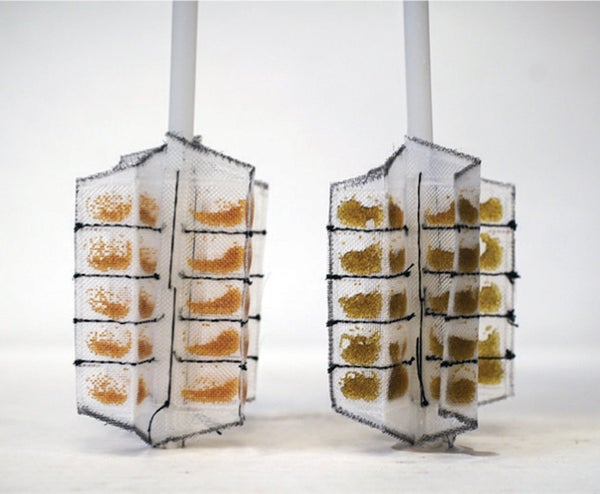
To streamline the process, Emily Hanhauser, a mechanical engineer at the Massachusetts Institute of Technology, and her colleagues created a low-tech sample-collection device that costs less than two dollars to make. It consists of a plastic handle tipped by propellerlike attachments made from polymer mesh, which contain small packets of absorbent resin beads that attract heavy metal ions. Users stir the device in water and then blot or air-dry it. Dunking the attachments in an acid solution releases the absorbed ions, which can then be measured.
Unlike possibly contaminated water samples, which are considered hazardous, the device can be safely mailed to testing facilities. It can also yield results after two years of storage, its creators say. In experiments, the tool accurately reflected the amounts of copper, nickel, lead and cadmium added to a variety of water samples, the researchers reported in March in Environmental Science and Technology.
On supporting science journalism
If you're enjoying this article, consider supporting our award-winning journalism by subscribing. By purchasing a subscription you are helping to ensure the future of impactful stories about the discoveries and ideas shaping our world today.
A detailed analysis of water quality ideally would be performed near the source, eliminating the need for sample shipping entirely, Hanhauser notes. But existing tools designed for that purpose cannot measure small enough amounts of contaminants, and they often have too much variation in measurement to be useful, she says. Her group's device might be able to provide remote communities and well owners—who in the U.S. are responsible for their own water-quality monitoring—with a feasible alternative to transporting high-volume liquid samples over long distances. A more advanced version of the device could potentially measure large clumps of contaminating metals as well, the researchers add.
“I think this could be a good diagnostic tool because of the low cost, good metal-recovery numbers and superiority over presence/absence tests,” says Siddhartha Roy, an environmental engineer at Virginia Tech, who studies the notorious drinking water in Flint, Mich., and who was not involved with the new study. “I can see superior versions of the device being used following contamination events for specific metals.”