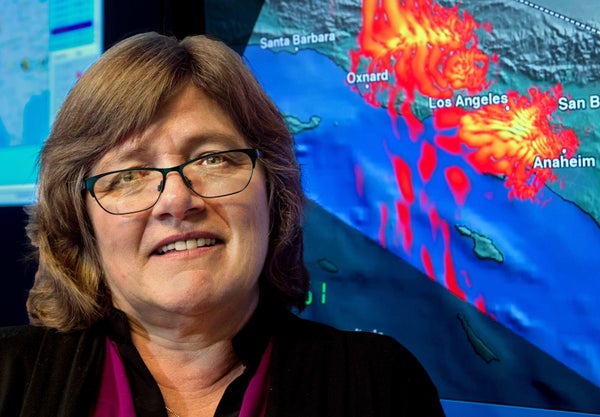
Lucy Jones is an American seismologist and research associate at the California Institute of Technology who is known for her work on earthquake forecasting and hazard assessment. She spent more than three decades with the U.S. Geological Survey and founded the Dr. Lucy Jones Center for Science and Society.
[This interview was edited for length and clarity.]
How would you describe the current state of American science?
On supporting science journalism
If you're enjoying this article, consider supporting our award-winning journalism by subscribing. By purchasing a subscription you are helping to ensure the future of impactful stories about the discoveries and ideas shaping our world today.
We’ve sort of shaken up all of our traditional approaches, so there are plenty of things getting lost. There’s also a very high state of anxiety, especially for young scientists. You’ve committed 10 or 15 years to getting a Ph.D. and a postdoc, and suddenly all the jobs have disappeared. It’s an incredibly uncertain time for scientists, and the setbacks in our research structure are going to leave us behind a lot of the rest of the world.
What needs to change in American science?
Given this attack, going forward, we’re going to have to figure out what the social commitment to scientific research is and how it should be structured. We’ve kind of been on autopilot since World War II, and it’s not working very well. We’re essentially a pyramid scheme—every professor is supposed to create 15, 20, 30 clones of themselves, and then those people are trying to find jobs to stay in research.
For a while, research funding was growing exponentially, so we pulled it off. But now we’re scaling back. There’s also a more fundamental issue about the relationship between scientists and the larger society. I was trained at the Massachusetts Institute of Technology and spent my career at Caltech, where the rest of the world sort of isn’t supposed to matter. We’re in our labs doing curiosity‑driven science, because that’s what’s really important.
I ended up doing a lot of work with policymakers, and for decades, people would say, “Why are you wasting your time on that? You could be writing another paper.” I was seen as an oddity for being willing to communicate with policymakers. That’s shifted, especially in the past decade, partly because of climate change.
We’re seeing the consequences of saying, “Working with policymakers isn’t our job. Our job is to explain the problem.” Social scientists tell you: if you present a problem without a solution, you just increase anxiety. And that’s essentially what scientists have done because we didn’t see solutions as in our purview.
Solutions have to be done in collaboration, which means spending time with policymakers. I started doing this after the Northridge earthquake about 30 years ago, and now colleagues come to me asking how to do it. But we also have to fund it properly. Someone trying to get tenure doesn’t get credit for doing this work. They’re strongly incentivized not to do it, and that has to change.
What gives you optimism right now?
Optimism can be hard, but I do see a change in attitude about the worthiness of applying science—of activation. That’s relatively new and really important. I’m also seeing more flexibility in some institutions. My biggest worry is losing a generation of scientists who are graduating right now. Scientists are resilient, though. They’re smart and adaptable. Internationally, other countries are stepping up. Science will continue, even if it doesn’t continue as strongly in the U.S.
What’s your best advice for an early‑career scientist?
Take care of yourself. Recognize that all of this is real. Acknowledge your anger and process it.
One project I’ve done recently is called Tempo: Music for Climate Action. We brought together climate scientists, social scientists who study emotional barriers and musicians who know how to evoke emotion. The goal is to change the emotional climate around climate change.
Scientists are human beings. We’re driven by emotion, too. We live with data, so we have an emotional connection to the problem through data. I look at the Keeling curve, and I’m scared. We try to explain that with more data, but other people don’t have that emotional engagement.
Social scientists tell us that safety, risk and fear are emotionally based, and we don’t take action until we’re emotionally engaged. Data are still critical, but they have to be incorporated into an emotional vehicle. You can’t just say, “I’ll do more science, and that will solve it.” It’s partnerships and engagement, and that takes time—time away from writing papers.
How has your field changed in the past few years?
The career is completely different. My first year in grad school, I was reading paper seismograms. Now everything is computerized. We used to do field deployments; now we have permanent networks. We’re starting to use fiber‑optic cables as seismometers. I spent a decade fighting to go from 200 to 500 stations in southern California. With fiber optics, you get a station every 10 meters. It’s a completely different kind of data. Now our data can be used to control manufacturing—you can stop a delicate procedure just before shaking arrives. Computers have changed everything, including science.