New Issue: Orbital Catastrophe Ahead? Read Now

Magnitude 4.0 Earthquake Rattles Bay Area, with Aftershocks Likely to Follow

A minor earthquake struck California in the early hours of the morning on November 26

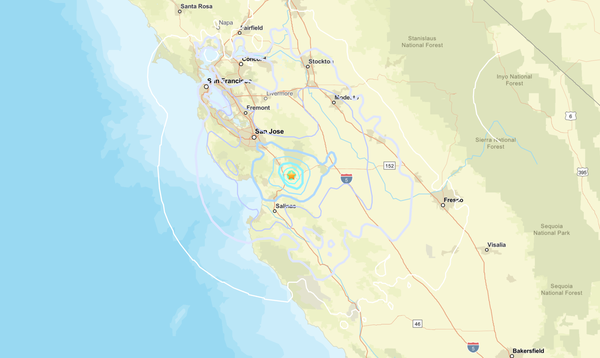
A map of California with a star marking the epicenter of an earthquake south of San Francisco Bay.

USGS

Join Our Community of Science Lovers!

An earthquake of magnitude 4.0 rattled the Bay Area shortly after 6 A.M. local time on November 26—the quake is the largest so far in a string of recent activity near Gilroy, Calif.

The U.S. Geological Survey had originally estimated the earthquake to be magnitude 4.3 but quickly revised the strength down to 4.0. That kind of revision is typical in the immediate aftermath of a quake as scientists analyze the data available to them.

The earthquake’s epicenter was 1.7 miles deep and about five miles east of Gilroy, south of San Francisco Bay and located about halfway between San Jose and Salinas, inland from the coast. The National Tsunami Warning Center quickly determined that the event did not pose any threat of a tsunami.


On supporting science journalism

If you're enjoying this article, consider supporting our award-winning journalism by subscribing. By purchasing a subscription you are helping to ensure the future of impactful stories about the discoveries and ideas shaping our world today.


The quake is the latest in a string of geological activity located in the area; USGS has identified 10 tremors in recent weeks that might be connected to this largest-yet event. The prior temblors were predominantly weaker than magnitude 2.0, which people usually do not feel.

Since the magnitude 4.0 event, two smaller quakes—located deeper in Earth’s crust than the larger one—have already occurred: first a magnitude 2.7 tremor just to the northeast, then a magnitude 3.6 quake to the southwest of both these events.

Whether or not you felt the recent earthquakes, if you were in the area, you can report your experience to USGS to better inform its analysis of the event.

Meghan Bartels is a science journalist based in New York City. She was previously a senior reporter at Scientific American. Before that she spent more than four years as a writer and editor at Space.com, as well as nearly a year as a science reporter at Newsweek, where she focused on space and Earth science. Her writing has also appeared in Audubon, Nautilus, Astronomy and Smithsonian, among other publications. She attended Georgetown University and earned a master’s degree in journalism at New York University’s Science, Health and Environmental Reporting Program.

More by Meghan Bartels

Subscribe to Support Independent Journalism

Great science journalism requires human expertise, time, effort and creativity. And it costs money. That’s why I and the journalists here at Scientific American hope you’ll join our community.

When you subscribe, you are supporting staff and freelance journalists who are passionate about telling science stories that are true, important and compelling. Our editors and reporters are often experts in their fields, which means they understand the nuances of big discoveries and can untangle the breakthroughs from the hype. With a subscription, you are also supporting rigorous fact-checking to ensure the words we publish are precise and accurate. And you’re supporting original illustrations, graphics and photos that bring you closer to an advanced laboratory, an ice sheet in Antarctica or a space mission in orbit. You’re helping us craft other types of high-quality journalism as well: Our newsletters are carefully written, edited and curated by staffers you have or will come to know and love. Our Science Quickly podcast is based on original reporting, collaboration with editors and scientists and exacting production.

Subscriptions keep this engine running so we can continue to deliver thoughtful, rigorous and independent science journalism to you. In an era of viral misinformation, this work is crucial. If you value what we do, I hope you’ll consider joining us as a subscriber

Thank you,

Jeanna Bryner, Editor in Chief, Scientific American

Subscribe