
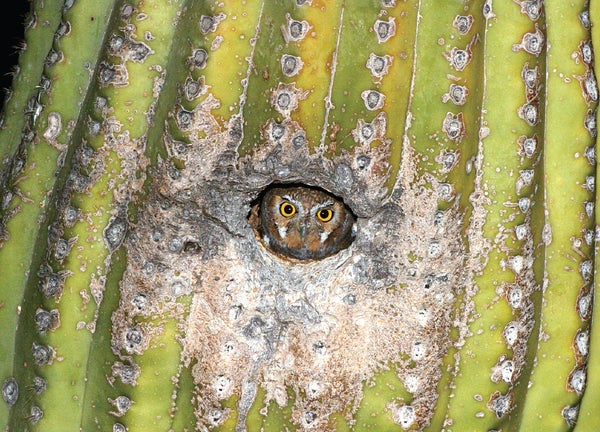
The Enigma of the Owl: An Illustrated Natural History
by Mike Unwin and David Tipling.
Yale University Press, 2017 ($40)
With their straight-on stares and nocturnal habits, owls are among the most intriguing and inscrutable of animals. In this large-format book, more than 200 photographs of owls in the wild and essays by nature writer Unwin help to demystify the creatures. The pictures, taken or selected by Tipling, catch owls on the wing, in the nest and on the hunt, providing a close-up look at dozens of species. Among the highlights: the Eurasian eagle owl, which can weigh up to 10 pounds and take down foxes and eagles, and the great grey owl, which, by sound alone, can locate and catch prey creeping underneath a layer of snow up to 30 feet below the bird's perch in a tree.
The Death and Life of the Great Lakes
by Dan Egan.
W. W. Norton: 2017 ($27.95)
On supporting science journalism
If you're enjoying this article, consider supporting our award-winning journalism by subscribing. By purchasing a subscription you are helping to ensure the future of impactful stories about the discoveries and ideas shaping our world today.
The Great Lakes are undergoing “an ecological catastrophe unlike any this continent has seen,” according to Pulitzer Prize finalist Egan. Humans have dramatically altered the lakes' fauna since invasive species first snuck up through the man-made Saint Lawrence Seaway. Blunders sometimes stemmed from well-meaning policies. Researchers imported Asian carp to kill river nuisances without chemicals, and now some worry the fish has silently invaded Lake Michigan's floor via the Chicago Sanitary and Ship Canal. And the lakes' imported problems are quickly becoming national disasters, such as the tiny and quick-spawning quagga mussel that has infested regions as far away as Lake Mead and Lake Powell on the Colorado River. Egan also relates the passionate narratives of conservationists and lake lovers who are fighting to save the Great Lakes. —Ryan F. Mandelbaum
Never Out of Season: How Having the Food We Want When We Want It Threatens Our Food Supply and Our Future
by Rob Dunn
Little Brown, 2017 ($27)
Our ancestors tens of thousands of years ago ate a tremendous variety of food based on what was in season. But in the U.S. today, nearly half the carbon in children's bodies originates from corn, and in regions of China, almost all calories consumed come from rice. This new way of eating brings greater risk, writes biologist and writer Dunn, who has authored several articles for Scientific American. Growing just a few crop types, each with minimal genetic diversity, leaves staples vulnerable to disease, climate change and unsustainable farming techniques. Dunn weaves together powerful historical and modern examples to show that the safety of our global food supply rests on the edge of a knife. —Andrea Gawrylewski
Curators: Behind the Scenes of Natural History Museums
by Lance Grande.
University of Chicago Press, 2017 ($35)
Natural history museums have gone through just as fascinating an evolution over the years as many of the species they chronicle in their displays. The earliest known museum was established in 530 B.C. in the ancient Mesopotamian city of Ur by Babylonian princess Ennigaldi. More recently, natural history museums in the 16th and 17th centuries devolved into “cabinets of curiosities” that often blended fact and fiction. But today these museums are more relevant than ever, serving as educational centers, entertainment hubs and institutions of original research, argues Grande, a curator of more than 33 years at the Field Museum in Chicago. In this lively account, he introduces readers to the hidden workings of natural history museums and the eccentric scientists and professionals that run them.