
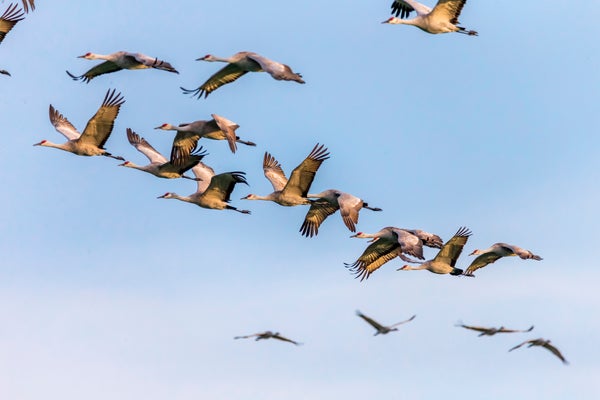
CLIMATEWIRE | Millions of birds are winging their way north now as part of their annual spring migration, preparing to settle down in their summer homes and raise their young. But some species may be welcoming fewer babies.
A new study finds that many bird species are producing fewer offspring as global temperatures rise. And large-bodied migratory birds are the most affected.
Published Monday in Proceedings of the National Academy of Sciences, the research examined data from more than 200 bird populations, encompassing more than 100 different species from across the planet. The scientists, who included dozens of collaborators from around the globe, investigated changes in the number of offspring these populations produced over the last 50 years.
On supporting science journalism
If you're enjoying this article, consider supporting our award-winning journalism by subscribing. By purchasing a subscription you are helping to ensure the future of impactful stories about the discoveries and ideas shaping our world today.
The world has warmed by close to 1 degree Celsius in that time. The researchers used models to investigate connections between rising temperatures and offspring production in the populations they examined.
The researchers found that about 43 percent of the species they studied are producing more offspring over time, while nearly 57 percent are producing less. Taken together, that means bird populations are slightly declining as a whole.
But zooming in on individual species, the researchers found that some types of birds are at much greater risk than others. Birds with larger bodies were more likely to produce fewer offspring than smaller birds. The same goes for migratory birds, compared to birds that stay in one place all year.
The findings suggest that smaller, non-migratory birds may be adapting faster to climate change. And in some cases, they may even benefit from rising temperatures.
The study found, for instance, that species that raise more than one brood in a single season tended to have greater nest success in warmer temperatures — that means their baby birds have higher odds of survival after the eggs are laid. It’s not completely clear why, but the scientists suggest it could be because warmer spring temperatures produce more vegetation earlier in the season, providing more food and allowing birds to better conceal their nests from predators.
On the other hand, larger birds and migratory species may be slower to adjust to rising temperatures. That could be because they tend to produce fewer offspring on the whole, take longer to mature and have more time between different generations — factors that can slow a species’ ability to adapt to environmental change.
The study does has some caveats, the researchers warn.
It contains relatively little data from the tropics, and it focuses more on coastal regions than on the central interior parts of the continents. Species concentrated in these blind spots could be experiencing different trends.
But the study does flag another possible pattern when it comes to the winners and losers of climate change.
It’s just one of the many ways that global warming is changing the life cycles and evolution of birds around the world. Some research suggests that a warmer world may indeed favor smaller birds over larger ones. Multiple studies have found that many bird species — along with other kinds of animals around the world — are actually shrinking over time.
It’s still not completely clear why, but scientists have some theories.
Smaller bodies tend to disperse heat more easily, helping animals regulate their body temperatures more efficiently in warm climates. Climate change may also be reducing the availability of food and water supplies in some areas, and smaller animals may be better suited to compete for limited resources.
At the same time, numerous studies have found that climate change is affecting bird migration patterns, causing many species to depart on their annual journeys earlier in the season.
Reprinted from E&E News with permission from POLITICO, LLC. Copyright 2023. E&E News provides essential news for energy and environment professionals.