
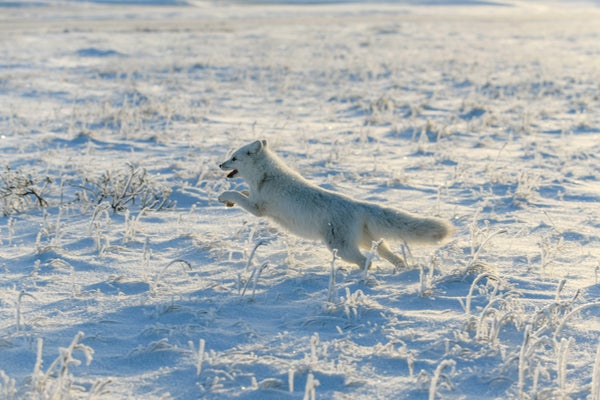
Under an around-the-clock summer sun, a young Arctic fox set out in July 2019 from Bylot Island in Nunavut, Canada. He wandered over the tundra for 299 days, probably alone, trotting an astonishing 6,400 kilometers before reaching a new home. A tracking collar confirmed the record-breaking journey.
“We knew Arctic foxes could go far,” says University of Quebec ecologist Dominique Berteaux, who has led an Arctic fox–tracking project for 20 years. “But we didn't know whether this was a rare behavior or just how far they'd go.” Indigenous communities have described the small foxes traversing entire continents, Berteaux adds, and widely separated fox populations have similar genetics. There are various likely reasons for such trips: parents often chase juvenile foxes away from their birth territory to keep competition low, for example, and mature foxes can be pushed out by stronger individuals.
For a recent study in Royal Society Open Science, Berteaux's team collared and tracked 170 foxes from 2007 to 2021. Among them, 37 attempted long-distance relocation journeys. Berteaux had expected the vast majority of migration attempts to be unsuccessful. Predators, starvation and other dangers make the treks risky, he says: “They try to find another spot, but it is difficult.” Of the 37 long-haulers, however, 13 successfully settled in new territory while their tracking collars were working.
On supporting science journalism
If you're enjoying this article, consider supporting our award-winning journalism by subscribing. By purchasing a subscription you are helping to ensure the future of impactful stories about the discoveries and ideas shaping our world today.

Credit: Daniel P. Huffman; Source: “Long-Term Satellite Tracking Reveals Patterns of Long-Distance Dispersal in Juvenile and Adult Arctic Foxes (Vulpes lagopus),” by Richard Gravel et al., in Royal Society Open Science; February 1, 2023 (fox dispersal data); National Snow & Ice Data Center (sea ice data)
“These small animals are so impressive,” says Eva Fuglei, a biologist at the Norwegian Polar Institute, who was not involved in the study. “With a satellite tag, we can follow the footsteps of the Arctic fox. It's fascinating to see how fast they walk.”
A surprising 20 percent of the epic trekkers were adults, upending assumptions that only younger foxes could handle such travel. This insight is especially relevant to scientists studying “the spreading of zoonoses—diseases—which can be very dangerous to humans,” Fuglei says.
Previously, researchers had assumed adult Arctic foxes were unlikely disease vectors because of less movement. The new study shows, however, that a significant number of hardy older foxes can and do cross continents, potentially bringing parasites and illnesses with them.