Edward Bell; Sources: NASA, GSFC and Arizona State University (moon); NASA (astronauts and equipment)
Join Our Community of Science Lovers!
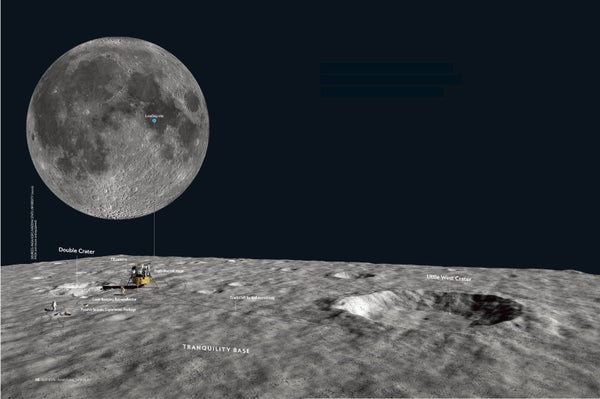
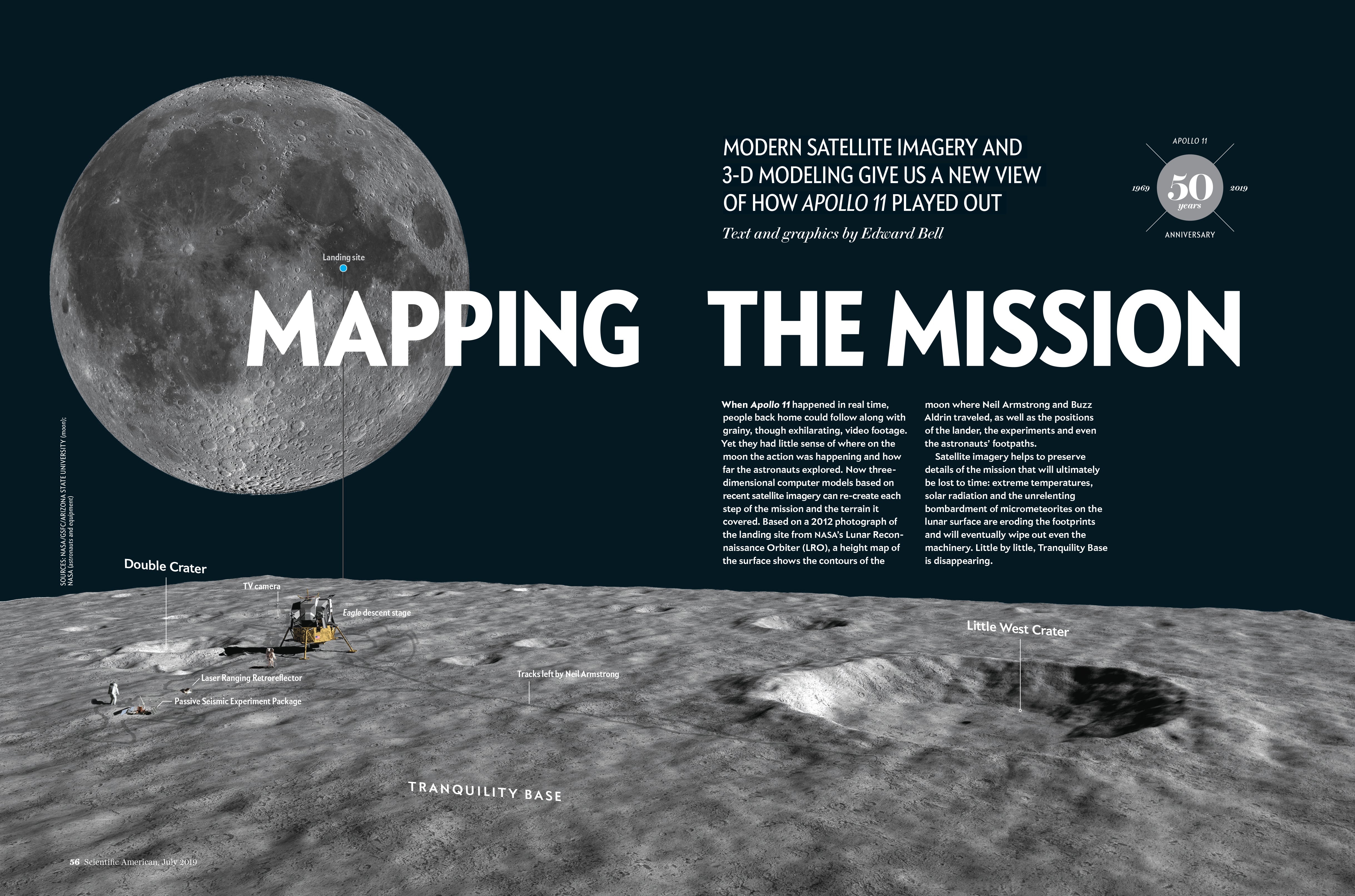
When Apollo 11 happened in real time, people back home could follow along with grainy, though exhilarating, video footage. Yet they had little sense of where on the moon the action was happening and how far the astronauts explored. Now three-dimensional computer models based on recent satellite imagery can re-create each step of the mission and the terrain it covered. Based on a 2012 photograph of the landing site from NASA’s Lunar Reconnaissance Orbiter (LRO), a height map of the surface shows the contours of the moon where Neil Armstrong and Buzz Aldrin traveled, as well as the positions of the lander, the experiments and even the astronauts’ footpaths.
Satellite imagery helps to preserve details of the mission that will ultimately be lost to time: extreme temperatures, solar radiation and the unrelenting bombardment of micrometeorites on the lunar surface are eroding the footprints and will eventually wipe out even the machinery. Little by little, Tranquility Base is disappearing.
On supporting science journalism
If you're enjoying this article, consider supporting our award-winning journalism by subscribing. By purchasing a subscription you are helping to ensure the future of impactful stories about the discoveries and ideas shaping our world today.
Credit: Edward Bell; Sources: NASA, GSFC and Arizona State University (moon); NASA (astronauts and equipment)
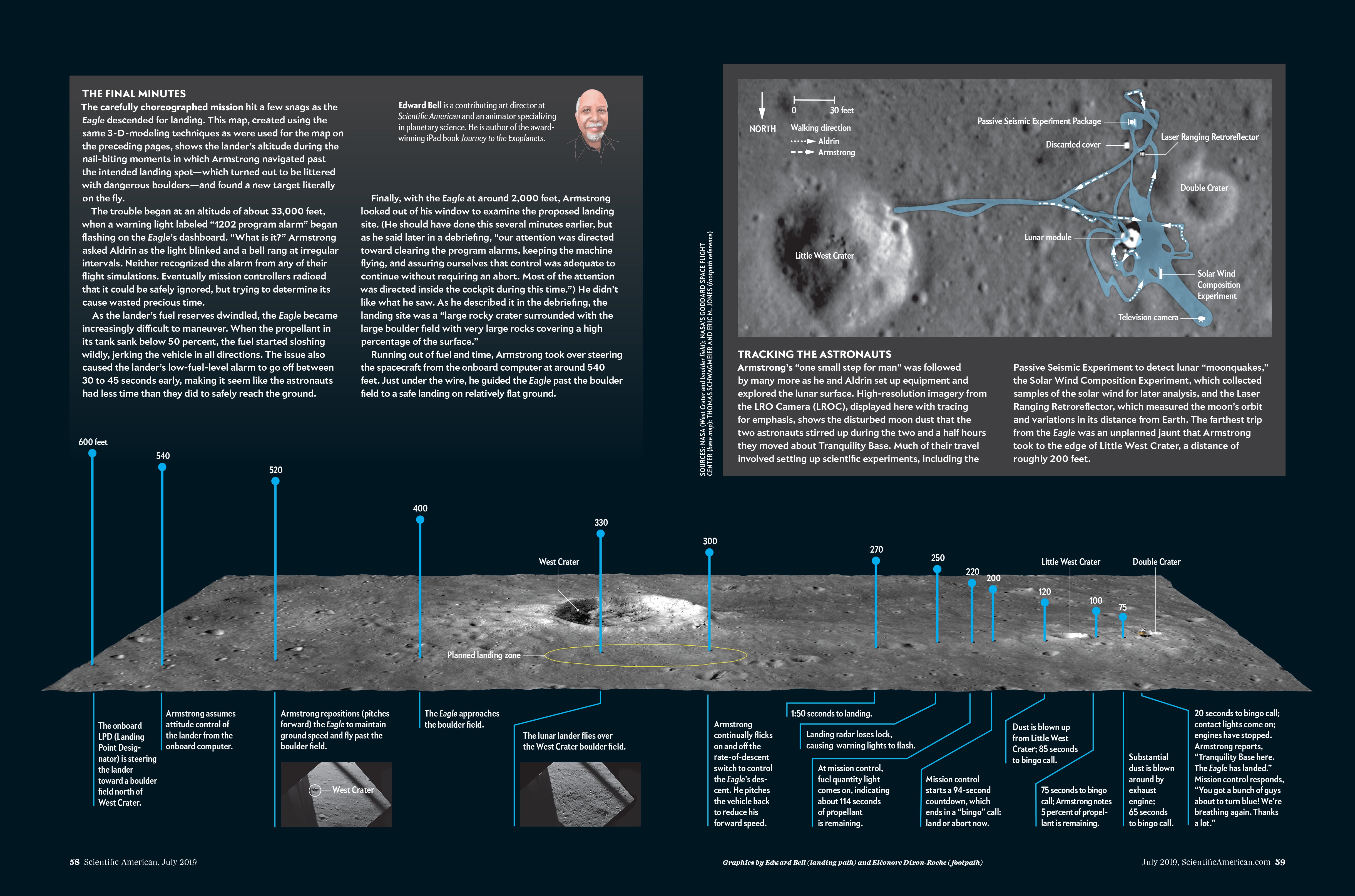
Credit: Edward Bell (landing path) and Eléonore Dixon-Roche (footpath); Sources: NASA (West Crater and boulder field); NASA’s Goddard Space Flight Center (base map); Thomas Schwagmeier and Eric M. Jones (footpath reference)
Subscribe to Support Independent Journalism
Great science journalism requires human expertise, time, effort and creativity. And it costs money. That’s why I and the journalists here at Scientific American hope you’ll join our community.
When you subscribe, you are supporting staff and freelance journalists who are passionate about telling science stories that are true, important and compelling. Our editors and reporters are often experts in their fields, which means they understand the nuances of big discoveries and can untangle the breakthroughs from the hype. With a subscription, you are also supporting rigorous fact-checking to ensure the words we publish are precise and accurate. And you’re supporting original illustrations, graphics and photos that bring you closer to an advanced laboratory, an ice sheet in Antarctica or a space mission in orbit. You’re helping us craft other types of high-quality journalism as well: Our newsletters are carefully written, edited and curated by staffers you have or will come to know and love. Our Science Quickly podcast is based on original reporting, collaboration with editors and scientists and exacting production.
Subscriptions keep this engine running so we can continue to deliver thoughtful, rigorous and independent science journalism to you. In an era of viral misinformation, this work is crucial. If you value what we do, I hope you’ll consider joining us as a subscriber
Thank you,
Jeanna Bryner, Editor in Chief, Scientific American