
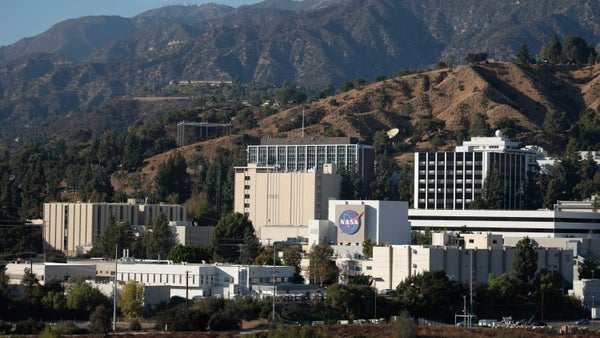
Budgetary issues have forced the Jet Propulsion Laboratory (JPL), NASA's chief center for robotic planetary exploration, to reduce its workforce by about 8%.
The cuts affect roughly 530 employees and 40 contractors, according to JPL officials, who announced the news this afternoon (Feb. 6).
"The impacts will occur across both technical and support areas of the Lab," JPL officials said in a statement today. "These are painful but necessary adjustments that will enable us to adhere to our budget allocation while continuing our important work for NASA and our nation."
On supporting science journalism
If you're enjoying this article, consider supporting our award-winning journalism by subscribing. By purchasing a subscription you are helping to ensure the future of impactful stories about the discoveries and ideas shaping our world today.
JPL, which lies just north of Los Angeles, is federally funded but managed by the California Institute of Technology. The center leads many of NASA's big-ticket science projects, such as the Curiosity and Perseverance rover missions on Mars.
One of Perseverance's main tasks is collecting and caching samples for future return to Earth. JPL is a driving force behind this ambitious Mars sample return (MSR) campaign, which aims to ratchet the search for Red Planet life up to new and exciting levels.
The projected budget for MSR has ballooned recently; last year, an independent review board estimated that the campaign will end up costing $8 billion to $11 billion if it gets off the ground by 2030 as planned.
These numbers alarmed some members of Congress, who have sought to rein in MSR's costs. For example, the Senate allocated just $300 million for MSR in its fiscal year 2024 appropriations bill — a 63% decrease from the funding granted in 2023, as JPL Director Laurie Leshin noted in a letter to employees that the lab released with today's layoff announcement. (Fiscal years work differently than calendar years; fiscal year 2024 began on Oct. 1, 2023, for instance, and will end on Sept. 30, 2024.)
Congress has not yet come together to pass a final appropriations bill for fiscal year 2024 — the House and Senate are still negotiating — but NASA instructed JPL to plan for a $300 million MSR budget, Leshin said.
"In response to this direction, and in an effort to protect our workforce, we implemented a hiring freeze, reduced MSR contracts, and implemented cuts to burden budgets across the Lab," she wrote in the letter. "Earlier this month, we further reduced spending by releasing some of our valued on-site contractors."
However, as it turned out, these measures "are not enough for us to make it through the remainder of the fiscal year," she added. "So in the absence of an appropriation, and as much as we wish we didn’t need to take this action, we must now move forward to protect against even deeper cuts later were we to wait."
NASA Administrator Bill Nelson lamented the JPL layoffs but stressed that they were necessary, given the budget situation.
"These painful decisions are hard, and we will feel this loss across the NASA family," Nelson said in an emailed statement.
"JPL has long been — and will continue to be — a shining example of America’s leadership in space," he added. "Even in the wake of current challenges, JPL will continue to help drive key upcoming NASA missions as we explore the cosmos with Europa Clipper, study our changing climate with the NASA-ISRO Synthetic Aperture Radar (NISAR), and defend the planet with the Near-Earth Object Surveyor space telescope (NEO Surveyor)."
Copyright 2023 Space.com, a Future company. All rights reserved. This material may not be published, broadcast, rewritten or redistributed.