New Issue: Orbital Catastrophe Ahead? Read Now

Mars Polar Lander wreck may be hidden in plain sight

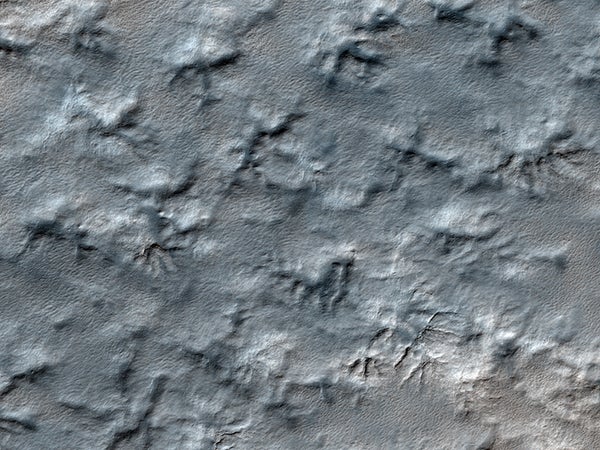
A Mars-bound lander that disappeared 10 years ago and has yet to be found may be hidden in an image such as this.

NASA/JPL/University of Arizona

Join Our Community of Science Lovers!


On supporting science journalism

If you're enjoying this article, consider supporting our award-winning journalism by subscribing. By purchasing a subscription you are helping to ensure the future of impactful stories about the discoveries and ideas shaping our world today.


A Mars-bound lander that disappeared 10 years ago and has yet to be found may be hidden in an image such as this. Mission controllers lost contact with the Mars Polar Lander (MPL) in December 1999 as the probe descended toward the Martian surface. A review board later determined that a premature shutdown of the descent engines, while the lander was still 40 meters above the surface, probably caused the loss of MPL.

Since the accident, NASA orbiters such as the Mars Global Surveyor and the Mars Reconnaissance Orbiter have searched the south polar region where MPL likely wrecked, in the hopes that photographic evidence from the crash site might provide some concrete answers about what happened. And in 2005 it appeared that NASA's Mars Global Surveyor spacecraft might have found MPL's remains. A report that year in Sky & Telescope presented images thought to be of the lander and its parachute, but later photographs showed the site to actually be barren.

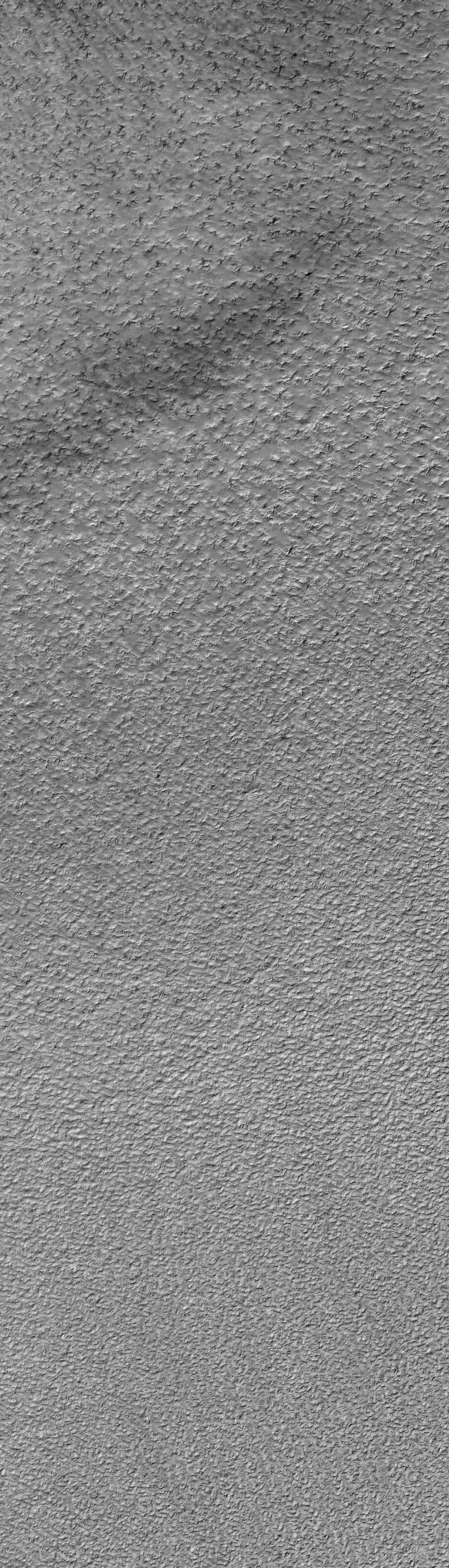
This image, taken by the Mars Reconnaissance Orbiter (MRO) on August 24, is a crop of a much larger photo of a southern swath near the MPL's presumed resting place. The images, from the MRO's powerful HiRISE camera, have a resolution of about 25 centimeters per pixel, but if MPL is in the target region it is well camouflaged, as it has yet to be found. Even with the help of HiRISE, the location of the Mars Polar Lander remains a mystery.
Subscribe to Support Independent Journalism

Great science journalism requires human expertise, time, effort and creativity. And it costs money. That’s why I and the journalists here at Scientific American hope you’ll join our community.

When you subscribe, you are supporting staff and freelance journalists who are passionate about telling science stories that are true, important and compelling. Our editors and reporters are often experts in their fields, which means they understand the nuances of big discoveries and can untangle the breakthroughs from the hype. With a subscription, you are also supporting rigorous fact-checking to ensure the words we publish are precise and accurate. And you’re supporting original illustrations, graphics and photos that bring you closer to an advanced laboratory, an ice sheet in Antarctica or a space mission in orbit. You’re helping us craft other types of high-quality journalism as well: Our newsletters are carefully written, edited and curated by staffers you have or will come to know and love. Our Science Quickly podcast is based on original reporting, collaboration with editors and scientists and exacting production.

Subscriptions keep this engine running so we can continue to deliver thoughtful, rigorous and independent science journalism to you. In an era of viral misinformation, this work is crucial. If you value what we do, I hope you’ll consider joining us as a subscriber

Thank you,

Jeanna Bryner, Editor in Chief, Scientific American

Subscribe