
By Brendan Pierson
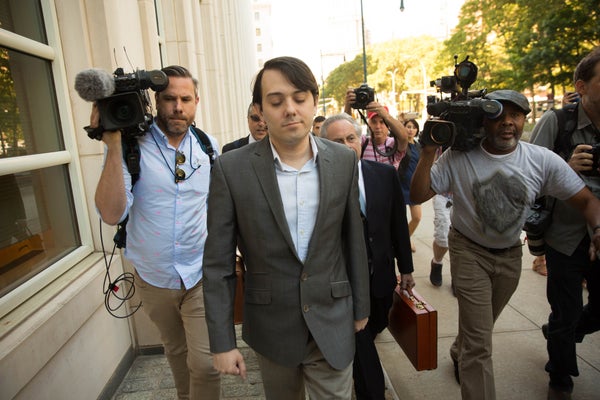
NEW YORK (Reuters) - Martin Shkreli, the pharmaceutical entrepreneur vilified as the "pharma bro" for raising the price of a life-saving drug by 5,000 percent, will go on trial on Monday for what U.S. prosecutors called a Ponzi-like scheme at his former hedge fund and a drug company he once ran.
Prosecutors have accused Shkreli of lying to investors in the hedge fund and siphoning millions of dollars in assets from biopharmaceutical company Retrophin Inc to repay them. He has pleaded not guilty.
On supporting science journalism
If you're enjoying this article, consider supporting our award-winning journalism by subscribing. By purchasing a subscription you are helping to ensure the future of impactful stories about the discoveries and ideas shaping our world today.
The trial, which will be heard by U.S. District Judge Kiyo Matsumoto in Brooklyn, is expected to last four to six weeks.
Shkreli, a boyish-looking 34, outraged patients and U.S. lawmakers by raising the price of anti-parisitic drug Daraprim to $750 a pill, from $13.50, in 2015, when he was chief executive of Turing Pharmaceuticals.
The charges that led to his arrest in December 2015 are not related to Turing but focus on Shkreli's management at Retrophin and the hedge fund MSMB Capital Management between 2009 and 2012.
Prosecutors said Shkreli lied about MSMB's finances to lure investors and concealed devastating trading losses from them. They said he paid the investors back with money stolen from Retrophin, which he founded in 2011.
The criminal case has drawn attention in part because of Shkreli's refusal to lay low. He has continued to court the public eye, especially through social media, sometimes complicating his defense.
At a hearing last Monday, prosecutors refused to agree to Shkreli's request to reduce his bail by $3 million, which he said he needs to pay taxes and legal bills, pointing to his own public boasts about his wealth.
Since his arrest, Shkreli has flaunted purchases including a World War II-era Enigma code breaking machine, a Picasso painting and unreleased albums by Wu-Tang Clan and Lil Wayne.
In April, he offered $40,000 to a Princeton University student who solved a mathematical proof. In May, he pledged on Facebook to pay $100,000 for tips leading to the arrest of the person who killed former Democratic National Committee employee Seth Rich.
Shkreli was banned from Twitter in January for harassing a female journalist who wrote an op-ed piece for Teen Vogue criticizing President Donald Trump, whom Shkreli has supported.
Shkreli's attention-seeking has at times exasperated his lawyer, Benjamin Brafman, who urged Matsumoto last week not to give much weight to his client's "preposterous statements."