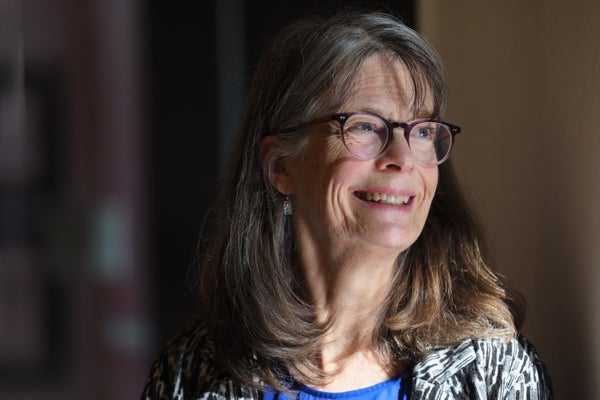
Mary Brunkow is a Distinguished Investigator in the Hood Lab at the Institute for Systems Biology, a nonprofit research center in Seattle. She shared the Nobel Prize in Physiology or Medicine in 2025 for groundbreaking discoveries related to a component of the human immune system that helps the body fight off attackers without harming itself. Her earlier work at Princeton University, where she received her Ph.D., contributed to scientists’ understanding that genes can be turned on or off depending on which parent they were inherited from—a process called genomic imprinting.
[This interview was edited for length and clarity.]
How would you describe the current state of American science?
On supporting science journalism
If you're enjoying this article, consider supporting our award-winning journalism by subscribing. By purchasing a subscription you are helping to ensure the future of impactful stories about the discoveries and ideas shaping our world today.
In light of the political atmosphere, I would say science is very confused and uncertain and a bit discouraged, especially in my own case. I’m really discouraged by the extremely aggressive and forceful and quick actions that have been taken to undermine science. On the other hand, I’m surrounded by, you know—scientists ... don’t stop, right? And so, in fact, I think they’ve shown an incredible amount of resilience and doggedness. I find that encouraging. I tend to take things to heart a lot, almost take it personally, like, “They’re coming after me and my work,” and that is not the case. There’s still reason to be encouraged and optimistic. We must go on; there’s still work to do.
What needs to change in American science right now?
We’re so affected by the political climate, and the politics reflects what the people are thinking. So we have to make science a higher priority in the public’s eye. It’s incumbent on scientists to do a better job of communicating what’s important about what’s being done in science and how it truly does impact everybody’s daily life. It’s easy, easy to point to things like medical advances, things [that] have a very tangible application to people’s lives. But I think it goes way beyond medicine into cool new technologies, new instruments that are made and inventions. And we just need to communicate that better.
What gives you optimism right now?
Optimism is just like the mindset of scientists and the absolute drive that keeps science moving forward. And the other thing, on a more practical level, I would say, I really think that the private sector has been stepping up to help with funding. An obvious issue right now is the lack of funding, the cuts to funding. But I think there’s been a lot of progress made in convincing private or philanthropic organizations to step up.
What is your best advice for an early-career scientist at the moment?
I would say: Stay optimistic and stay focused on your work. Work on something that is truly exciting and interesting and really dive into it. But also keep an open mind and keep your eyes open to alternate paths. There’s nothing wrong with swerving to a different open door that’s off on the side that you never anticipated. I would just say: keep an open mind but stay excited about science even in light of challenges that we’re currently facing.
How has your field specifically changed in the past few years?
First, my current field is not the field I was in when I did the work for the Nobel Prize. I work at the Institute for Systems Biology, and more specifically, I’m involved in systems medicine—so really trying to apply the principles of systems biology to health care and wellness care. The biggest changes in the past few years would be just the number of other groups that have jumped into this field. It’s a hugely growing field, and it has benefited greatly from big technical advances, such as different ways of measuring analytes [particular substances] in the body and different imaging methodologies and that sort of thing. And so our ability to describe the phenotype or the phenome [a collection of phenotypes or observable traits] of humans or other organisms has really exploded. Also, of course, everyone says [a notable change is] the use of artificial intelligence so that the vast amounts of data that are being generated can be analyzed and made sense of.
What was a eureka moment when you realized a big idea was going to work?
Well, it’s easy to go back to the work that got the Nobel Prize. I can remember a feeling around, reaching a point in the project where it seemed like everything was coming together—like the genetic approach that we were using was really meshing nicely with the physical mapping that we were doing. Before we actually had a gene in hand, it felt like there was no way we could succeed at this.
If you were given a $100-million grant that didn’t require any preliminary data or guaranteed milestones, what high-risk project would you start?
I think at this point, I can’t lay out a research plan. But I would throw it into the area of neurodegeneration and understanding the human brain.