
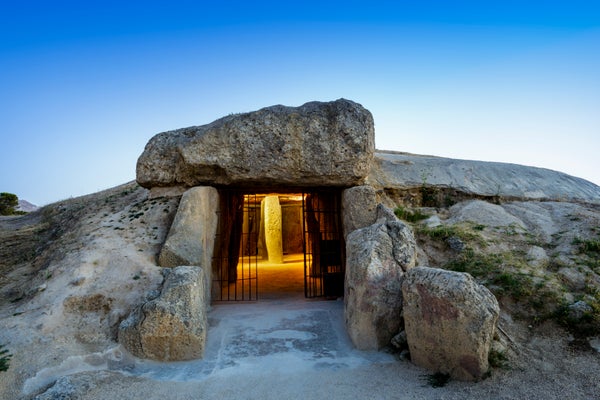
The Neolithic farmers and herders who built a massive stone chamber in southern Spain nearly 6,000 years ago possessed a good rudimentary grasp of physics, geometry, geology and architectural principles, finds a detailed study of the site.
Using data from a high-resolution laser scan, as well as unpublished photos and diagrams from earlier excavations, archaeologists pieced together a probable construction process for the monument known as the Dolmen of Menga. Their findings, published on 23 August in Science Advances, reveal new insights into the structure and its Neolithic builders’ technical abilities.
The dolmen pre-dates the main stone circle at Stonehenge in the United Kingdom by about 1,000 years, but the construction process described in the study would have involved similar techniques and demanded a similar level of engineering.
On supporting science journalism
If you're enjoying this article, consider supporting our award-winning journalism by subscribing. By purchasing a subscription you are helping to ensure the future of impactful stories about the discoveries and ideas shaping our world today.
“These people had no blueprints to work with, nor, as far as we know, any previous experience at building something like this,” says study co-author Leonardo García Sanjuán, an archaeologist at the University of Seville in Spain. “And yet, they understood how to fit together huge blocks of stone” with “a precision that would keep the monument intact for nearly 6,000 years”.
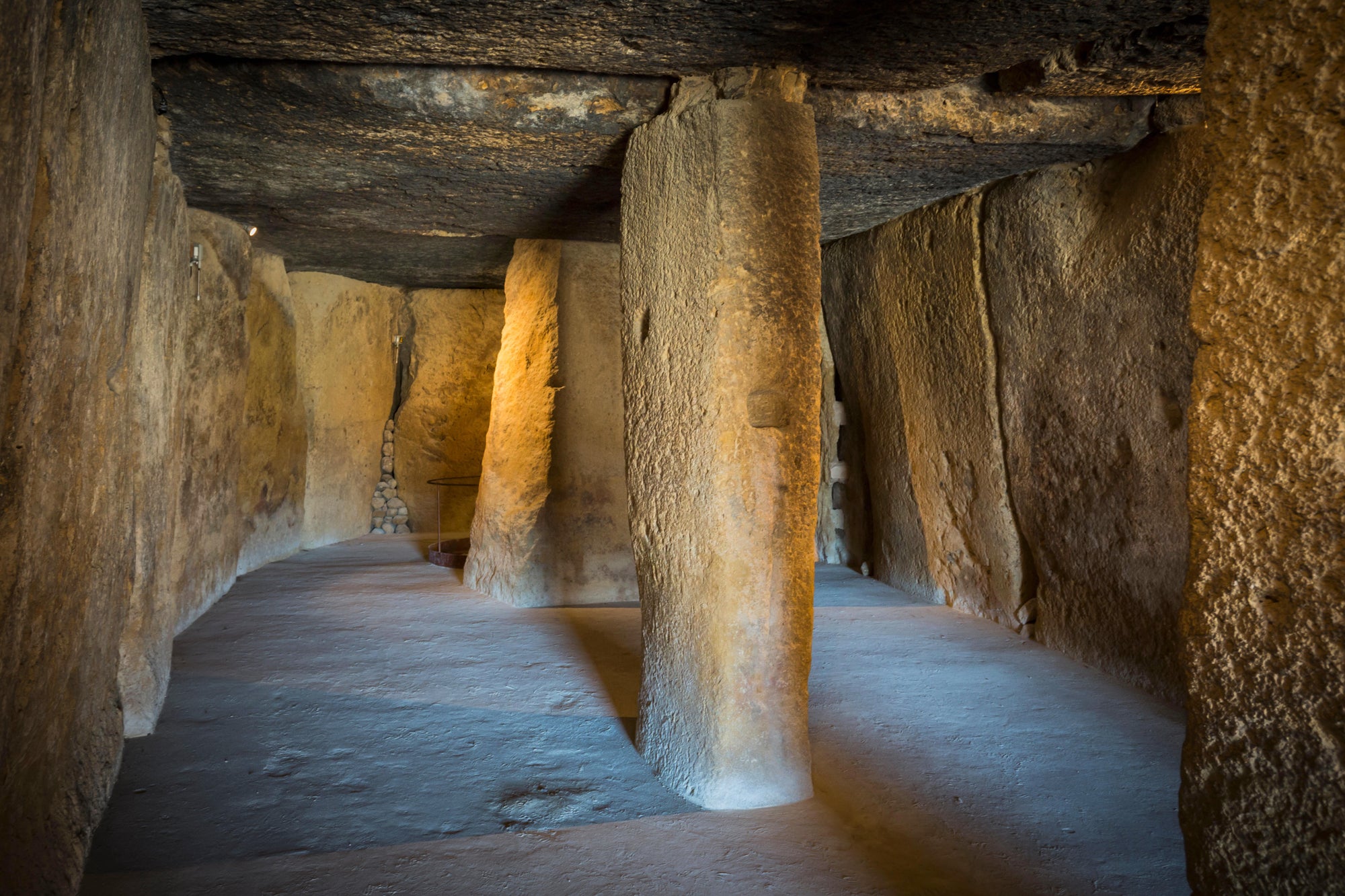
The dolmen’s stones are fitted together with high precision, suggesting that the people who built the tomb understood principles of science and engineering.
Classic Image/Alamy Stock Photo
“There’s no way you could do that without at least a basic working knowledge of science,” he adds.
Super-solid structure
To construct the dolmen, its builders transported 32 giant stone blocks from a quarry around one kilometre away and used them to form the walls, pillars and roof of a massive chamber measuring around 28 metres long, 6 metres wide and 3.5 metres high. The largest of these blocks, one of the capstones that forms part of the roof, is 8 metres long and weighs an estimated 150 tonnes. By comparison, the biggest stone used to build Stonehenge weighs about 30 tonnes.
Transporting these huge slabs from the quarry to the site without breaking them would have required particular care, the researchers say, particularly with the soft sandstone used for the roof. They suggest that this could have been done using specially built wooden tracks to reduce friction as the stones were dragged along, much as the builders of Stonehenge are thought to have done.
Another task that demanded precision and skill was finessing the upright slabs into sockets carved 1.5 metres deep into the bedrock. The laser scans revealed that the builders used counterweights and ramps to move the uprights carefully into the sockets, tilting them at precise, millimetre-scale angles. The stones were carved into facets that meant they locked against their neighbours when the weights and ramps were removed.
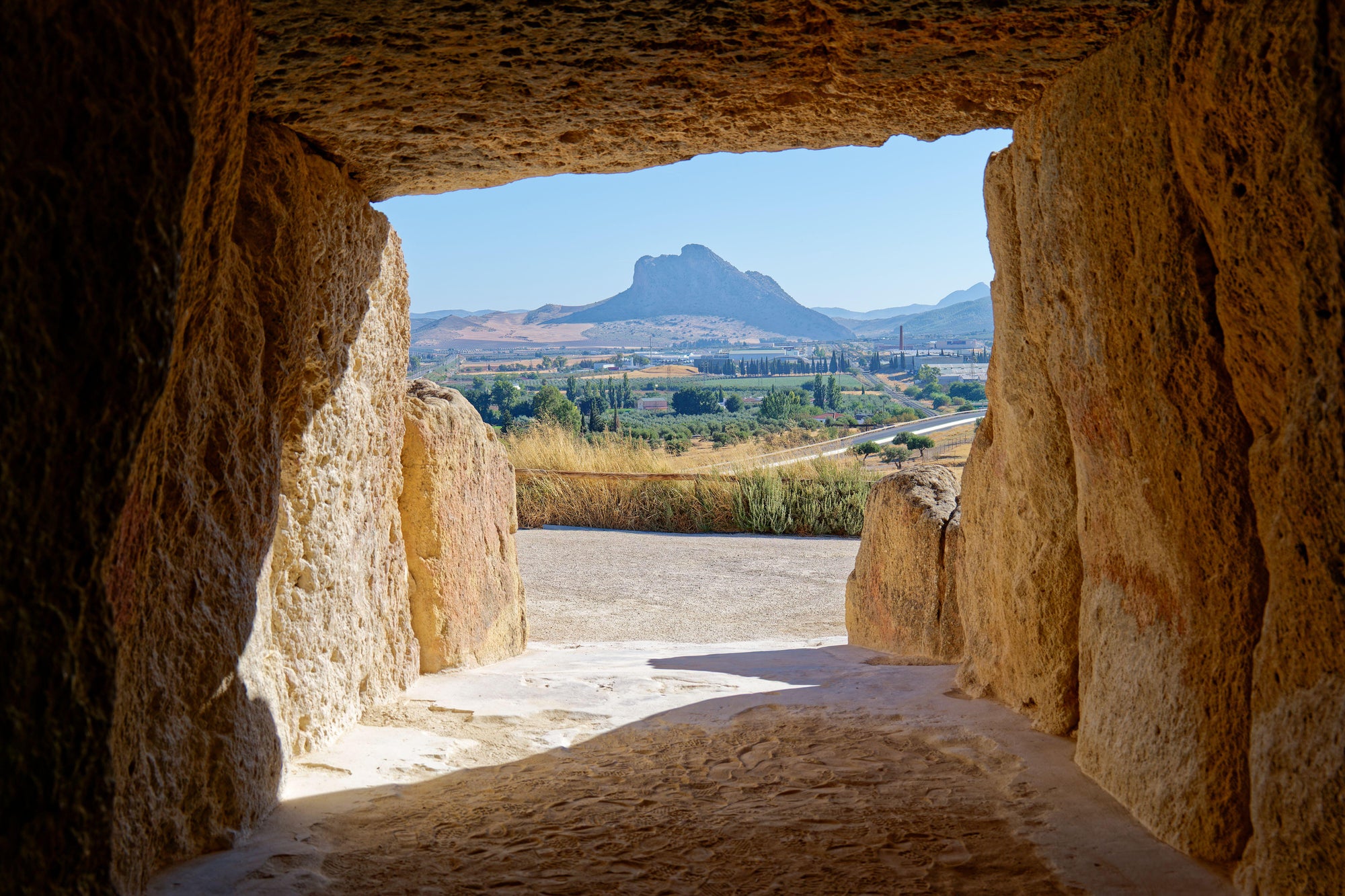
Interior of the megalithic monument Dolmen of Menga looking at Antequera with the Lovers' Rock in the background.
stu.dio/Alamy Stock Photo
“I’ve always been amazed by the engineering skills needed to build this dolmen,” says Michael Parker Pearson, an archaeologist at University College London. “This paper reveals just how precisely that has to have been done, with an extraordinary eye on dimensions and angles. With such big stones, they could not have afforded to make mistakes when manoeuvring them into position. If even just one was a few centimetres out, that would have been hard to correct once an upright stone was set in its trench.”
Parker Pearson adds that the prehistoric engineers’ understanding of physics and geometry resulted in a ‘super-solid monument’. “It’s the sort of thing we see at Stonehenge a thousand years later, with the mortise and tenon joining of uprights and lintels.”
But unlike Stonehenge, the Dolmen of Menga is in a seismically active, earthquake-prone area. Despite this, after nearly 6,000 years, the stonework is still snug and secure, says García Sanjuán. “These people really knew what they were doing.”
This article is reproduced with permission and was first published on August 23, 2024.