
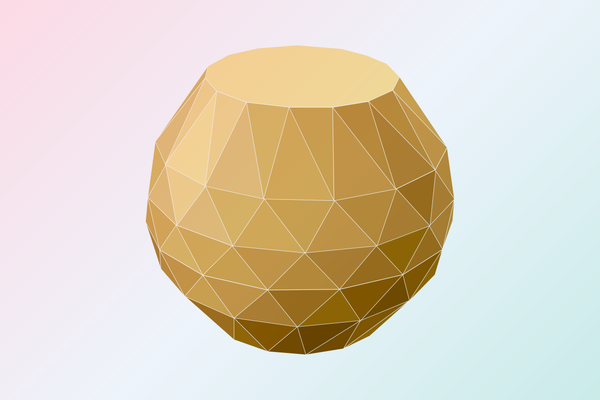
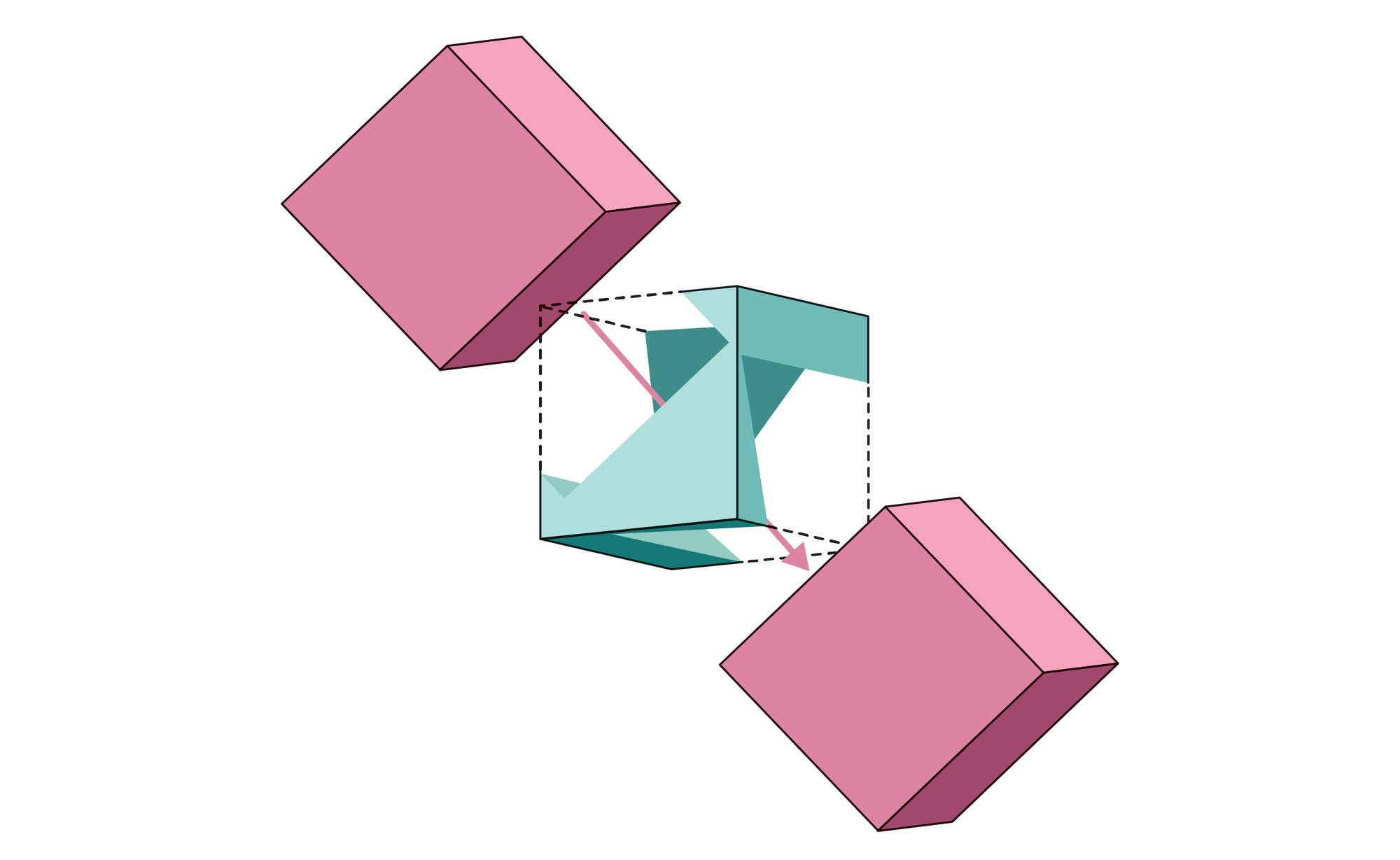
Can you drill a hole in a cube that an identical cube could fall through? Prince Rupert of the Rhine first asked this question in the 17th century, and he soon found out the answer is yes. One can imagine propping a cube up on its corner and boring a large-enough square hole vertically through it to fit a cube of the same size as the original.
Amanda Montañez
Later, mathematicians found more and more three-dimensional shapes that eventually came to be called “Rupert”: they are able to fall through a straight hole in an identical shape. In 2017 researchers formally conjectured that all 3D shapes with flat sides and no indents, known as convex polyhedrons, are Rupert. Nobody could prove them wrong—until now.
On supporting science journalism
If you're enjoying this article, consider supporting our award-winning journalism by subscribing. By purchasing a subscription you are helping to ensure the future of impactful stories about the discoveries and ideas shaping our world today.
Enter the brand-new noperthedron. It has 90 vertices, 240 edges, 152 faces and one very special property: it’s “nopert,” a word coined this year by independent computer science researcher Tom Murphy VII to mean “not Rupert.” Mathematicians Sergey Yurkevich of Austrian technology company A&R Tech and Jakob Steininger of Statistics Austria, the country’s national statistical institute, introduced this new shape to the world recently in a paper posted on the preprint server arXiv.org. The noperthedron isn’t the first shape suspected of being nopert, but it is the first proven so—and it was designed with certain properties that simplify the proof. Using a bespoke computer program, the researchers managed to verify that no matter how each of two identical noperthedrons is shifted or rotated, one could not possibly fall through a hole in the other.
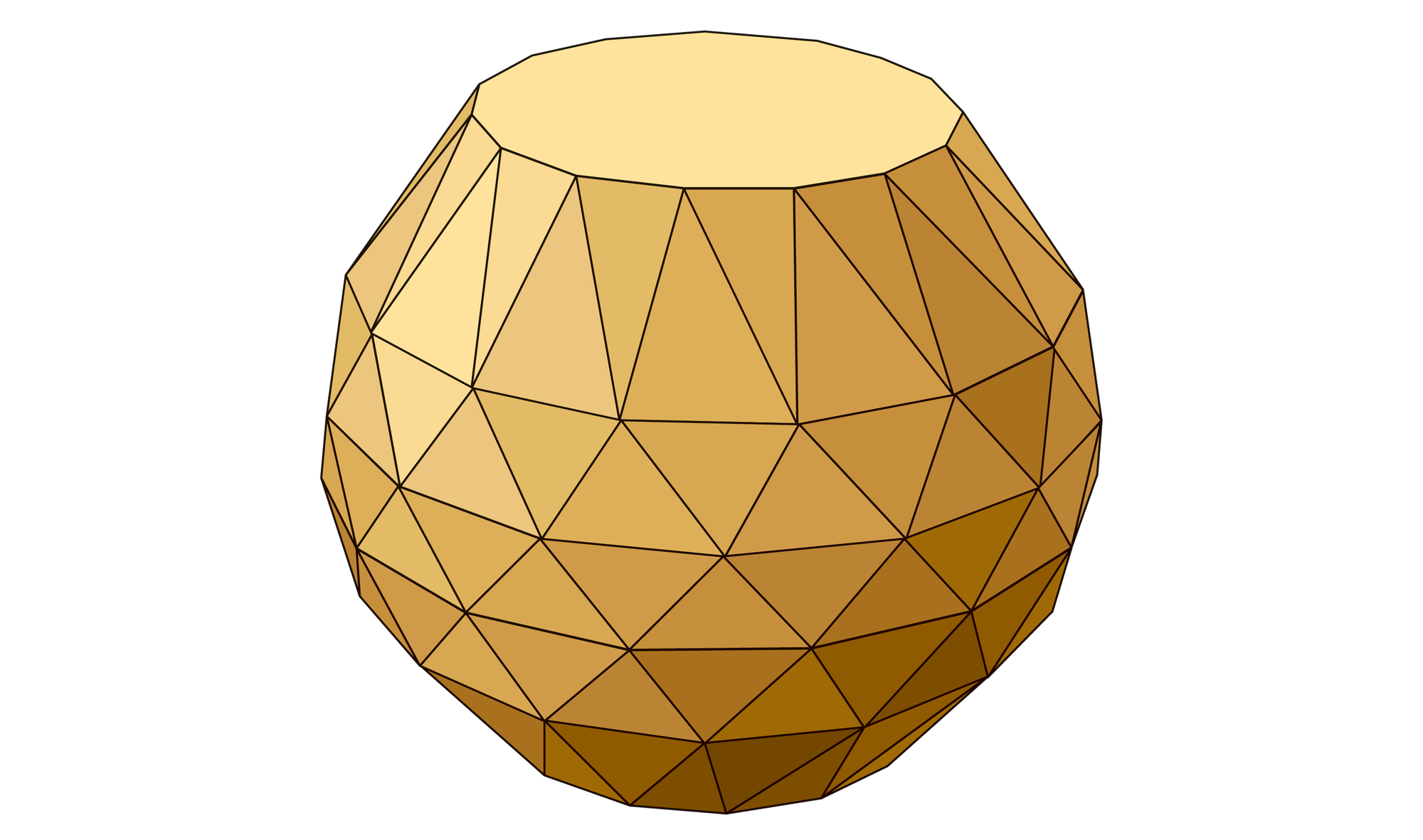
Amanda Montañez; Source: “A Convex Polyhedron without Rupert’s Property,” by Jakob Steininger and Sergey Yurkevich; arxiv.org/abs/2508.18475v1, August 25, 2025 (reference)
Yurkevich and Steininger have been studying Rupert’s property for years, and they’ve been working together even longer; the pair met as teens preparing for a math olympiad. “After so many years, we know each other’s strengths,” Steininger says. Yurkevich adds, “If one of us says something that doesn’t make sense, the other one has no problem saying, ‘I have no idea what you just meant.’”
They first stumbled on Prince Rupert’s cube on YouTube as university students, and they quickly found that such solids’ prevalence was an open problem. In a 2020 paper, Yurkevich and Steininger were the first to publicly conjecture that not every convex polyhedron has Rupert’s property. Now, five years later, they’ve seen their conjecture through to its proof.
The researchers described the set of all possible noperthedron holes as a five-dimensional cube, with each axis representing a different rotation of the polyhedron. With a clever mix of mathematical reasoning and computer programming, they discounted each area of that cube as a possibility. “Their approach is both creative and rigorous,” says Pongbunthit Tonpho, a mathematician at Chulalongkorn University in Thailand, who researches Rupert’s property. “I did not expect that someone would be able to disprove the conjecture so soon.”