
In 1986 Belgian mathematician Jean Bourgain posed a seemingly simple question that continued to puzzle researchers for decades. No matter how you deform a convex shape—consider shaping a ball of clay into a watermelon, a football or a long noodle—will you always be able to slice a cross section bigger than a certain size? A paper by Bo’az Klartag of the Weizmann Institute of Science in Rehovot, Israel, and Joseph Lehec of the University of Poitiers in France, posted to the preprint site arXiv.org, has finally provided a definitive answer: yes.
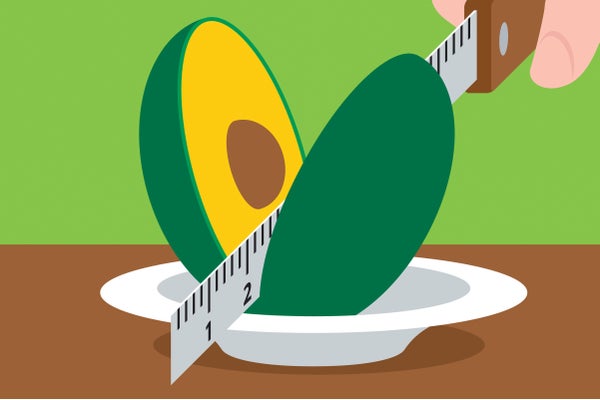
Bourgain’s slicing problem asks whether every convex shape in n dimensions has a “slice” such that the cross section is bigger than some fixed value. For three-dimensional objects, this is like asking whether an avocado of a given size, no matter the exact shape, can always be split into two halves with each side revealing at least some sizable slice. Bourgain, a titan of mathematics, is said to have spent more time on this problem than any other; although it may seem deceptively easy to resolve in the physical world’s two or three dimensions, it quickly balloons in difficulty when we consider four or five. This added complexity makes determining anything in n-dimensional space seem impossible. “If you believe in this so-called curse of dimensionality, you might just give up,” Klartag says. Fortunately, he adds, he and Lehec “belong to a different school of thought.”
The pair’s breakthrough builds on recent progress by mathematician Qingyang Guan of the Chinese Academy of Sciences, who approached the problem with a technique based on physics rather than geometry. Specifically, Guan showed that modeling how heat diffuses out of a convex shape can reveal hidden geometric structures. Researchers could calculate filling any convex shape with warm gas and carefully observe the heat’s dissipation according to physical laws. Guan’s key insight—a precise limit on how rapidly the rate of dissipation changes during this heating process—proved to be just what Klartag and Lehec needed. “Guan’s bound tied together all the other key facts” known for the problem, says mathematician Beatrice-Helen Vritsiou of the University of Alberta.
On supporting science journalism
If you're enjoying this article, consider supporting our award-winning journalism by subscribing. By purchasing a subscription you are helping to ensure the future of impactful stories about the discoveries and ideas shaping our world today.
The result let Klartag and Lehec resolve the problem in only a few days. Klartag notes that “it was lucky because we knew [Guan’s result] was exactly one of the things we needed” to connect several seemingly disparate approaches to the puzzle. With this final piece in place, the geometry of convex bodies in high dimensions is now a little less mysterious—although, as always in mathematics, each new slice reveals more questions to explore.