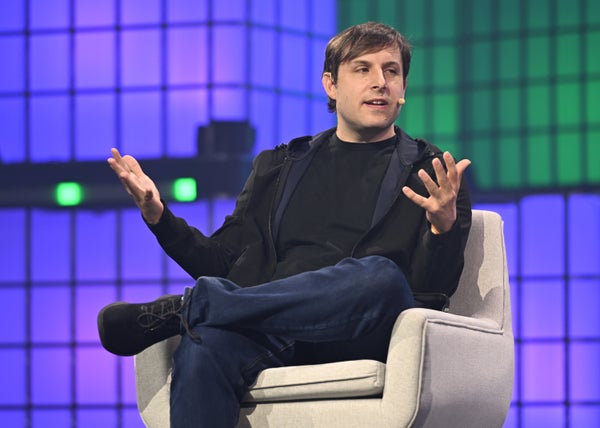
Max Hodak is a biomedical engineer and technology entrepreneur. He is co-founder and CEO of Science Corporation, which develops neural technologies, and previously co-founded Neuralink, where he served as president through early 2021.
[This interview was edited for length and clarity.]
How would you describe the current state of American science?
On supporting science journalism
If you're enjoying this article, consider supporting our award-winning journalism by subscribing. By purchasing a subscription you are helping to ensure the future of impactful stories about the discoveries and ideas shaping our world today.
Full of potential. We’ve defined the state of the art for the past 50 years and have all of the ingredients to continue to lead, but the future is not going to look like the past. Much of what has historically been publicly funded is increasingly becoming privately funded. At the same time, the biggest experiments are becoming much more capital-intensive.
A lot of this is regulatory but it’s also the fact that modern experiments aren’t a genius scientist alone at a bench anymore but rather large teams with extremely advanced equipment manufactured by three or four layers of other advanced equipment with complex global supply chains. Some fields, such as astronomy and high-energy physics, have been like this for a while, but it’s increasingly coming to almost everything.
A lot of what happens next will come down to political will: many Americans don’t want to hear about money being spent on what they perceive to be far-off basic research when they’re struggling to afford rent and groceries. And we haven’t done a good job recently of communicating that technology is what enables amazing things to become affordable, if we don’t get in our own way.
What needs to change in American science?
This really depends on the field, but in the areas I know, we have created a regulatory environment (out of good intentions!) that has made it very difficult to do things. There are easily multiyear delays from the time we have clear evidence something is worth trying to the time that patients, even terminally ill ones, can receive it. Beyond sheer wait times with programs essentially paused, pending regulatory reviews, we are also often limited by infrastructure such as manufacturing facilities, the design and build of which take years while our global competitors are increasingly able to [achieve them] in months.
Without reform, it is very possible that, in a decade, all of the most advanced medical therapies will be happening elsewhere, and Americans who want to benefit from them will need to travel internationally, potentially to places with very different values.
What gives you optimism right now?
Artificial intelligence is opening entirely new frontiers in many fields; much that was inconceivable just a few years ago is now generating accelerating progress. The toolbox is expanding, and it’s clear that opportunities exist now to totally transform everything from oncology to cardiovascular disease to neurodegeneration. We really are in the midst of a new industrial revolution, opening up a future that is as advanced relative to our present world as that [present] is to preindustrial societies
What’s your best advice for an early-career scientist?
Obviously, the heart of a scientific career is mastery of the object-level material in question, and that will never change. But the two most important supporting skills to enable your ability to actually push that understanding further are strong computational abilities—code and command-line fluency plus a clear understanding of how to use modern datasets and compute resources—as well as the communication skills required to [communicate] to the world why this work is worth doing. We are increasingly losing the public, for whom a lot of scientific progress seems either like a distraction from their day-to-day challenges or, worse, actually adverse to their interests. The raw technical results are not enough; we also need to inspire people and paint a picture of a compelling future in which they can see themselves.
Without this, science will eventually struggle to coordinate the resources and regulatory environment required to make progress. You need to get out of your bubble and bring society along with the excitement of the work—and, in translational fields, actually see it all the way through to impact, not just papers.
How has your field changed in the past few years?
It’s incomparable. We are rapidly learning lots about engineering brains, both biological and synthetic, supported by resources that simply didn’t exist just a few years ago. Neural engineering is now a real industrial effort with multiple well-funded groups pursuing different promising research and product directions. This both means more devices getting into patients as well as new basic research results opening doors that we didn’t even know existed. It’s an incredibly exciting time to be doing this work.