
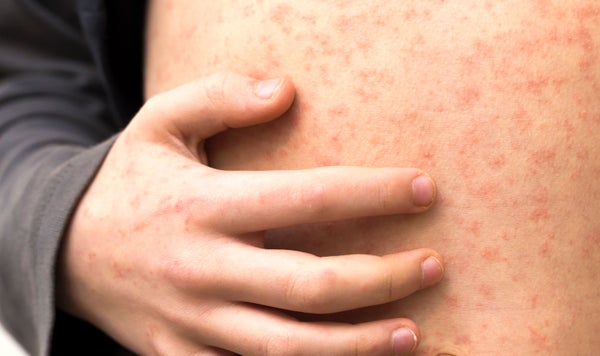
Measles outbreaks are now flaring across multiple U.S. states, and this week Texas public health officials announced that a second child has died of lung failure caused by the highly contagious viral disease. This eight-year-old had no underlying health conditions and had not received vaccination against measles, mumps and rubella (MMR)—the primary, most effective tool to prevent infection.
Meanwhile cases continue to burst across state lines: new measles reports have spiked in Kansas, Hawaii, Colorado, Indiana and Michigan this week. Separately, increasing measles reports in Ontario have triggered travel alerts in neighboring New York State, while recent cases in Mexico have been traced to outbreaks in the U.S.
As efforts to contain these outbreaks sputter and spread of infections stretches into nearly three months, public health experts fear measles—a disease that was virtually eliminated nationally for a quarter-century—may soon officially reclaim a hold on the U.S.
On supporting science journalism
If you're enjoying this article, consider supporting our award-winning journalism by subscribing. By purchasing a subscription you are helping to ensure the future of impactful stories about the discoveries and ideas shaping our world today.
Peter Marks, a leading vaccine official who recently resigned from his position as director of the U.S. Food and Drug Administration’s Center for Biologics Evaluation and Research, recently told NBC News, “I think we’re well on our way” to losing the country’s measles elimination status—a long-standing public health achievement that was largely accomplished through the widespread distribution of MMR vaccines.
Measles’ Elimination Status in the U.S.
A disease receives “elimination” status when its incidence is reduced to zero in a specific region for a set time frame. The amount of time can vary for different diseases; for measles, the U.S. Centers for Disease Control and Prevention and the World Health Organization define this status by a period of 12 months with zero endemic cases. In other words, “there needs to be no continuous transmission chain for 12 months or more, and a transmission chain is when you can link one infectious individual to the next,” explained Amy Winter, a demographer and epidemiologist at the University of Georgia College of Public Health, in a media briefing about measles in March.
The U.S. was officially certified for measles elimination in 2000 and has been able to sustain that status through prevention measures—especially the country’s high vaccination coverage. “It’s really legitimately amazing and [applause-worthy] that we’ve been able to eliminate the disease and keep it eliminated in this country,” Winter said.
A single dose of the MMR vaccine provides 93 percent effective protection against the disease, and the recommended two doses provide 97 percent protection. Polio is another disease that had been declared eliminated in the U.S., also largely because of the widespread use of polio vaccines.
Measles cases can enter a community via a person who has traveled to a place where the disease has not been eliminated, and this can result in short-term outbreaks. The CDC notes that such cases in the U.S. often arise among unvaccinated travelers and that typically two out of three of them are Americans.
“All the measles cases in our country are due to international importations, either a U.S. person going to a foreign country, getting infected and bringing it back, or someone from a foreign country visiting us and transmitting,” explains Walter Orenstein, an epidemiologist and a professor emeritus at Emory University. “One of the big concerns I have is not supporting global efforts to enhance immunization, which is a win-win situation: one, for the countries that we help, and two, for our domestic health security.”
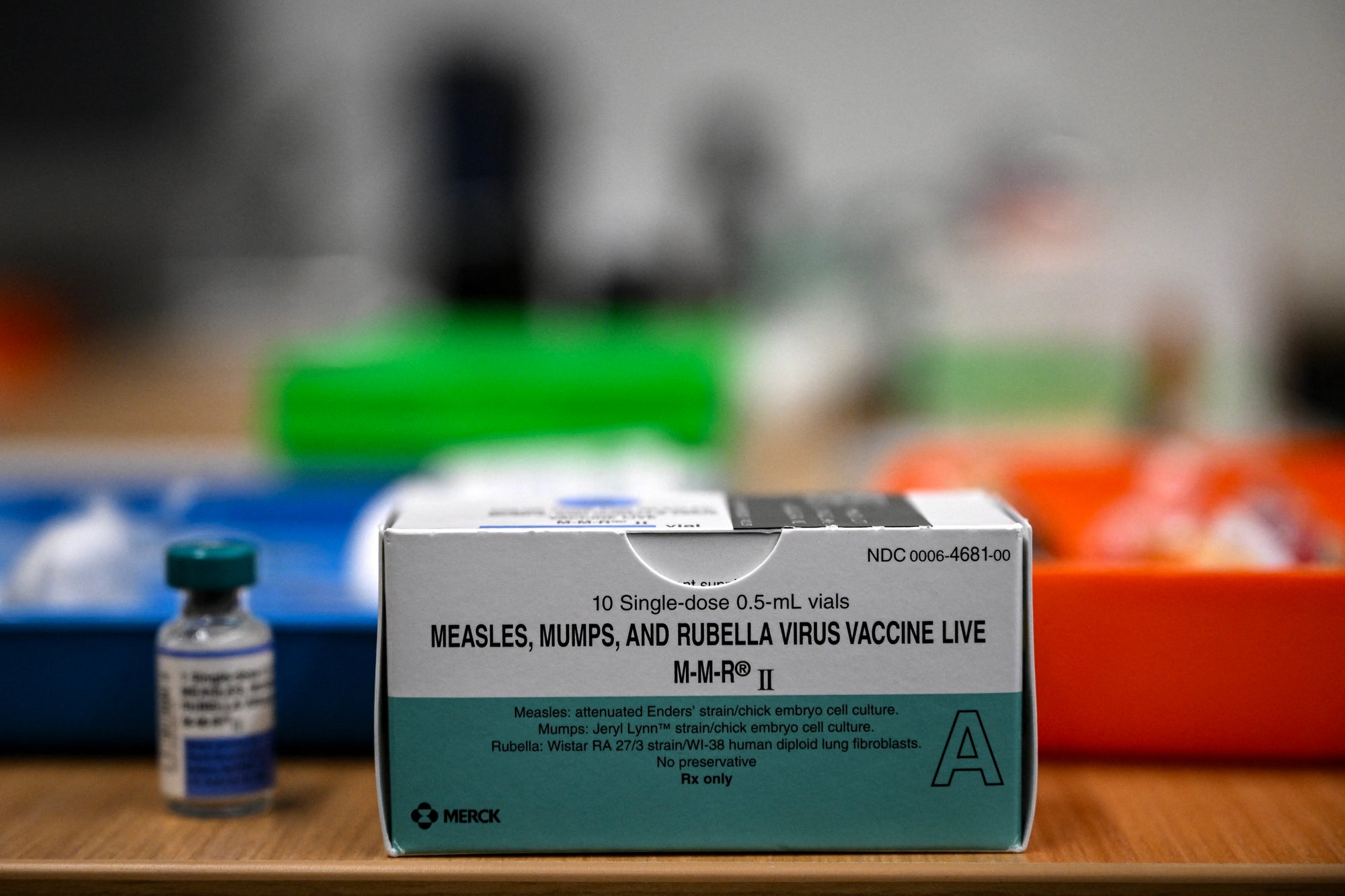
A dose of measles vaccine is pictured in a health center in Lubbock, Texas, on February 27, 2025.
Ronaldo Schemidt/AFP via Getty Images
Could We Eradicate Measles?
The term “eradication” refers to the worldwide absence of a disease. The only human disease to have reached this status is smallpox.
“What we did with smallpox, which I worked on in India during 1974–1975, is: we got rid of transmission in other countries, which meant it couldn’t be transmitted back into our country,” Orenstein says. Because smallpox has been eradicated, vaccination against the disease among the general public is no longer needed anywhere.
“Eventually, perhaps we can eradicate measles, but [that] is very difficult, particularly because of its high contagiousness,” Orenstein says. “But certainly we can maintain our elimination status if we can get very high levels of immunization in our communities and sustain those levels.”
What’s the Possibility that the U.S. Loses Elimination Status?
Given measles’ high contagiousness, Orenstein says, “uniformly” high immunity is extremely important in preventing spread. Even small dips in population immunity (also called “herd immunity”) among small pockets of unvaccinated people can spur outbreaks—and can do so even if the overall state or country’s vaccination rate is relatively high.
“With these threats and dropping immunization coverage, we may have enough susceptibles to eliminate our elimination status” for measles, Orenstein says.
The U.S. almost lost measles elimination status in 2019, when a New York State outbreak lasted from approximately January to October, said William Moss, executive director at the Johns Hopkins Bloomberg School of Public Health’s International Vaccine Access Center, at a recent media briefing on vaccines’ role in eliminating diseases. “That outbreak in 2019 was largely fueled by a large outbreak of over 900 cases in New York City, in New York State,” Moss explained. “What is striking about this current [2025] outbreak is the speed at which it’s expanding and increasing.”
Since the first U.S. cases were reported in the initial measles outbreak in Texas in January, the CDC’s total number of measles cases this year has reached 607, though experts say the real count is likely higher. More than 70 percent of cases have been in people under age 19, and the majority of hospitalizations—21 percent—are in children under age five. The year’s total cases to date are the highest they’ve been since the 2019 outbreak. “It’s hard to say right now whether this outbreak is going to continue for 12 months,” Moss said at the recent briefing. “I hope that is not the case, that we can get a handle on this outbreak through increasing vaccination coverage. But it does remain a threat, and we potentially could lose our measles and elimination status if this continues the way it has.”
And frontline health officials now suggest this could happen amid the current U.S. outbreaks. According to the New York Times, Katherine Wells, public health director of the city of Lubbock, Tex., said in a March news briefing that she anticipated the outbreak “is going to be a year long.”
“Elimination is protection, not just for our vaccinees but for people who can’t be vaccinated or don’t make a good immune response to their vaccine,” Orenstein says. “And to me, natural measles is not healthy for you—and that seems to be a message people are not understanding. There’s no reason that someone has to suffer measles.”
Additional reporting by Meghan Bartels.