
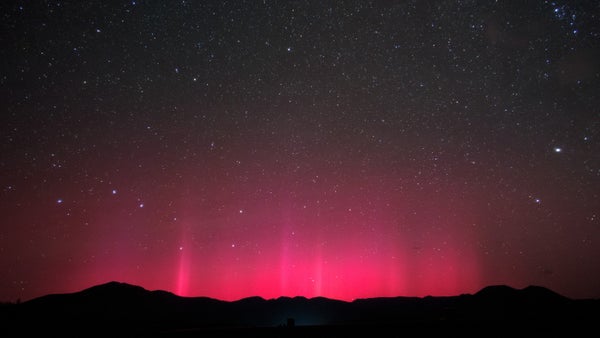
For three nights straight in the winter of 1204, red and white stripes stretched across the northern and northeastern horizon in the night sky over Kyoto. This observation was recorded in part by a Japanese noble and poet named Fujiwara Sadaie in his diary, entitled Meigetsuki (The Record of the Clear Moon).

A hand-copied version of the Heian- and Kamakura-period diary Meigetsuki dating to the later Edo period. The page shown references “red lights in the northern sky.”
National Archives of Japan
“It was an aurora, and three-day-long auroras are extremely rare,” says Hiroko Miyahara, a physicist at the Okinawa Institute of Science and Technology. To trace the solar events behind these auroras, Miyahara and her colleagues looked for spikes of telltale atomic variations trapped in 13th-century tree rings, using medieval literature to guide their search. Their findings were published in the Proceedings of the Japan Academy, Series B.
On supporting science journalism
If you're enjoying this article, consider supporting our award-winning journalism by subscribing. By purchasing a subscription you are helping to ensure the future of impactful stories about the discoveries and ideas shaping our world today.
During the active part of a solar cycle, the sun can throw coronal mass ejections and bursts of particles with energies of up to 10 billion electron volts toward Earth. If these high-energy streams hit our atmosphere, they can interact with molecules in the air, leading to the colorful lights we call aurora. Other chemical reactions produce rare versions of atoms, including one called carbon-14. Trees then absorb this radioactive isotope, locking a chemical time stamp of the solar storm into their annual growth rings. Extreme solar storms leave massive carbon-14 spikes in tree rings, but smaller-scale events are much harder and more time-consuming to detect without knowing where to look.

Illustration of Fujiwara Sadaie from the Edo period.
Kikuchi Yosai
Searching through mentions of auroras in writing from Asia and Europe led Miyahara and her colleagues to focus on the period between 1196 and 1211. To their surprise, the prolonged auroras of 1204 left no corresponding surge in carbon-14. Instead the team found an abrupt jump in the isotope just a few years earlier, between 1200 and 1201, that matched descriptions of an aurora and sunspots in Chinese and Korean texts. This jump, researchers calculated, was caused by an event 14 times larger than the solar storm of February 23, 1956, which remains the most intense such storm recorded in the modern era. “If this happened today, it would cause us lots of trouble,” Miyahara says: sufficiently powerful solar storms can affect satellites, communications systems and the power grid.
According to Charlotte Pearson, a dendrochronologist—tree-ring researcher—at the University of Arizona, who was not involved in the study, the work “is especially cool [because] you get two records for the price of one: you get solar events and solar cycles in year-to-year detail.”

Asunaro cypress tree samples provided by Tohoku University in Japan.
Hiroko Miyahara/OIST
Miyahara’s team found that the solar cycles back in the 13th century were shorter, lasting between seven and eight years instead of the 11 years that we observe today. The researchers also found that the 1200–1201 event occurred at the maximum of one of these abbreviated activity cycles. Powerful storms at solar maximum are expected—but the literature analysis revealed accounts of many more unusual storms that occurred around the cycle minimum as well. Like the Meigetsuki observation, these incidents might not have left tree-ring records.
“It means we need to pay attention to potentially significant solar events not just when the sun is highly active but also when it is at low activity,” says Brian Thomas, an astrophysicist at Washburn University in Kansas, who was not part of the study. “Although this is not an entirely new concept, this paper reinforces it.”
Miyahara wants to search for details of these cycle-minimum storms in her future historical work, she says: “This is unexpected, and we will be looking further into what solar conditions could cause this.”
Editor’s Note (7/17/26): This article was edited after posting to correct the caption for the photograph of a hand-copied version of Meigetsuki.