
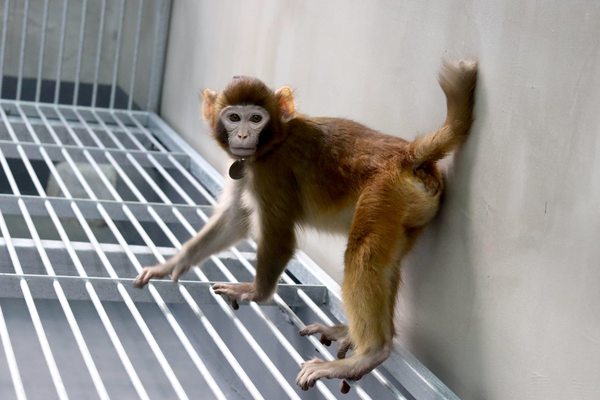
For the first time, a cloned rhesus monkey (Macaca mulatta) has lived into adulthood — surviving for more than two years so far.
The feat, described today in Nature Communications, marks the first successful cloning of the species. It was achieved using a slightly different approach from the conventional technique that was used to clone Dolly the sheep and other mammals, including long-tailed macaques (Macaca fascicularis), the first primates to be cloned.
By replacing the placenta of the cloned embryo with that of embryos produced by an in vitro fertilization technique, scientists reduced developmental defects that can hinder embryo survival while using fewer embryos and surrogate mothers. The new technique could unlock possibilities for using cloned primates in drug testing and behavioural research.
On supporting science journalism
If you're enjoying this article, consider supporting our award-winning journalism by subscribing. By purchasing a subscription you are helping to ensure the future of impactful stories about the discoveries and ideas shaping our world today.
“We could produce a large number of genetically uniform monkeys that can be used for drug-efficacy tests,” says Mu-ming Poo, director of the Institute of Neuroscience in the Chinese Academy of Sciences in Shanghai.
Low survival rate
The standard cloning technique known as somatic cell nuclear transfer (SCNT) — in which the nucleus of a body cell is transferred into an egg cell whose nucleus has been removed — typically results in extremely low birth and survival rates for cloned embryos.
Success in primates has been particularly limited.
When researchers cloned long-tailed macaques in 2018, they created 109 cloned embryos and implanted nearly three-quarters of them into 21 surrogate monkeys, resulting in six pregnancies. Just two of the monkeys survived birth.
In 2022, researchers cloned a rhesus monkey using SCNT, but the animal survived for less than 12 hours.
To investigate what can go wrong in the cloning process, researchers at the Chinese Academy of Sciences in Shanghai compared 484 SCNT rhesus embryos with 499 embryos produced by directly injecting a sperm cell into an egg, a technique known as intracytoplasmic sperm injection (ICSI). The two types of embryo went through similar developmental stages before they were implanted into surrogates. But only 35 SCNT embryos were successfully implanted, compared with 74 ICSI embryos, and fewer SCNT embryos survived to term.
The researchers ran a series of DNA analyses of SCNT embryos and found significant differences in the patterns of epigenetic modifications — structural changes that impact gene activity without altering the DNA sequence — during development. This included a decrease in DNA methylation, a process that affects levels of gene expression. “If you have different methylation [patterns], then the gene expression during development is different,” explains Poo. “That’s why a cloned embryo does not develop well.”
The researchers also found that genes that are normally expressed differently between maternal and paternal genomes lost their distinct patterns in cloned embryos, especially in cells in the placenta. Furthermore, the placentas that developed for SCNT embryos seemed to be thicker than normal and contained defects.
To address this, the researchers developed a technique that involved replacing the SCNT trophoblast — the outer layer of cells in a developing embryo, which later forms the major part of the placenta — with trophoblasts from ICSI embryos. This meant the embryos developed a “natural placenta,” says study co-author Zhen Liu, a neuroscientist at the Chinese Academy of Sciences, “but the fetus is still a cloned fetus.”
One healthy clone
Using this approach, the researchers created 113 cloned rhesus monkey embryos and implanted 11 of them into seven surrogates, resulting in two pregnancies.
One of the pregnant surrogates gave birth to a healthy male rhesus monkey named ReTro, which has survived for more than two years. (The other surrogate carried twins, which died on day 106 of gestation.)
The researchers showed that incorporating trophoblast replacement into SCNT clones reduced defects in the placenta and in DNA methylation. But “the efficiency of the process is similar, even lower” than that of SCNT, said Lluís Montoliu, a geneticist at the Spanish National Center for Biotechnology in Madrid, in a statement to the UK Science Media Centre in London. “It is extremely difficult to succeed with these experiments, with such low efficiencies,” he added.
Since the first primate was cloned using SCNT six years ago, scientists have used cloned monkeys to model diseases such as depression and anxiety, and to assess the efficacy and safety of drugs, including antidepressants.
“We’re seeing the beginning of the use of these cloned monkeys now,” says Poo. “We want to use as few animals as possible to show drug efficacy, without the interference of genetic background.” But he adds that the process of producing clones still involves too many surrogates. Even with the most recent advances, “we have not solved the efficiency of cloning,” he says.
This article is reproduced with permission and was first published on January 16, 2024.