
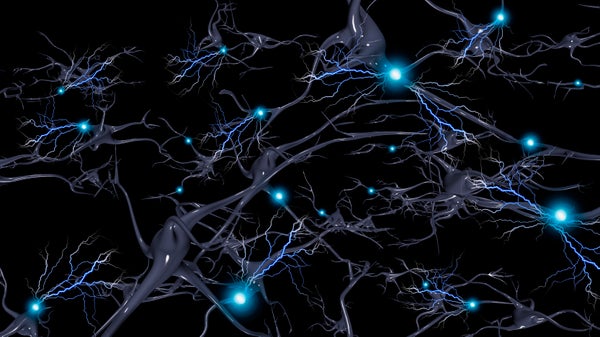
When a long-term memory forms, some brain cells experience a rush of electrical activity so strong that it snaps their DNA. Then, an inflammatory response kicks in, repairing this damage and helping to cement the memory, a study in mice shows.
The findings, published on 27 March in Nature, are “extremely exciting,” says Li-Huei Tsai, a neurobiologist at the Massachusetts Institute of Technology in Cambridge who was not involved in the work. They contribute to the picture that forming memories is a “risky business,” she says. Normally, breaks in both strands of the double helix DNA molecule are associated with diseases including cancer. But in this case, the DNA damage-and-repair cycle offers one explanation for how memories might form and last.
It also suggests a tantalizing possibility: this cycle might be faulty in people with neurodegenerative diseases such as Alzheimer’s, causing a build-up of errors in a neuron’s DNA, says study co-author Jelena Radulovic, a neuroscientist at the Albert Einstein College of Medicine in New York City.
On supporting science journalism
If you're enjoying this article, consider supporting our award-winning journalism by subscribing. By purchasing a subscription you are helping to ensure the future of impactful stories about the discoveries and ideas shaping our world today.
Inflammatory response
This isn’t the first time that DNA damage has been associated with memory. In 2021, Tsai and her colleagues showed that double-stranded DNA breaks are widespread in the brain, and linked them with learning.
To better understand the part these DNA breaks play in memory formation, Radulovic and her colleagues trained mice to associate a small electrical shock with a new environment, so that when the animals were once again put into that environment, they would ‘remember’ the experience and show signs of fear, such as freezing in place. Then the researchers examined gene activity in neurons in a brain area key to memory — the hippocampus. They found that some genes responsible for inflammation were active in a set of neurons four days after training. Three weeks after training, the same genes were much less active.
The team pinpointed the cause of the inflammation: a protein called TLR9, which triggers an immune response to DNA fragments floating around the insides of cells. This inflammatory response is similar to one that immune cells use when they defend against genetic material from invading pathogens, Radulovic says. However, in this case, the nerve cells were responding not to invaders, but to their own DNA, the researchers found.
TLR9 was most active in a subset of hippocampal neurons in which DNA breaks resisted repair. In these cells, DNA repair machinery accumulated in an organelle called the centrosome, which is often associated with cell division and differentiation. However, mature neurons don’t divide, Radulovic says, so it is surprising to see centrosomes participating in DNA repair. She wonders whether memories form through a mechanism that is similar to how immune cells become attuned to foreign substances that they encounter. In other words, during damage-and-repair cycles, neurons might encode information about the memory-formation event that triggered the DNA breaks, she says.
When the researchers deleted the gene encoding the TLR9 protein from mice, the animals had trouble recalling long-term memories about their training: they froze much less often when placed into the environment where they had previously been shocked than did mice that had the gene intact. These findings suggest that “we are using our own DNA as a signalling system” to “retain information over a long time,” Radulovic says.
Fitting in
How the team’s findings fit with other discoveries about memory formation is still unclear. For instance, researchers have shown that a subset of hippocampal neurons known as an engram are key to memory formation. These cells can be thought of as a physical trace of a single memory, and they express certain genes after a learning event. But the group of neurons in which Radulovic and her colleagues observed the memory-related inflammation are mostly different from the engram neurons, the authors say.
Tomás Ryan, an engram neuroscientist at Trinity College Dublin, says the study provides “the best evidence so far that DNA repair is important for memory.” But he questions whether the neurons encode something distinct from the engram — instead, he says, the DNA damage and repair could be a consequence of engram creation. “Forming an engram is a high-impact event; you have to do a lot of housekeeping after,” he says.
Tsai hopes that future research will address how the double-stranded DNA breaks happen and whether they occur in other brain regions, too.
Clara Ortega de San Luis, a neuroscientist who works with Ryan at Trinity College Dublin, says that these results bring much-needed attention to mechanisms of memory formation and persistence inside cells. “We know a lot about connectivity” between neurons “and neural plasticity, but not nearly as much about what happens inside neurons,” she says.
This article is reproduced with permission and was first published on March 27, 2024.