New Issue: Orbital Catastrophe Ahead? Read Now

A Deadly Coronavirus Resurfaces in France for First Time in 12 Years

French health officials are trying to trace all the contacts of two men who contracted MERS, a potentially lethal disease that is typically confined to the Middle East

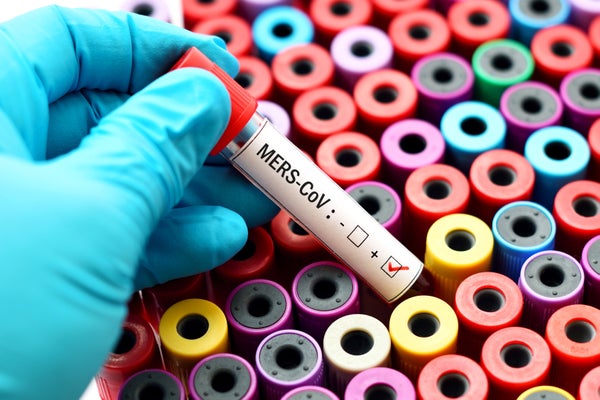
Close-up of a MERS coronavirus test

jarun011/Getty Images

Join Our Community of Science Lovers!

French health officials are working to trace all the contacts of two men who contracted Middle East respiratory syndrome (MERS), a potentially deadly disease that typically only occurs in the Middle East.

These cases of the disease are the country’s first in 12 years, according to the French health ministry. The men, both of whom are in their 70s, are in a stable condition. About four in every 10 people who have a MERS infection die of the illness, and there is no cure or vaccine.

Officials have begun deploying strategies to contain the disease, including tracing known human contacts, performing testing and applying isolation. They have also issued instructions on what to do if symptoms occur. The MERS-causing coronavirus MERS-CoV, which belongs to the same family as the pathogen that causes COVID, can bring about severe respiratory problems, including cough, breathlessness and fever.


On supporting science journalism

If you're enjoying this article, consider supporting our award-winning journalism by subscribing. By purchasing a subscription you are helping to ensure the future of impactful stories about the discoveries and ideas shaping our world today.


Most cases of MERS-CoV happen when humans encounter infected camels—a known reservoir of the virus—or if they ingest milk or meat from infected animals. But human-to-human transmission can occur. According to French health officials, the infected men in France had recently traveled to Oman, where they had eaten camel meat and visited a live-animal market.

Subscribe to Support Independent Journalism

Great science journalism requires human expertise, time, effort and creativity. And it costs money. That’s why I and the journalists here at Scientific American hope you’ll join our community.

When you subscribe, you are supporting staff and freelance journalists who are passionate about telling science stories that are true, important and compelling. Our editors and reporters are often experts in their fields, which means they understand the nuances of big discoveries and can untangle the breakthroughs from the hype. With a subscription, you are also supporting rigorous fact-checking to ensure the words we publish are precise and accurate. And you’re supporting original illustrations, graphics and photos that bring you closer to an advanced laboratory, an ice sheet in Antarctica or a space mission in orbit. You’re helping us craft other types of high-quality journalism as well: Our newsletters are carefully written, edited and curated by staffers you have or will come to know and love. Our Science Quickly podcast is based on original reporting, collaboration with editors and scientists and exacting production.

Subscriptions keep this engine running so we can continue to deliver thoughtful, rigorous and independent science journalism to you. In an era of viral misinformation, this work is crucial. If you value what we do, I hope you’ll consider joining us as a subscriber

Thank you,

Jeanna Bryner, Editor in Chief, Scientific American

Subscribe