
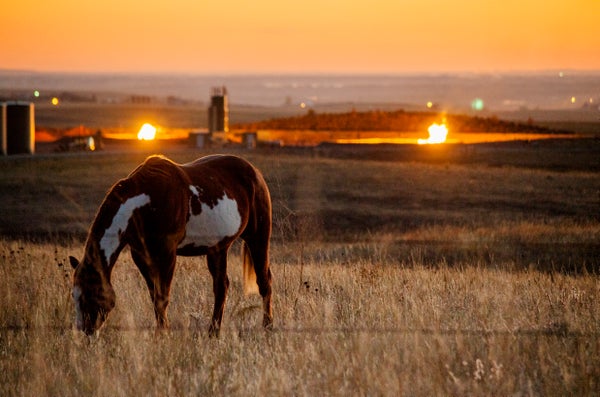
The fossil fuel industry may be responsible for a much greater share of the world’s methane emissions than previously estimated, according to new research that could intensify urgency around curbing the potent gas from oil and gas production.
The research, published yesterday in the journal Nature, delves into the sources of "fossil" methane emissions, or methane that comes from the Earth’s geologic formations. There are two main ways fossil methane can be released into the atmosphere—human activities from fossil fuel production or natural processes, including the slow release of gas from mud volcanoes or undersea methane seeps.
Recent inventories have placed emissions from natural sources at around 40 million to 60 million metric tons of methane each year. But the new study suggests these estimates are far too high. At the very most, natural sources might contribute about 5 million tons in a given year—and more like 1.5 million tons annually on average.
On supporting science journalism
If you're enjoying this article, consider supporting our award-winning journalism by subscribing. By purchasing a subscription you are helping to ensure the future of impactful stories about the discoveries and ideas shaping our world today.
The researchers, led by Benjamin Hmiel of the University of Rochester, took a different approach to their estimates. Rather than adding up estimates of emissions from individual sources—what’s known as a “bottom-up” approach—they instead measured the methane inside long-frozen ice samples, retrieved from a site in Greenland.
The ice they sampled is several hundred years old—too old to contain any emissions from the fossil fuel industry. That means all the fossil methane preserved inside the ice comes from natural sources. They also compared these measurements with Antarctic samples from around the same time period.
The results suggest that researchers have been overestimating methane emissions from natural sources.
The new study suggests that if there’s less methane produced from natural sources, then emissions from the fossil fuel industry must be higher than previously suspected. The authors suggest that these estimates could be reasonably revised upward by about 40%.
If that’s the case, then the study may actually suggest an opportunity for more meaningful action to combat climate change by reducing human-caused methane emissions. Methane is a powerful greenhouse gas—it has a much shorter lifetime in the atmosphere than carbon dioxide, but a much greater warming potential while it lasts.
“Placing stricter methane emission regulations on the fossil fuel industry will have the potential to reduce future global warming to a larger extent than previously thought,” said lead author Hmiel in a statement.
Not all scientists agree with these conclusions. Daniel Jacob, a Harvard University atmospheric chemist and methane expert, argues that the study doesn’t necessarily suggest that fossil fuel estimates should be higher.
He agrees that estimates of natural emissions were previously too high, and that the new research demonstrates they should be revised downward. But he suggests that this could mean total fossil methane emissions are lower than previously thought, not that fossil fuel emissions must be higher.
Aside from this critique, he says the study presents some significant findings. Jacob has worked on estimates of the global carbon budget, including the amount of total methane in the atmosphere and its possible sources. He says that previous, higher estimates of natural methane emissions had never fit well into the budget.
“It’s very important that they brought down the estimates of natural geogenic sources, and they did this in a very convincing way,” Jacob told E&E News.
In general, the global methane budget is often a source of confusion and debate among scientists. Atmospheric measurements suggest that methane concentrations in the air steadily increased over the 20th century, leveled off briefly around the year 2000, and then suddenly skyrocketed in 2007.
Scientists have been unable to agree on the exact source of the spike. In addition to geologic methane seeps and activity from the fossil fuel industry, methane is also produced by biological sources, like livestock, wetlands and thawing permafrost.
Still, in the midst of these debates, there’s recent evidence to suggest that methane emissions from the fossil fuel industry are indeed higher than previously thought.
Some regional studies have suggested that methane emissions from oil and gas production are actually higher than the EPA’s inventories would suggest. Other research has found that more methane could be pouring from urban environments—potentially from leaking pipes—than government estimates indicate.
One striking study in 2018 estimated that methane emissions from the oil and gas supply chain could be as much as 60% higher than the levels estimated in EPA inventories.
Curbing methane emissions from human sources presents another opportunity for climate action, experts say—particularly if these emissions are higher than previously suspected.
“I don’t want to get too hopeless on this because my data does have a positive implication: Most of the methane emissions are anthropogenic, so we have more control,” said Hmiel. “If we can reduce our emissions, it’s going to have more of an impact.”
Reprinted from Climatewire with permission from E&E News. E&E provides daily coverage of essential energy and environmental news at www.eenews.net.