
A preliminary estimate from NOAA finds that levels of atmospheric methane, a potent heat-trapping gas, have hit an all-time high.
Methane is roughly 80 times more powerful than carbon dioxide, and while it stays in the atmosphere for only around a decade, as opposed to centuries, like CO2, its continued rise poses a major challenge to international climate goals.
“Here we are. It’s 2020, and it’s not only not dropping. It’s not level. In fact, it’s one of the fastest growth rates we’ve seen in the last 20 years,” said Drew Shindell, a climate scientist at Duke University.
On supporting science journalism
If you're enjoying this article, consider supporting our award-winning journalism by subscribing. By purchasing a subscription you are helping to ensure the future of impactful stories about the discoveries and ideas shaping our world today.
To gauge methane levels, scientists regularly gathered samples of air from dozens of sites around the world and analyzed them at NOAA’s Global Monitoring Laboratory in Boulder, Colorado. By comparing measurements, they were able to determine the global average. In 2019, the concentration of atmospheric methane reached nearly 1875 parts per billion, the highest level since record-keeping began in 1983.
Even more troubling, 2019 saw the second-largest single-year leap in two decades. However, this figure may change, as preliminary estimates have trended high, said Ed Dlugokencky, a research chemist at NOAA. The final numbers will likely be unveiled in November after a more detailed analysis.
“We’re still waiting to see what the final number is going to be, and it’s going to be many months before we know that,” Dlugokencky said. “But the fact that methane is increasing means it’s further contributing to climate change.”
Methane emissions primarily come fromnatural sources, like wetlands, and manmade sources, like farms and oil and gas wells. In wetlands, microbes excrete methane, an issue that humans can do little about. On farms, cows and sheep belch methane—a problem that people can address by raising fewer livestock.
“Eat less beef and less dairy. That’s the most straightforward thing,” Shindell said. “For the sake of our own health, we should be doing that anyway.”
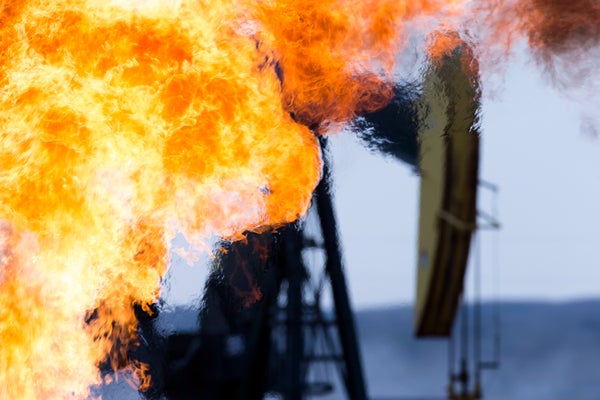
The easiest way to stem methane pollution, however, is to limit its release from oil and gas drilling sites, he said. Natural gas is mostly methane, and it is prone to leaking from wells. There are essentially two ways to deal with this problem. The first is to burn the natural gas that seeps out, which turns the methane into carbon dioxide. The second is to plug the leaks.
Companies can install recovery equipment that allows them to collect the natural gas that would otherwise seep out. They can then sell this gas, helping to offset the cost of the equipment. By one estimate, oil and gas firms could cut methane pollution by 45 percent at no net cost.
Despite this, many companies are reluctant to pay for recovery equipment. Firms will instead spend their limited capital on a new drilling site, for instance, which will yield a greater return on investment, Shindell said, though practices vary.
Major players—including Chevron, Exxon Mobil, BP and Shell—are taking steps to cap methane pollution, in part, to shore up their public image. However, smaller firms operating on thinner profit margins have less incentive to invest in recovery equipment. And the coronavirus could make the problem worse, as companies facing declining revenues could pay less attention to leaks. For this reason, advocates have called for greater regulation of the oil and gas sector.
“I think that has taken on urgency because in recent years we have witnessed a surge in production of oil and natural gas,” said Devashree Saha, a policy analyst at the World Resources Institute. “Increasing the oversight and regulation of oil and gas production is the only way to go right now.”
Methane levels were more or less flat from the late 1990s to the early 2000s. They began to rise after 2006 thanks, at least in part, to more oil and gas drilling. Their recent uptick threatens the goals of the Paris Climate Agreement, as scientists had assumed that methane concentrations would stay level and then drop off when they projected how countries would meet their climate targets. Experts say that curbing methane emissions is needed to limit warming in the short term, buying humanity much needed time to adapt to climate change.
“You see the benefits in the first decade or two that you make cuts. You see fewer people dying from heat waves. You see less powerful storms and all of the stuff that comes from climate change,” Shindell said. “As long as we’re still using fossil fuels, we should at least not be leaking out lots and lots of methane.”