
Plants have evolved an impressive range of strategies to ward off hungry, leaf-chomping insects. Well-known defenses include foul-tasting toxins, sticky resins and sharp thorns, and now scientists have identified yet another example: microscopic wrinkles that make leaves harder to walk on.
Wrinkles form in many leaves' cuticles—coatings that limit water evaporation, mediate gas exchange, and protect the plant from pathogens. The new research, published in Royal Society Open Science, finds that along with the cuticle's inherently slippery surface, its tiny wrinkles also help discourage insects. The wrinkles most likely become more pronounced as the leaf matures and its cuticle builds up, eventually expanding and buckling.
“Plants are really good at surviving,” says Dana MacGregor, a molecular botanist at Rothamsted Research in England, who was not involved in the new study. “There are excellent ways by which they can change their structure, their chemistry or their physiology to hinder herbivores from eating their leaves. This is another example of plants changing their shape to make sure they survive.”
On supporting science journalism
If you're enjoying this article, consider supporting our award-winning journalism by subscribing. By purchasing a subscription you are helping to ensure the future of impactful stories about the discoveries and ideas shaping our world today.
For the experiment, the researchers created silicone replicas of leaves from a rubber tree at various stages of development. This step let them measure the effects of the leaf's structural properties alone—without the slippery influence of the cuticle's waxy coating.
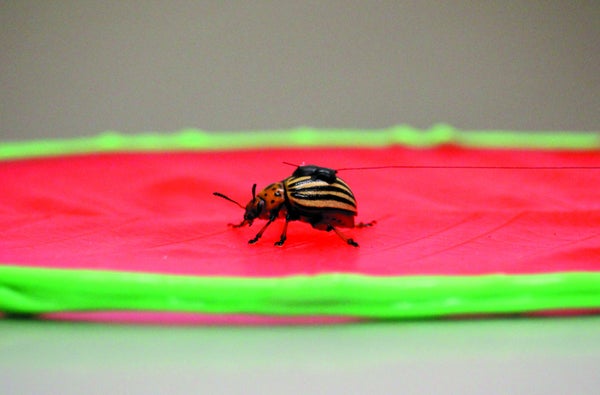
The scientists fastened minuscule sensors to the hard forewings of eight Colorado potato beetles, then measured the traction forces as the insects meandered along a synthetic leaf; the beetles walked more easily on the “younger” and smoother replicas but slipped on the “older” ones' wrinkles.
“We were surprised by the way such wrinkles developed on plant leaves, and the significant effect they had on insect attachment at different growth stages,” says Venkata A. Surapaneni, a biomechanist at the University of Freiburg in Germany and lead author on the study. Surapaneni, who is a part of a multicenter research program called PlaMatSu, is interested in developing polymers that mimic these microscopic wrinkles to produce insect-deterring surfaces. And maybe, he says, plants could be bred or engineered to have more wrinkles, possibly paving the way for reducing pesticide use in agriculture.