
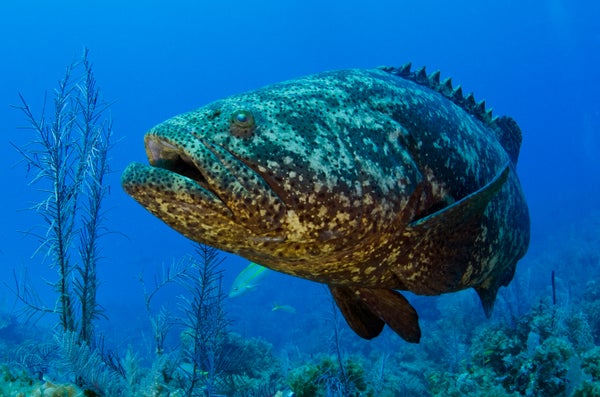
We humans often watch and wonder at wildlife. But a defense agency’s new initiative turns the tables—it aims to deploy marine animals to keep an eye on human activity.
The agency wants to know if sea life ranging from bioluminescent plankton to goliath grouper can serve as components of underwater surveillance systems capable of detecting the enemy’s oceangoing drones, large nuclear submarines and other underwater vehicles. The research effort is called Persistent Aquatic Living Sensors (PALS).
Many marine animals respond audibly or visibly to sound, optical, electromagnetic and chemical shifts in the water around them. For instance, schools of black sea bass change their behavior when disturbed by underwater vehicles, and certain microbes react to the magnetic signatures of submarines. Existing surveillance technology can pick up this behavior but typically has treated it as background noise.
On supporting science journalism
If you're enjoying this article, consider supporting our award-winning journalism by subscribing. By purchasing a subscription you are helping to ensure the future of impactful stories about the discoveries and ideas shaping our world today.
“The PALS program was developed to leverage the great sensitivity that organisms have in the ocean to changes in their environment,” says Lori Adornato, manager of the initiative, which is administered by the federal Defense Advanced Research Projects Agency (DARPA).
Sonar is the conventional approach to underwater surveillance. However, adversaries can detect those pings as well. And sonar sensors are expensive, laborious to install and prone to being corroded or encrusted with organisms. Some must even remain close to ship or shore to reach power sources. So, the Navy primarily uses underwater surveillance to protect high-value assets, such as ports and aircraft carriers.
In contrast, living organisms are self-powered and can sense visual, magnetic and chemical cues as well as sounds. “This gives you a lot more flexibility in how you would observe things in the ocean,” says Adornato. Plus, these sensors are already “installed” throughout the seas, with each generation naturally replacing the previous one. All these features make ocean life ideal agents for continuous, long-term surveillance. “By taking advantage of organisms, you can then look at persistence and wide-scale coverage as opposed to using one single sensor that does the whole job,” says Adornato.
At least two challenges come with leveraging living organisms for maritime monitoring. First, DARPA will need detectors to pick up on the relevant animal behavior. Those detectors could face the same problems that trouble conventional sensors. Second, “you have to have some understanding of animal behavior, and that’s always a huge wild card,” says Kim Martini, a physical oceanographer based in Seattle, who is not part of the initiative.
To see what is possible, DARPA has started to grant a total of $45 million to five research teams, each studying a specific marine organism and its responses to underwater vehicles. Researchers will use some combination of hydrophones, sonar, cameras and other sensors to study and record the organisms’ behavior. They then will analyze the data to screen out false positives. Finally, the teams will develop technology that can relay signals back to the military.
A group led by Laurent Chérubin, a physical oceanographer at Florida Atlantic University’s Harbor Branch Oceanographic Institute, will use PALS funding to record and analyze the noises made by goliath grouper. These territorial fish, which can grow up to 8.2 feet in length and weigh up to 800 pounds, are known to make distinct low-frequency “booms” when divers approach them. Researchers suspect the boom is a distress call made in response to all kinds of intruders, including underwater drones and submarines.
To test this theory, Chérubin and his colleagues will become well-acquainted with every facet of the species’ behavior, bringing to light never-seen behaviors, says Chérubin. The work will begin with captive fish before moving on to goliath grouper in natural habitats to see if any behaviors only occur in the wild.
Alison Laferriere, an oceanographic engineer at Raytheon BBN Technologies, will lead a team of biologists focusing on snapping shrimp. Only a few centimeters long, snapping shrimp are one of the loudest marine organisms, producing 200-decibel popping noises that Laferriere likens to the sizzle of frying bacon. The pops travel for long distances, so they could strike enemy vehicles and bounce back to sensors, much like sonar does. “It has the potential to detect even the quietest vehicles that might be there,” says Laferriere.
Laferriere is excited that her PALS project also will contribute to basic research. While listening to the collective shrimp sounds of the ocean, her teams also will monitor habitat health and biodiversity. And they’re breaking new ground; no one has studied how snapping shrimp react to the presence of an underwater vehicle and how that affects the overall soundscape, she says.
Other teams will use cameras and machine learning to look for useful patterns in the responses of bioluminescent organisms to underwater vehicles. All of the researchers are expected to publish their findings, at least the unclassified ones, in the next several years. And when they do, we can listen in too.