
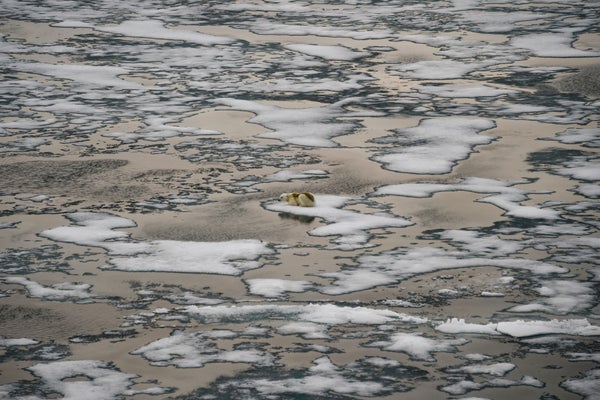
The Arctic is warming at a rate of about two to four times that of the global average. As polar ice caps melt and permafrost thaws, scientists are scrambling to keep tabs on the changing region and its effects on the rest of the planet. Their research often entails formidable challenges—from harsh environments to polar bears that destroy instruments—but now they face an additional obstacle: a virtual lack of data from Russia.
Russia accounts for almost half the land in the Arctic. But ever since the country invaded Ukraine, global collaborations with Russian scientists have ground to a halt, and Russian field stations have become off-limits to most foreign researchers. A study published this week in Nature Climate Change confirms that should these trends continue, scientific understanding of the changing Arctic will significantly deteriorate.
The biases in the numbers that depict the Arctic’s climate after subtracting the Russian data could be as dramatic as the effects that climate change itself is expect to cause by 2100, says lead study author Efrén López-Blanco, an Arctic ecosystem modeler at Aarhus University in Denmark. “This is another collateral damage of this conflict.”
On supporting science journalism
If you're enjoying this article, consider supporting our award-winning journalism by subscribing. By purchasing a subscription you are helping to ensure the future of impactful stories about the discoveries and ideas shaping our world today.
López-Blanco and his colleagues used data for their study from 60 of 94 International Network for Terrestrial Research and Monitoring in the Arctic (INTERACT) sites, the largest network of research stations in northern latitudes. Nearly one third of the 60 stations they selected were located in Russia, and all were above 59 degrees north latitude, just below Greenland’s southern tip. The researchers excluded stations located on Greenland’s ice sheet, however, because it is not a typical terrestrial ecosystem.
They used a suite of computer models developed by the Intergovernmental Panel on Climate Change to assess how well eight ecosystem variables—including temperature, precipitation and snow depth—could be represented across the Arctic from 2016 to 2020 and from 2096 to 2100, both with and without inclusion of the 17 Russian stations.
The researchers’ analysis revealed existing knowledge gaps across the entire Artic domain, even when all of the stations were included. This is probably because more of the stations are located in relatively wet, warm places with less dense vegetation. “Basically, it takes quite a lot of effort to gather information in harsh, remote environments, so the data is quite limited, unfortunately,” López-Blanco says. “We don’t have coordinated or standardized data sets across the entire region.”
The findings also showed that when data from the Russian stations were excluded, biases significantly increased in key ecosystem variables—which decreased scientists’ ability to describe Arctic changes accurately.
According to Hiroyuki Enomoto, vice director-general of Japan’s National Institute of Polar Research, who was not involved in the work, the new study shows that it will not be possible to obtain a full picture of climate change’s effects in the Arctic without cooperation from Russia.
While this situation was something the scientific community already suspected, he says, having a “concrete analysis” to confirm it “is highly desirable.”
Kim Holmén, a climate and environment scientist at UiT the Arctic University of Norway, who was not involved in the research, says that the “stringent” new paper portends an “even more dramatic erosion” of other fields of Arctic science, especially ones that have less systematic coverage than terrestrial ecosystems or more of a reliance on Russian observations. This could include research on marine biology, river ecosystems and oceanography—“not to mention social sciences and humanities, without which we are left ignorant about human fates in the Russian Arctic,” Holmén says.
“To understand what is happening in the Arctic, we need detailed long-term monitoring from all facets of this heterogenous and complex environment,” he adds. “The lack of Russian data is a great loss for humankind and our ability to discover change and, in extension, build knowledge that allows robust prediction of future change.”