
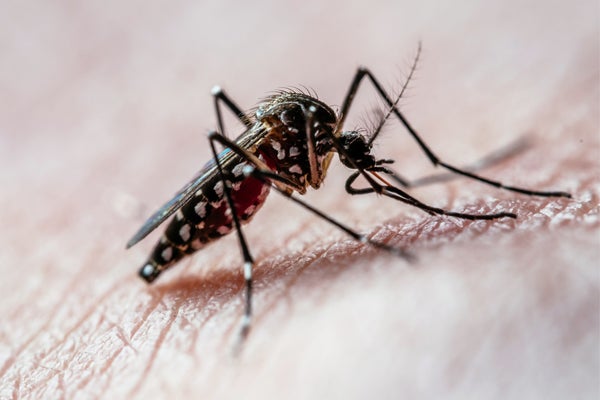
A pair of hormones work in tandem to activate or suppress mosquitoes’ cravings for blood, according to a study published today.
The findings reveal a possible mechanism for what drives mosquitoes’ attraction to people and other animals, which has remained a mystery until now. “The discovery could provide new pesticide targets for preventing mosquito reproduction and disease transmission,” says Zhen Zou, an entomologist at the Chinese Academy of Science’s Institute of Zoology in Beijing.
The females of most mosquito species — including Aedes aegypti, the carrier of the viruses that cause dengue fever, yellow fever and zika — feed on animal blood for the development of their eggs. But once they’ve eaten a blood meal, their appetite for blood shuts down until after they lay their eggs.
On supporting science journalism
If you're enjoying this article, consider supporting our award-winning journalism by subscribing. By purchasing a subscription you are helping to ensure the future of impactful stories about the discoveries and ideas shaping our world today.
Michael Strand, an entomologist at the University of Georgia in Athens, wanted to better understand the mechanism that controls this cycle of attraction. He noticed that the levels of a hormone produced in the insect gut called neuropeptide F (NPF) spiked when mosquitoes were seeking a host and disappeared after they feasted on blood. “That motivated us to look at whether this hormone’s presence was a driving factor in seeking a blood meal,” says Strand.
With his colleagues, Strand analysed mosquito enteroendocrine cells, which produce hormones in the gastrointestinal tract. As expected, NPF levels skyrocketed before mosquitoes had a blood meal and fell six hours after they fed. The mosquitoes’ attraction to humans matched this hormonal swing: they showed no interest in a human hand on the day of their meal, but made a beeline for it after they had laid their eggs. “There was this almost perfect mirror image,” says Strand.
Next, the researchers knocked down the gene that produces NPF in female mosquitoes and found that it reduced their attraction to humans. When they injected the hormone into these mutant mosquitoes, it restored their interest in humans but had little effect on mosquitoes that were carrying eggs.
The team also found that certain neurons that reach into the gut produced another hormone called RYamide, which regulates feeding behaviour in insects. Just as NPF levels dropped after a blood meal, RYamide levels increased. In mosquitoes without eggs, an injection of RYamide reduced their NPF levels and suppressed their attraction to human hosts, whereas the control mosquitoes — with natural hormone levels — zipped towards a human hand. This suggests that NPF and RYamide work together to stimulate and suppress host attraction in mosquitoes.
Strand and his colleagues plan to investigate other molecular factors that are involved in host attraction to build a more complete picture. “Life is never simple,” he says.
This article is reproduced with permission and was first published on July 1, 2024.