New Issue: Orbital Catastrophe Ahead? Read Now

Mosquitoes Show a Clear Preference for Human Blood after Deforestation

Mosquitoes captured in the remnants of the Atlantic Forest in Brazil predominantly feasted on humans instead of other animals, a new study shows

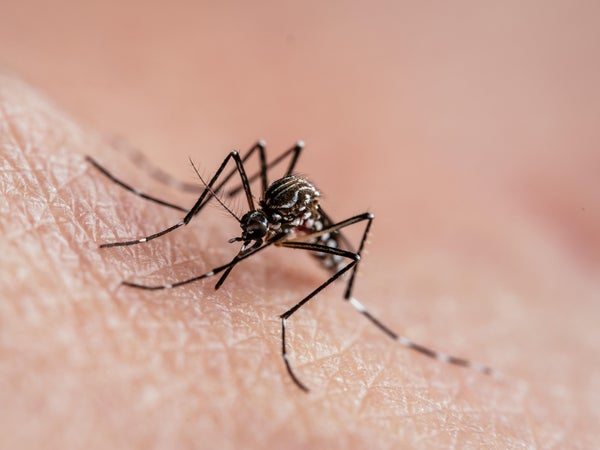
Macro of a yellow fever mosquito (Aedes aegypti) sucking blood from human skin

João Burini

Join Our Community of Science Lovers!

Mosquitoes are nature’s opportunists. They will eat anything from plant nectar to blood from chickens, rats, alligators, frogs—and, of course, humans. And now a new study finds that when humans encroach on wild places, these insects may develop a special taste for human blood above all other food sources.

Researchers in Brazil analyzed blood samples from mosquitoes collected in nature reserves in the Atlantic Forest, a heavily deforested region of Brazil. Several of the collected species showed “a clear preference for feeding on humans,” said Jeronimo Alencar, a biologist at the Oswaldo Cruz Institute in Brazil and an author of the paper, in a statement.

The findings jibe with previous evidence that deforestation brings humans in more contact with creatures that spread deadly diseases. Mosquitoes can transmit Zika, dengue fever, malaria and encephalitis, to name a few illnesses—all of which are harmful to human health and can kill.


On supporting science journalism

If you're enjoying this article, consider supporting our award-winning journalism by subscribing. By purchasing a subscription you are helping to ensure the future of impactful stories about the discoveries and ideas shaping our world today.


The findings were published on Thursday in Frontiers in Ecology and Evolution.

According to the researchers, the Atlantic Forest supports about 270 mammalian species, 850 kinds of birds and about 570 reptiles and amphibians. The forest once spanned 1.3 million square kilometers across Brazil—an area larger than Texas and California combined. But it has been reduced to less than a third of that size by agricultural and residential development.

The study has several limitations. For one, it only analyzed blood from 145 female mosquitoes, and not all these samples could be identified, so it’s unclear how broadly the results can be applied. It’s also unclear how mosquitoes’ preferences have changed since the Atlantic Forest was fully intact.

Still, the study could help researchers better understand the complex relationship between deforestation and disease. Humans eliminate about 10 million hectares of forest per year. “Deforestation reduces local biodiversity, causing mosquitoes, including vectors of pathogenic agents, to disperse and seek alternative food sources,” the authors write. And those sources, it turns out, may be us.

Jackie Flynn Mogensen is a breaking news reporter at Scientific American. Before joining SciAm, she was a science reporter at Mother Jones, where she received a National Academies Eric and Wendy Schmidt Award for Excellence in Science Communications in 2024. Mogensen holds a master’s degree in environmental communication and a bachelor’s degree in earth sciences from Stanford University. She is based in New York City.

More by Jackie Flynn Mogensen

Subscribe to Support Independent Journalism

Great science journalism requires human expertise, time, effort and creativity. And it costs money. That’s why I and the journalists here at Scientific American hope you’ll join our community.

When you subscribe, you are supporting staff and freelance journalists who are passionate about telling science stories that are true, important and compelling. Our editors and reporters are often experts in their fields, which means they understand the nuances of big discoveries and can untangle the breakthroughs from the hype. With a subscription, you are also supporting rigorous fact-checking to ensure the words we publish are precise and accurate. And you’re supporting original illustrations, graphics and photos that bring you closer to an advanced laboratory, an ice sheet in Antarctica or a space mission in orbit. You’re helping us craft other types of high-quality journalism as well: Our newsletters are carefully written, edited and curated by staffers you have or will come to know and love. Our Science Quickly podcast is based on original reporting, collaboration with editors and scientists and exacting production.

Subscriptions keep this engine running so we can continue to deliver thoughtful, rigorous and independent science journalism to you. In an era of viral misinformation, this work is crucial. If you value what we do, I hope you’ll consider joining us as a subscriber

Thank you,

Jeanna Bryner, Editor in Chief, Scientific American

Subscribe