
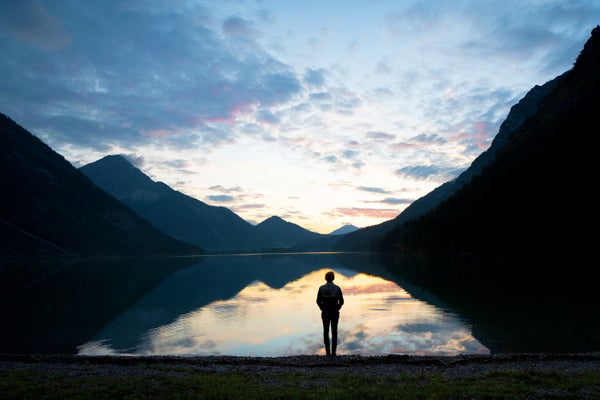
The designation “mountain man” conjures an image of a rough, bearded, possibly grimy white man living ruggedly and adventurously amid trees, snow, deer and the occasional bear. Although most people who live in the U.S.’s mountain states today do not reflect this narrow, stereotypical extreme, the peaks that surround them may shape personality traits that resonate with the persona.
Findings published in Nature Human Behaviour on September 7 suggest that mountainous landscapes may promote openness to new experiences among the people who live in them. But the authors also reported that denizens of the slopes scored lower for other traits, such as agreeableness and extraversion—in keeping with the stereotype of the laconic individualist that has often been portrayed in Westerns. The spirit of adventure seems to come with an embrace of solitude and isolation, all traits that may help adaptation to these harsh environments.
Although the results seem to confirm that mountains can shape some aspects of a “mountain adventurer,” the impact—what researchers call the effect size—for any one individual might be small, says the study’s first author Friedrich Götz, a Ph.D. candidate and psychologist at the University of Cambridge. Not every single person living along the Colorado Front Range is a wild-haired, adventurous loner. But mountains may draw out these traits to different degrees in people who live there, creating a sort of broad regional tendency. Even if the effects are relatively small, Götz says, this geographical influence could “scale up to produce consequential outcomes on the regional level.”
On supporting science journalism
If you're enjoying this article, consider supporting our award-winning journalism by subscribing. By purchasing a subscription you are helping to ensure the future of impactful stories about the discoveries and ideas shaping our world today.
The exploration of the “frontier” mystique in the western U.S. needs to be revisited in other mountainous settings before making broader statements about whether “physical topography is associated with personality,” says Michele Gelfand, a distinguished university professor in the department of psychology at the University of Maryland, who was not involved in the study.
Gelfand also raises the question of whether the findings apply primarily to the U.S. and its “loose and individualistic culture.” For example, the study results suggested that mountains might underlie lower scores for conscientiousness, a measure of conformity. If researchers were to look at Switzerland, which is more close-knit and collectivist in its culture, they might find that “conscientiousness is higher in mountainous regions” there, she says.
To examine the relationship between mountain living in the western U.S. and personality, Götz and his colleagues used self-reported data for about 3.39 million people aged 10 to 99 distributed across 37,227 zip codes in the 48 contiguous states, Alaska and Washington, D.C. Almost three quarters of the respondents were white.
The investigators evaluated the “mountainousness” of the zip codes using both elevation and change in elevation. And they looked at the commonly used “big five” markers of personality traits: agreeableness (trust and altruism), conscientiousness (responsibility and adherence to social rules), extraversion (sociability), neuroticism (anxiety or emotional instability) and openness to experience (curiosity and creativity). Then they compared how topography and these personality traits tracked with each other.
The team found that mountains tend to draw out openness to new experiences, emphasizing people’s tendencies toward originality and adventurousness. But they seem to decrease the other four traits.
Even though the “opening of the West” is long past—at least in terms of European settlement of lands taken from Native Americans in the region—its rugged mountains have “acquired a unique sociocultural meaning” that has lingered even as they have ceased to be the “frontier,” Götz says. That persistent mystique and cultural legacy may still influence people even in the 21st century.
Götz is careful to emphasize that mountains’ effect on personality is only one of many factors that shape broadly regional traits. Just as many gene variants can contribute to who we are, several influences, including “mountainousness,” act in concert to shape personality.
People living in cities might also embrace openness as a personality trait but with more of a social emphasis, Gelfand observes. “In cities, this trait may be adaptive because you are constantly meeting new people, and there are many weak ties and social networks,” she says. So “while mountainous regions may be also high on openness, that could be for different reasons.”
Although the big five personality construct is useful, it is “not without flaws” and may not “yield perfectly comparable results across cultures,” Götz says. Given the study’s focus on the sociocultural constructs around settlers moving west across the American landscape, the “cross-cultural generalizability remains an open question,” he says. It’s a question he and his colleagues intend to pursue, examining cultures with populated mountain areas but without the colonialist American frontier legacy.
Because the effects of mountainousness are consistent but small, many other factors need to be assessed as candidates for shaping personality. The big data sets and machine-learning approaches Götz and his colleagues used are excellent tools to search for these small but important factors. Götz says that sorting through the massive amounts of information “will be a long and tedious journey,” not unlike an adventurous trek westward.