
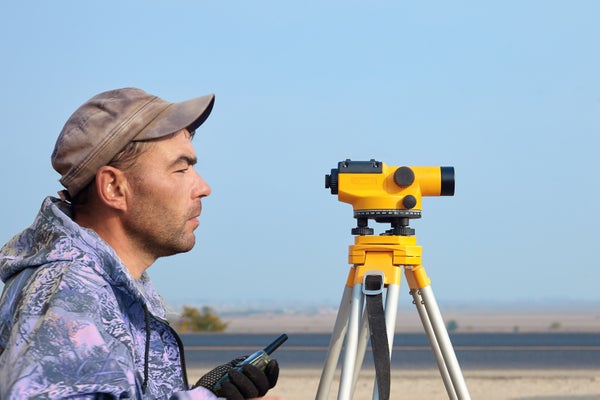
In 2023 every U.S. land surveyor will finally be on equal footing. One kind of foot, specifically: the “international foot.” These engineers have long measured land with two versions of the unit, depending on which state they are in and whom they work for. To eliminate the resulting confusion, surveyors will soon stop using what is called the “U.S. survey foot” and use only the international version.
The two are nearly identical—dividing one by the other provides a ratio of 0.999998. But over long distances, such minuscule differences add up and can cause big problems. Every building in the U.S. sits on specific GPS coordinates, which are typically rendered and documented in meters. When mapping property or construction plans, surveyors convert those meters to feet. If they use an unexpected type of foot, future engineers referencing those maps might install or look for infrastructure in the wrong place.

Credit: Amanda Montañez; Source: NOAA’s National Geodetic Survey
On supporting science journalism
If you're enjoying this article, consider supporting our award-winning journalism by subscribing. By purchasing a subscription you are helping to ensure the future of impactful stories about the discoveries and ideas shaping our world today.
“It's kind of a mess,” says Michael Dennis, the National Geodetic Survey project manager overseeing the transition. Most engineering projects in the U.S. have used the international foot since 1959, but land surveys—which map boundaries and infrastructure locations—use whichever foot an organization or state wants. (The international foot is exactly 0.3048 of a meter, whereas the U.S. survey foot, 1200/3937 of a meter, has an unending decimal.) This means that anyone working in multiple U.S. locations or with different agencies must keep careful track of which foot is in use. A recent poll of 530 attendees of a National Geodetic Survey Webinar, who were mostly surveyors, found that 62 percent blamed confusion between the two feet for problems in their work.
Bungled math is common in trying to interpret others' measurements, says Brian Fisher, a registered land surveyor in Arizona: “I've seen it dozens or hundreds of times in my career.” Fortunately, he adds, “it's not an error until you build it.” But Dennis notes that this does happen, citing an engineer's account of a building that was constructed near a landing strip—and had to lose its top floor at the last minute to avoid obscuring the planes' glide path, which had been calculated with a differing type of foot.
The official announcement of the impending change is slated for the end of June, and the public has been given a chance to weigh in on the mandate. Some people have expressed support; others warn it may cause even more confusion, and a few suggest U.S. surveyors just embrace the metric system. “We really wanted people to go metric,” Dennis says, “but that's a different kind of battle.”
Editor’s Note (5/26/20): The graphic in this story was amended to correct the key indicating which states use the “international foot” or “U.S. survey foot.”