
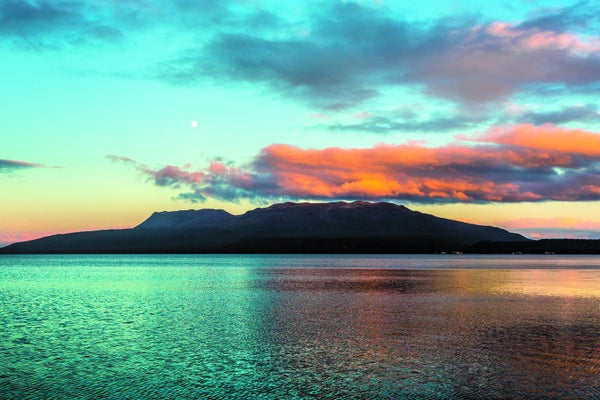
Volcanoes that are thought to be mild-mannered, releasing steady lava flows, can sometimes erupt explosively without warning—as New Zealand's Mount Tarawera did in June 1886, causing widespread damage and death. Geologists have long wondered why volcanoes make this sudden and dangerous transition, says earth scientist Danilo Di Genova of the University of Bayreuth in Germany.
Di Genova and his colleagues propose in Science Advances that such a catastrophic switch may begin with crystal grains called nanolites, which can form in rising magma and are only about 1/100th the size of an average bacterium. The researchers say these grains make magma more viscous, preventing volcanic gases from escaping the molten rock. This builds up pressure, setting the stage for a violent explosion.
Using electron microscopy and spectroscopic imaging tools, the scientists found nanolites in the ashes of active volcanoes, including Mount Etna in Italy and Tambora in Indonesia.
On supporting science journalism
If you're enjoying this article, consider supporting our award-winning journalism by subscribing. By purchasing a subscription you are helping to ensure the future of impactful stories about the discoveries and ideas shaping our world today.
The team then examined how nanolites form in a comparatively runny type of magma that becomes basalt when it cools. Such low-viscosity magma usually allows gases to escape easily, leading to smooth lava flows. The researchers produced nanolites in the laboratory by melting basalt and then cooling it rapidly. The cooling process is critical: during eruptions, magma loses heat as it rises toward the top of a vent. The study found nanolites will form only if the heat loss rate is just right, Di Genova explains.
“Magma is a multicomponent system, mainly made by silicon and oxygen,” Di Genova says. “It has other elements such as aluminum, calcium and iron, the last of which seems to be the most important element in forming nanolites.” Most of the nanolites are iron oxide crystals with traces of aluminum, he adds. And because iron is found in all magmas, such crystals can form in various magma types.
Next the researchers created an artificial magma to show that nanolites boost viscosity. They used silicon oil (which is as viscous at room temperature as basalt magma is during an eruption), adding glass spheres to mimic nanolites in shape and size. The team found that even at relatively low concentrations nanoparticles tend to clump together, disrupting the free flow of the liquid. In a real volcano, this sudden increase in the magma's viscosity would trap bubbles of escaping gas. Eventually enough pressure would build to push out blobs of magma all at once rather than in a steady stream—resulting in an explosion.
“This is an exciting study that addresses a question we have had for a long time,” says Columbia University geologist Einat Lev, who was not involved in the new research. “It will be important and challenging to figure out how to incorporate this information in future volcanic models.”