
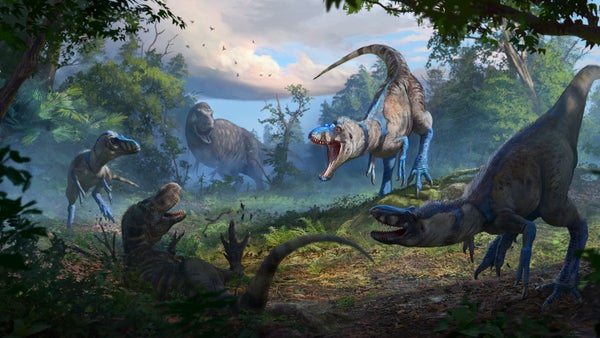
For more than three decades, paleontologists have argued over whether a lithe predatory dinosaur called Nanotyrannus ever really prowled Cretaceous North America—or whether the bones that some researchers attributed to the creature instead belonged to teenage examples of Tyrannosaurus rex that were still growing into their monstrous frame. A new study in Nature may have finally settled the score in favor of Nanotyrannus based on an analysis of Montana’s striking “Dueling Dinosaurs” fossil, discovered in 2006. The fossil shows a triceratops entwined with a small tyrannosaurlike dinosaur, both with significant injuries.
“Simply put, the Dueling Dinosaur Nanotyrannus is fully grown at half the length and one tenth the body mass of a mature T. rex,” says study co-author Lindsay Zanno, a paleontologist at North Carolina State University. “There is no scenario in which this animal morphs into a T. rex.” She explains that Nanotyrannus must have been a smaller, sleeker predator that hunted alongside Tyrannosaurus.
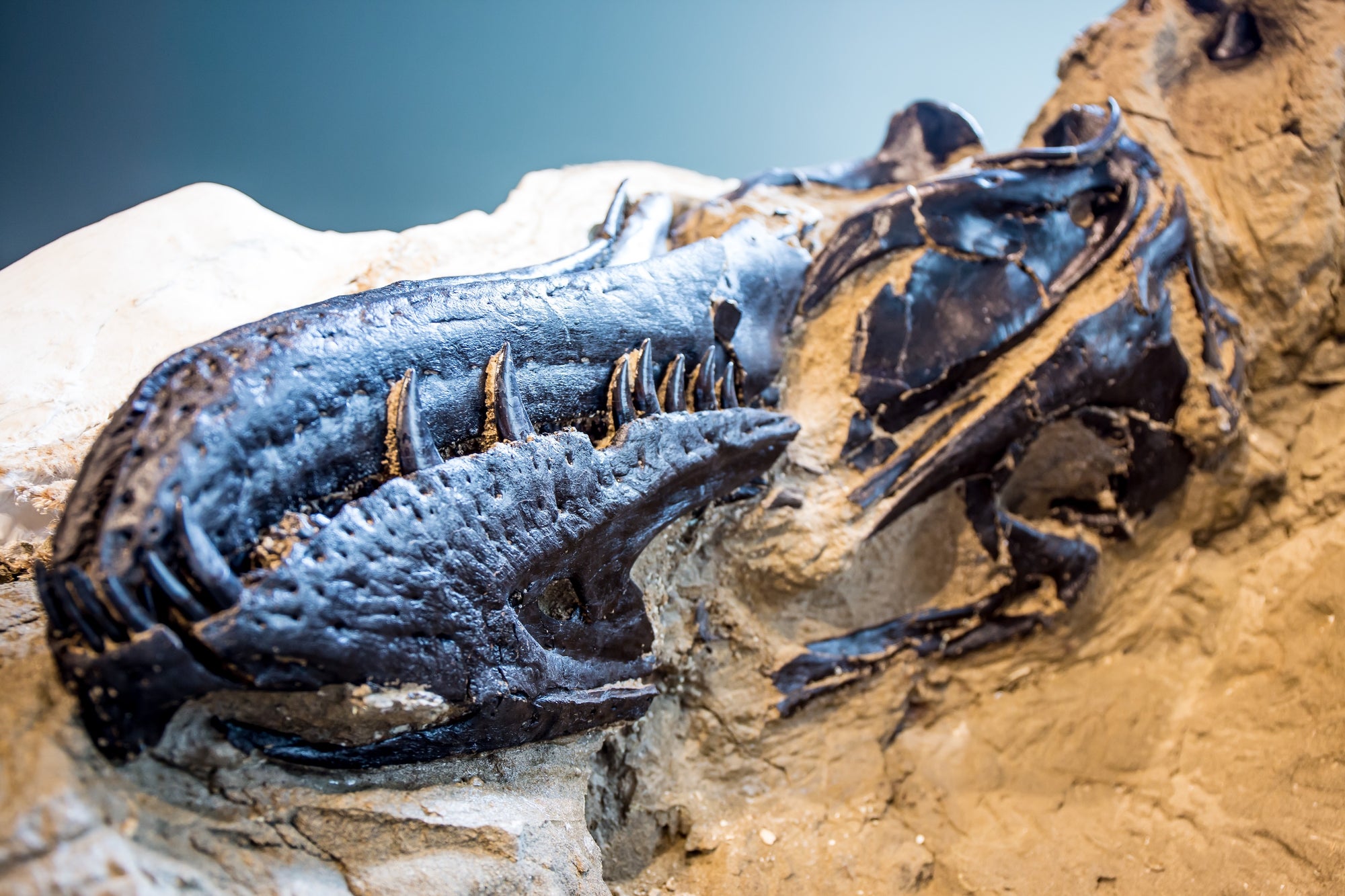
Skull of Nanotyrannus lancensis.
North Carolina Museum of Natural Sciences (CC BY-NC-ND)
On supporting science journalism
If you're enjoying this article, consider supporting our award-winning journalism by subscribing. By purchasing a subscription you are helping to ensure the future of impactful stories about the discoveries and ideas shaping our world today.
The most definitive evidence comes from a microscopic feature called an external fundamental system—a series of tightly packed growth rings in bone—that suggests the fossilized animal had finished growing, explains study co-author James G. Napoli, a paleontologist at Stony Brook University. Zanno and Napoli argue this confirms Nanotyrannus as a distinct genus alongside T. rex in the ecosystem of the fossil-rich Hell Creek Formation site in Montana, which spanned the last million years of the Cretaceous.
Using high-resolution scans, the team also found the Nanotyrannus skull contained more tooth sockets than a T. rex of any age and different routes for cranial nerves and sinuses than T. rex exhibits. These features would have been established early in embryonic development and remain fixed for life.
The researchers conducted a computer-based evolutionary analysis, which positioned Nanotyrannus in a new clade just outside the T. rex line. This clade, called Nanotyrannidae, may have originated in eastern North America.
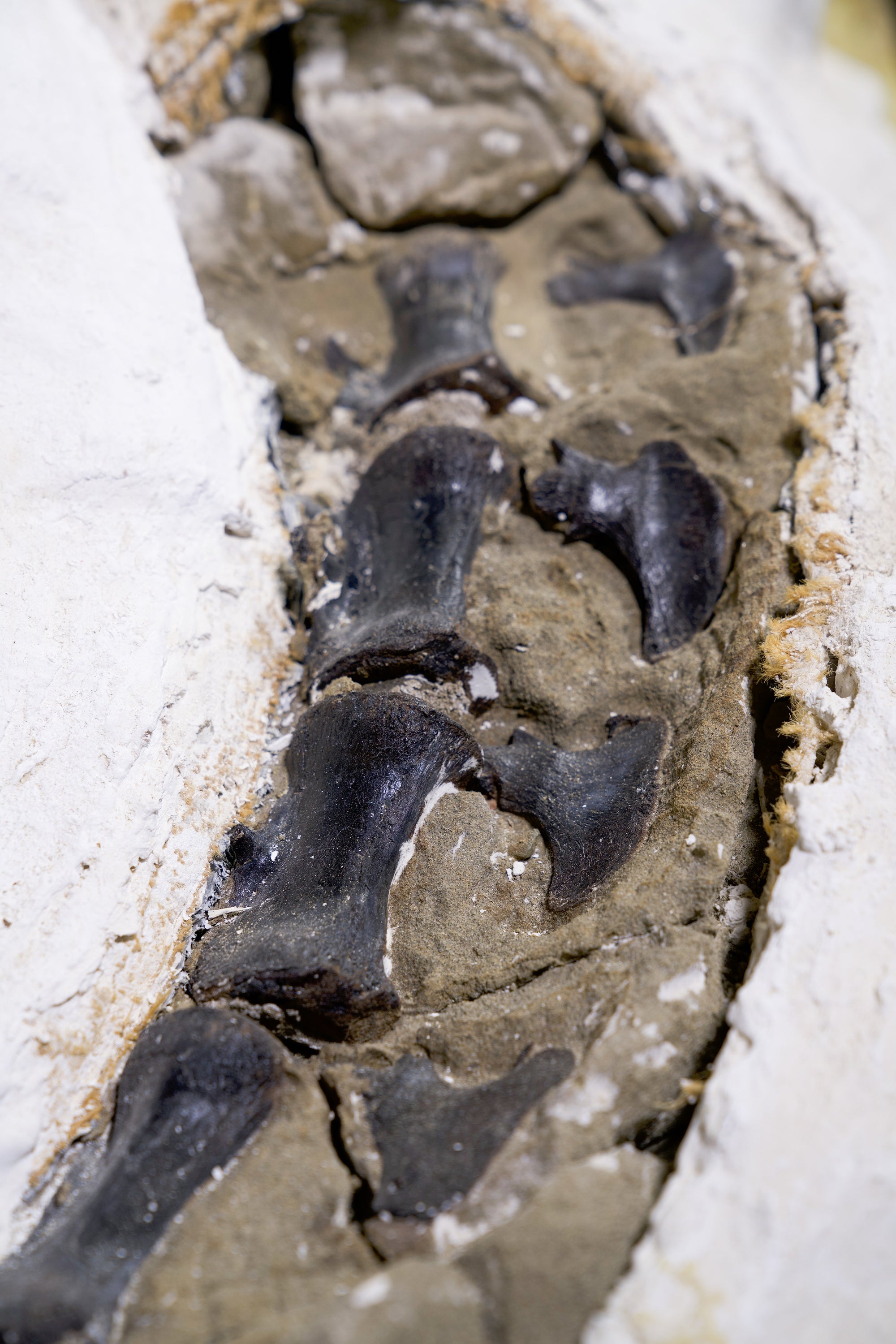
The N. lancensis specimen from the Dueling Dinosaurs fossil included the first complete tail of the Nanotyrannus genus to be found.
North Carolina Museum of Natural Sciences (CC BY-NC-ND)
Additionally, the team compared the Dueling Dinosaurs specimen with two earlier finds that were also made in Montana’s Hell Creek Formation—a skull unearthed by a team from the Cleveland Museum of Natural History (CMNH) that first defined Nanotyrannus and a fossil called “Jane” that was discovered by a team from the Burpee Museum of Natural History. In doing so, Zanno and Napoli formalized the names of these specimens: They confirmed the Dueling Dinosaurs fossil represented the same species as the CMNH skull, which was named Nanotyrannus lancensis in 1988. And they described Jane as a new species, Nanotyrannus lethaeus.
That picture builds on hints noted decades ago by paleontologist Philip J. Currie, who co-authored the 1988 paper that first named Nanotyrannus. Currie says he still points to Nanotyrannus’s higher tooth counts as a definitive difference from T. rex. Thomas R. Holtz, Jr., a paleontologist at the University of Maryland, who was not part of the new paper, observes that such pairing isn’t unprecedented—Asia’s tyrannosaur Tarbosaurus lived beside the smaller tyrannosaur Alioramus, with the two splitting the menu between giant and fleet-footed prey.
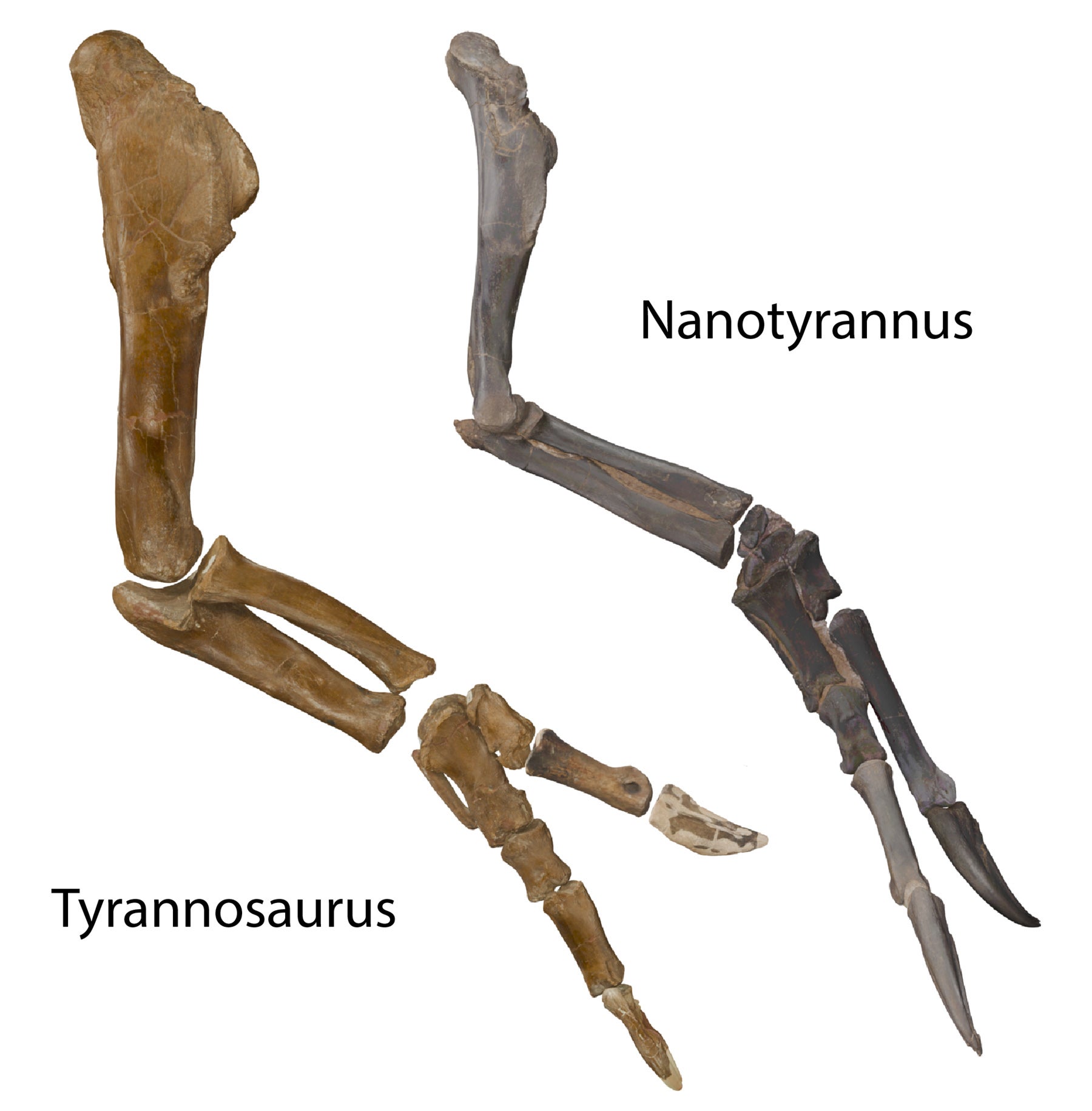
A comparison of the arms of Nanotyrannus and T. rex.
North Carolina Museum of Natural Sciences (CC BY-NC-ND)
Long-time advocates of the juvenile T. rex hypothesis, though acknowledging the strong evidence in the new paper, aren’t yet ready to rewrite the family tree of T. Rex and its kin. Stephen Brusatte, an evolutionary biologist at the University of Edinburgh, who was not involved in the study, asks, “If every small skeleton is Nanotyrannus, where are the juvenile T. rexes?” Paleontologist Thomas Carr of Carthage College, who was also not part of the research, argues that skeletal maturity alone doesn’t define a species. Without more small T. rex fossils, he says, distinguishing growth from evolution remains difficult.
Nevertheless, Nanotyrannus adds a fresh dimension to the final days of the dinosaurs. Rather than a one-species monopoly under T. rex, the Hell Creek landscape may have hosted a tiered guild of hunters. Zanno calls the next challenge “a completely new question” for research on tyrannosaurs and their relatives: understanding how Nanotyrannus and Tyrannosaurus coexisted, avoided competition and shaped the evolution of their prey. Napoli says the findings challenge decades of interpreting these littler dinosaurs as juvenile T. rexes. “Now that we’ve corrected the record on Nanotyrannus, we think it’s possible that other smaller tyrannosaur fossils are misidentified and that there may be many more species awaiting recognition.”