
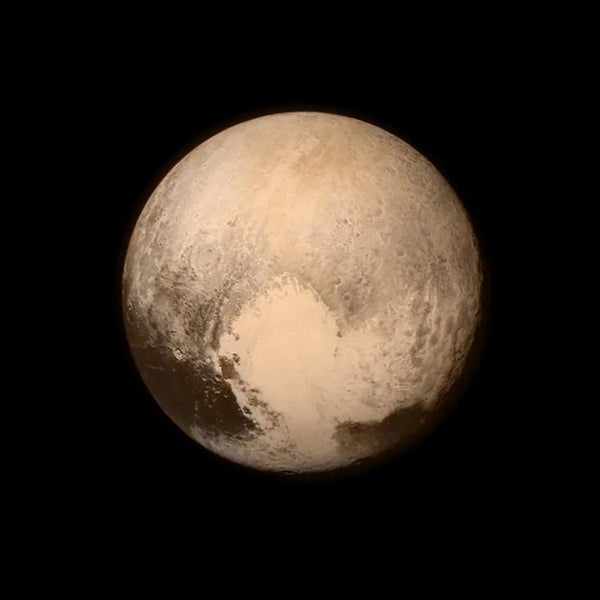
Could Pluto be repromoted to planetary status? On Tuesday NASA administrator Jared Isaacman told a Senate committee hearing that he is “very much in the camp of make Pluto a planet again.” NASA is currently working on scientific papers on “a position that we would love to escalate through the scientific community to revisit this discussion," he added.
Pluto was originally classified as a planet after its discovery in 1930. But changes to the consensus definition of a planet led to the International Astronomical Union (IAU)—the world’s largest professional organization for astronomers—downgrading Pluto to the status of dwarf planet in 2006. The move fueled heated debates among astronomers as to what, exactly, a planet is.
The conversation has reignited after people close to President Donald Trump, including Elon Musk, suggested he could upgrade Pluto to planetary status through an executive order.* That’s not how planets or other celestial bodies are classified, however; instead the IAU is the field’s ultimate authority on naming objects in space and setting astronomical standards, such as what a planet is. It’s unclear what new scientific studies NASA may be undertaking on the dwarf planet. NASA did not immediately respond to a request for comment.
On supporting science journalism
If you're enjoying this article, consider supporting our award-winning journalism by subscribing. By purchasing a subscription you are helping to ensure the future of impactful stories about the discoveries and ideas shaping our world today.
In the same Senate testimony, Isaacman also said the space agency’s upcoming Nancy Grace Roman Space Telescope could launch a month ahead of schedule. Currently, NASA is anticipating a launch this September.
“We’re not nailing down the date specifically, but you may, in the near future, be adjusting your marks to talk about Nancy Grace Roman launching in perhaps August instead of September,” Isaacman said. The telescope is designed to reveal new details about mysterious forces such as dark energy, planets beyond our solar system, and more. Isaacman noted that it will also be a key stepping stone in scouting potentially habitable worlds. He also committed the agency to launching the planned Space Reactor-1 Freedom mission to Mars in 2028. The mission would mark the first test of using nuclear fission to power an interplanetary spacecraft.
While the space agency head received bipartisan congratulations for the success of the recent Artemis II mission to the moon, Isaacman fielded questions from Democrats on the committee about his vocal support for Trump’s budget proposal for the coming fiscal year, which would cut funding to NASA’s science program by 46 percent. Senator Chris Coons of Delaware pointed to a line item that would entirely axe funding to NASA’s Office of STEM Engagement, which offers students opportunities to move towards science, technology, engineering and mathematics (STEM) careers through grants, fellowships and other programs.
Isaacman defended that decision, saying that “every one of the components that’s in that office is also funded through the mission directorates. So we have internship programs we have grant funding to universities in every one of the mission directorates.”
Editor’s Note (4/30/26): This sentence was edited after posting to correct the description of people suggesting that Donald Trump could change Pluto’s status via an executive order.