New Issue: Orbital Catastrophe Ahead? Read Now

NASA Commits to Plan to Build a Nuclear Reactor on the Moon by 2030

The U.S. space agency and the Department of Energy will work together to build a fission reactor on the lunar surface in the next four years

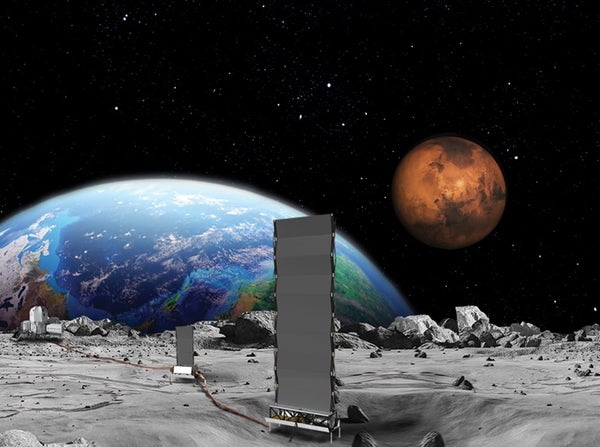
Concept image of a nuclear device on moon, with Earth and Mars in the background

A 2024 concept image of NASA’s fission surface power system for the moon.

NASA

Join Our Community of Science Lovers!

The moon is going nuclear. On Tuesday NASA and the U.S. Department of Energy announced a commitment to build a fission reactor on the lunar surface.

NASA has been exploring nuclear power for the moon for years, but the endeavor got a boost late last year in an order from President Donald Trump to build one to ensure “American space superiority.”

The reactor will be capable of operating “for years without the need to refuel,” according to NASA. It will provide power for the agency’s Artemis program, which seeks to establish a long-term human presence on the moon—and eventually Mars.


On supporting science journalism

If you're enjoying this article, consider supporting our award-winning journalism by subscribing. By purchasing a subscription you are helping to ensure the future of impactful stories about the discoveries and ideas shaping our world today.


“America is committed to returning to the Moon, building the infrastructure to stay, and making the investments required for the next giant leap to Mars and beyond,” said NASA Administrator Jared Isaacman in a statement.

Nuclear power may be an ideal fuel source in the sometimes dark, cold moon environment. While many lunar landers are equipped with batteries and solar panels to keep them running for the length of their mission, they ultimately run out of fuel—either because of a lack of sunlight as the moon turns on its axis or because their batteries die.

The space agency’s partnership with the DOE could help speed NASA’s efforts to build moon-ready reactors. Aside from any technical hurdles, putting a nuclear reactor on the moon will require a significant amount of engineering to make sure it works as desired on the lunar surface.

Jackie Flynn Mogensen is a breaking news reporter at Scientific American. Before joining SciAm, she was a science reporter at Mother Jones, where she received a National Academies Eric and Wendy Schmidt Award for Excellence in Science Communications in 2024. Mogensen holds a master’s degree in environmental communication and a bachelor’s degree in earth sciences from Stanford University. She is based in New York City.

More by Jackie Flynn Mogensen

Subscribe to Support Independent Journalism

Great science journalism requires human expertise, time, effort and creativity. And it costs money. That’s why I and the journalists here at Scientific American hope you’ll join our community.

When you subscribe, you are supporting staff and freelance journalists who are passionate about telling science stories that are true, important and compelling. Our editors and reporters are often experts in their fields, which means they understand the nuances of big discoveries and can untangle the breakthroughs from the hype. With a subscription, you are also supporting rigorous fact-checking to ensure the words we publish are precise and accurate. And you’re supporting original illustrations, graphics and photos that bring you closer to an advanced laboratory, an ice sheet in Antarctica or a space mission in orbit. You’re helping us craft other types of high-quality journalism as well: Our newsletters are carefully written, edited and curated by staffers you have or will come to know and love. Our Science Quickly podcast is based on original reporting, collaboration with editors and scientists and exacting production.

Subscriptions keep this engine running so we can continue to deliver thoughtful, rigorous and independent science journalism to you. In an era of viral misinformation, this work is crucial. If you value what we do, I hope you’ll consider joining us as a subscriber

Thank you,

Jeanna Bryner, Editor in Chief, Scientific American

Subscribe