
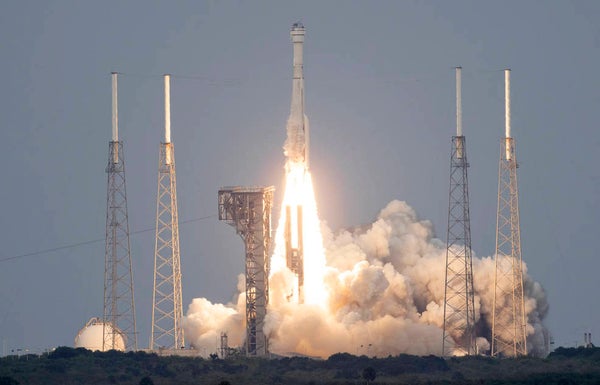
Boeing’s Starliner spacecraft is officially on its way to the International Space Station (ISS) after 2.5 years of delays.
A United Launch Alliance (ULA) Atlas V rocket launched from Cape Canaveral Space Force Station in Florida on Thursday (May 19) at 6:54 p.m. EDT (2254 GMT), carrying Starliner aloft on an uncrewed mission called Orbital Flight Test 2 (OFT-2).
If all goes according to plan, Starliner will dock with the ISS on Friday evening (May 20) and spend four to five days attached to the orbiting lab before coming back to Earth for a parachute-aided landing in the western U.S. Success on all of those fronts would likely show that the Boeing spacecraft is ready to carry NASA astronauts to and from the station.
On supporting science journalism
If you're enjoying this article, consider supporting our award-winning journalism by subscribing. By purchasing a subscription you are helping to ensure the future of impactful stories about the discoveries and ideas shaping our world today.
Starliner got itself into the proper orbit after separating from the Atlas V on Thursday, a huge milestone for Boeing and NASA. After all, the capsule was unable to rendezvous with the ISS during the original OFT in December 2019 after suffering some software glitches shortly after launch. And it failed to get off the ground when OFT-2 first rolled out to the pad last summer; prelaunch checks revealed malfunctioning valves in Starliner’s propulsion system, a problem that took about eight months to address.
OFT-2’s liftoff was a big milestone for ULA as well, marking the 150th launch for the rocket company, which is a joint effort of Lockheed Martin and Boeing.
At a post-launch press conference on Thursday night, NASA and Boeing experts were quick to congratulate their various teams for the hard work that led to the successful launch.
“Today was just a huge day for commercial crew,” said Steve Stich, manager of NASA’s Commercial Crew Program. As he listed the hurdles and launch milestones of the day’s events, he also mentioned one small Starliner malfunction.
During the spacecraft’s orbital insertion burn, which occurred 31 minutes after liftoff, two of Starliner’s thrusters didn’t fire as expected. The first failed after only one second. Its backup immediately kicked on and was able to fire for another 25 seconds before it also failed. Redundancy failsafes activated a tertiary backup for the thruster group, and Starliner was able to complete the crucial burn without incident.
The Boeing spacecraft is outfitted with four of these thruster groups on its aft section, referred to in industry nomenclature as “doghouses,” which each contain three orbital maneuvering and attitude control (OMAC) thrusters used to perform significant maneuver burns like those that achieve orbital insertion. The two OMAC thrusters that malfunctioned, and the third that stepped in to compensate, were all in the same doghouse on Starliner’s aft section, Boeing representatives said.
“The system is designed to be redundant, and it performed like it was supposed to. Now the team is working the ‘why’ as to why we had those anomalies occur,” said Mark Nappi, vice president and program manager for Boeing’s commercial crew program.
Nappi emphasized that the issue was not one that needed to be resolved prior to the completion of the OFT-2 mission. During the briefing, Stich pointed out that Starliner had performed a second significant burn with the same OMAC thrusters, putting it on course to rendezvous with the International Space Station.
“That second burn that we performed … did use that third thruster in that doghouse, and it performed fine for that entire burn. So, it doesn’t look like something that’s common to all three. And, as Mark [Nappi] said, they started firing right. The first one fired, and the second one picked up, fired for 25 seconds,” Stitch said.
“So, we’ll just have to go through a little bit more troubleshooting and see if we can figure out why those two thrusters didn’t complete that orbit insertion burn,” he added.
Starliner will catch up to the space station on Friday evening (May 20). Once within about 2 miles (3 kilometers) of the orbiting lab, the spacecraft will demonstrate stop-and-retreat maneuvers before moving in to dock at around 7:10 p.m. EDT (2310 GMT).
Copyright 2022 Space.com, a Future company. All rights reserved. This material may not be published, broadcast, rewritten or redistributed.