
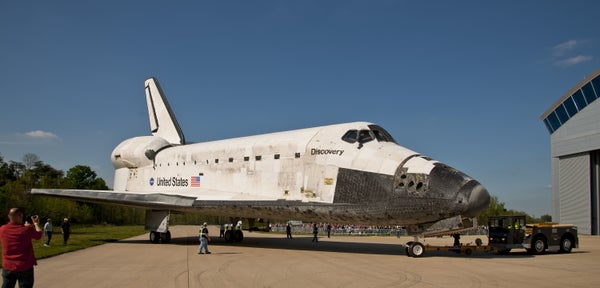
The great Texas space shuttle saga has taken a new twist: Jared Isaacman, President Donald Trump’s pick to lead NASA, indicated that the space shuttle Discovery may not move from its retirement home in a Smithsonian museum to Houston after all despite a Texas lawmaker push over the past year to make it happen.
The effort to shift Discovery from its hangar in Chantilly, Va., an annex of the Smithsonian’s National Air and Space Museum, was previously described as a “heist” by Senator Dick Durbin of Illinois in July—that same month, the move was enshrined into law by the Trump administration’s One Big Beautiful Bill Act, which provided $85 million to transfer the shuttle to the Space Center Houston museum within 18 months. Yet in a recent interview with CNBC, Isaacman said that whether the spacecraft can be moved remained to be seen.
“My job now is to make sure that we can undertake such a transportation within the budget dollars that we have available and, of course, most importantly, ensuring the safety of the vehicle,” Isaacman said. NASA and the Smithsonian have estimated that moving Discovery would cost at least $120 million.
On supporting science journalism
If you're enjoying this article, consider supporting our award-winning journalism by subscribing. By purchasing a subscription you are helping to ensure the future of impactful stories about the discoveries and ideas shaping our world today.
If it turns out not to be possible, he added, then NASA could ultimately move a different vehicle to Houston. “We’ve got spacecraft that are going around the moon with Artemis II, III, IV and V. One way or another, we’re going to make sure that Johnson Space Center gets their historic spacecraft,” Isaacman said.
Space scientists and legal experts previously decried Discovery’s move in interviews with Scientific American as a “theft” and “a vanity project.” Others expressed concern that the Texas museum would not be able to properly house and maintain the spacecraft.
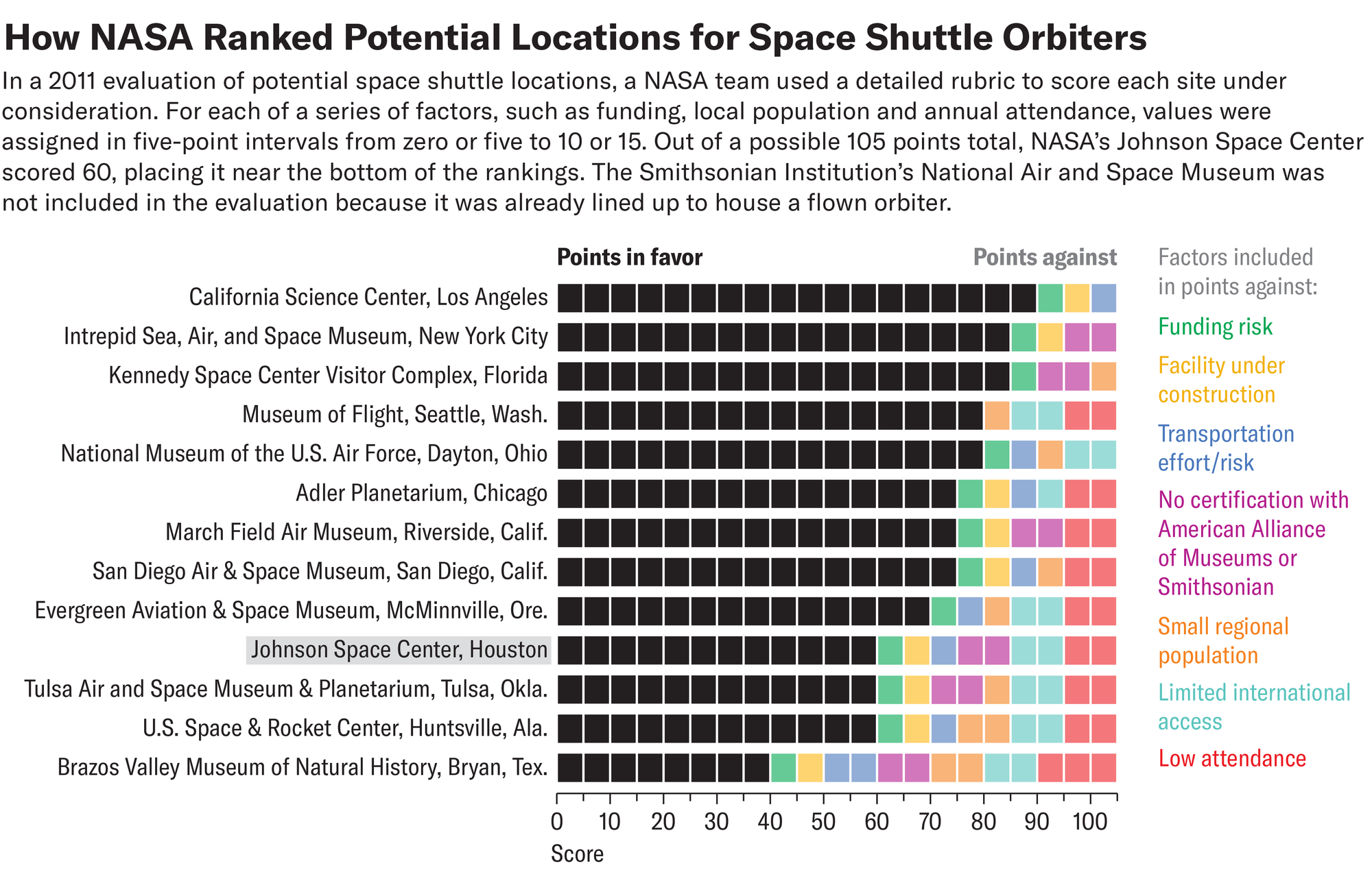
Amanda Montañez; Source: NASA Office of Inspector General (data)
“Such a move would be a waste of money—a vanity project that is apt to destroy a near-priceless American treasure,” Matthew Hersch, a fellow in legal history at New York University School of Law and an associate of the Harvard University Department of the History of Science, told Scientific American.
“The removal of Discovery from the Smithsonian Institution would be a theft, by the federal government, of a $2-billion artifact from a private museum that owns it and has been maintaining it properly for over a decade,” he said.
Discovery was first launched in 1984, completing 39 missions to space—more than any of the four other space shuttles NASA built that went to space—including a mission to loft the Hubble Space Telescope into orbit in 1990.