
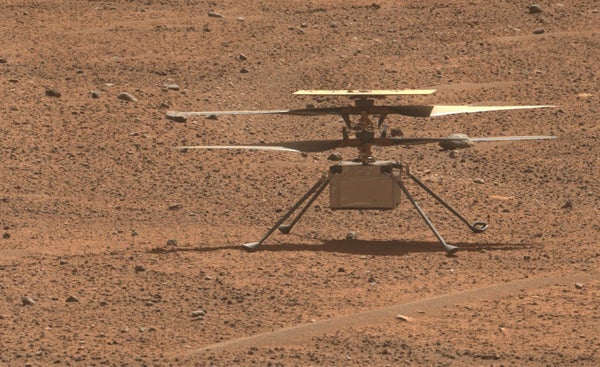
I held my breath for a moment on Jan. 18, when scientists announced they'd lost contact with the Perseverance Mars rover's helicopter friend, Ingenuity.
Ingenuity had been nearing completion of its 72nd flight — a liftoff far past the threshold of "borrowed time" in this case, as the mighty craft was originally built for a mere maximum of five flights. The fate of Ingenuity was pretty uncertain for a short while.
However, I'm pleased to report that Ingenuity has officially regained communication with ground control and continues to surpass the limitations scientists once thought it'd need to live by. According to a Jan. 20 NASA post on X (formerly Twitter), Perseverance had conducted long-duration listening sessions to help pinpoint Ingenuity's signal. "The team is reviewing the new data to better understand the unexpected comms dropout during Flight 72," the post says.
On supporting science journalism
If you're enjoying this article, consider supporting our award-winning journalism by subscribing. By purchasing a subscription you are helping to ensure the future of impactful stories about the discoveries and ideas shaping our world today.
Ingenuity launched to the Martian surface alongside the Perseverance rover on July 30, 2020. It landed on its target less than a year later, and soon began its mission of flying above the Red Planet to foremost gather information about whether it's possible to control an airborne vehicle on a world with a gravitational pull and atmosphere different from those of Earth.
Thanks to Ingenuity's success, scientists concluded that such a feat is indeed possible. But after five planned flights surrounding this particular mission, it became clear that Ingenuity had much more juice left within. It kept flying… and flying… and flying until, as we see, it finished its stunning 72nd flight. It has since greatly expanded its purpose too, taking cool and crucial images of the Martian area Perseverance is tasked with exploring. It's a region called the Jezero crater, and it's thought to have once been flooded with water.
This small helicopter communicates with NASA ground control via the Deep Space Network, which is the classic line on which tons of space missions talk to scientists on Earth.
Everything seemed fine during the probe's 72nd hop on Mars' red surface, as it successfully climbed to an expected maximum altitude of 40 feet (12 meters) and communicated its ascension status with Perseverance, NASA explained. But, during descent, "communications between the helicopter and rover terminated early, prior to touchdown," the agency had said in a statement.
Nonetheless, the glitch is all in the past, so I (and I'm sure many others across the world) can stop holding my breath. Hopefully, we'll be getting some answers as to why the situation arose in the first place, but meanwhile, Ingenuity continues to prove resilient.
Copyright 2023 Space.com, a Future company. All rights reserved. This material may not be published, broadcast, rewritten or redistributed.