
It looks like Bennu was indeed the right target for NASA's first-ever asteroid sample-return mission.
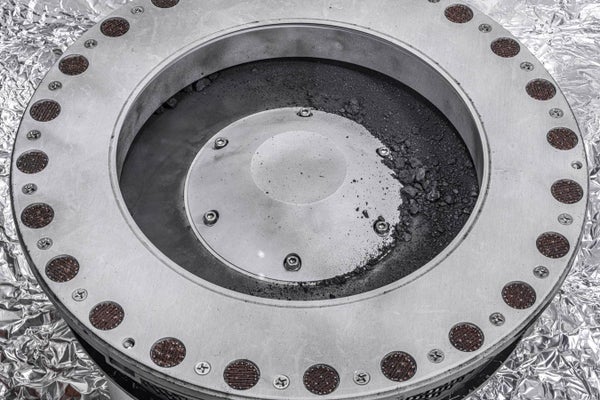
That mission, OSIRIS-REx, delivered pieces of the 1,650-foot-wide (500 meters) Bennu to Earth late last month. NASA gave the world its first look at the sample today (Oct. 11) during a live webcast event, which also provided a rundown of the first analyses performed on the off-Earth material.
Those very early scientific returns are promising, showing that Bennu is rich in both water and carbon-containing compounds, mission team members said.
On supporting science journalism
If you're enjoying this article, consider supporting our award-winning journalism by subscribing. By purchasing a subscription you are helping to ensure the future of impactful stories about the discoveries and ideas shaping our world today.
"The OSIRIS-REx sample is the biggest carbon-rich asteroid sample ever delivered to Earth and will help scientists investigate the origins of life on our own planet for generations to come," NASA Administrator Bill Nelson said in a statement today.
"Almost everything we do at NASA seeks to answer questions about who we are and where we come from," Nelson added. "NASA missions like OSIRIS-REx will improve our understanding of asteroids that could threaten Earth while giving us a glimpse into what lies beyond. The sample has made it back to Earth, but there is still so much science to come — science like we've never seen before."
OSIRIS-REx launched in September 2016 and arrived at Bennu in December 2018. The probe spent the next 22 months studying the space rock from orbit and searching for the right place to swoop down and grab a sample.
That sampling run took place in October 2020, and it provided a fair bit of drama: Bennu's surface turned out to be surprisingly porous, and OSIRIS-REx sank deeply into it.
But the probe emerged with a bounty — so much material that its collection mechanism got clogged, allowing some asteroid dirt and pebbles to escape into space. OSIRIS-REx still managed to secure most of the Bennu bits in its sample container, and the probe headed toward Earth in May 2021.
The journey home wrapped up on Sept. 24, when OSIRIS-REx's return capsule landed in the desert of northern Utah. A day later, the sample arrived at NASA's Johnson Space Center (JSC) in Houston, where it's being processed, curated and stored.
That work has only just begun. For example, mission team members still don't know exactly how much material OSIRIS-REx hauled home. They think it's about 8.8 ounces (250 grams) — far higher than the mission requirement of 2.1 ounces (60 g) — but that's just an estimate, calculated while the return capsule was still in space.
JSC will distribute parts of the Bennu sample over the coming months and years to researchers around the world, who will study it in great detail.
Their work will determine, among other things, the identity of the carbon compounds, which could shed light on how life got started here on Earth. (Many researchers think carbon-rich asteroids like Bennu seeded our planet with life's building blocks long ago, via impacts.)
And Bennu is a relic of our solar system's planet-building era, so taking the rock's measure will help us understand the formation and evolution of our cosmic backyard on a larger scale, mission team members said.
"As we peer into the ancient secrets preserved within the dust and rocks of asteroid Bennu, we are unlocking a time capsule that offers us profound insights into the origins of our solar system," Dante Lauretta, OSIRIS-REx principal investigator at the University of Arizona, said in the same statement.
"The bounty of carbon-rich material and the abundant presence of water-bearing clay minerals are just the tip of the cosmic iceberg," he said. "These discoveries, made possible through years of dedicated collaboration and cutting-edge science, propel us on a journey to understand not only our celestial neighborhood but also the potential for life's beginnings. With each revelation from Bennu, we draw closer to unraveling the mysteries of our cosmic heritage."
The journey isn't over for the OSIRIS-REx spacecraft, by the way. Though its return capsule is now back on Earth, the probe keeps on flying, toward another asteroid called Apophis. OSIRIS-REx is scheduled to arrive at that space rock in 2029 and study it up close, on an extended mission called OSIRIS-APEX.
Copyright 2023 Space.com, a Future company. All rights reserved. This material may not be published, broadcast, rewritten or redistributed.