New Issue: Orbital Catastrophe Ahead? Read Now

NASA pushes ahead with ‘wet’ dress rehearsal for Artemis II moon mission

A crucial test of NASA’s upcoming crewed flight to the moon is set to take place as soon as Saturday, the agency said

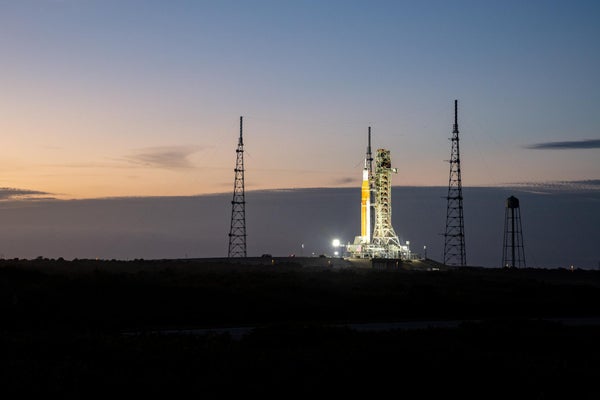
An illuminated rocket is seen from a distance

NASA’s Artemis II Space Launch System (SLS) rocket and Orion spacecraft are seen illuminated by lights at Launch Complex 39B on January 17, 2026, at NASA’s Kennedy Space Center in Florida.

NASA/Keegan Barber

Join Our Community of Science Lovers!

NASA is gearing up to launch Artemis II, the agency’s highly anticipated first crewed mission to moon in more than half a century. A crucial step is Artemis II’s “wet” dress rehearsal—a major test of the Space Launch System (SLS) rocket and the Orion capsule that will house the mission’s four astronauts. At Florida’s Kennedy Space Center, engineers will attempt to fuel the rocket and simulate a countdown to launch as soon as January 31, the agency said in an update on Monday.

If it all goes smoothly, the agency’s plan to slingshot four astronauts around the moon and back to Earth will go ahead, with a launch date coming as early as the first week of February.

The wet dress rehearsal will see NASA technicians load up the uncrewed spacecraft’s rocket with more than 700,000 gallons of cryogenic fuel—specifically, liquid oxygen and liquid hydrogen—before running through a countdown to launch.


On supporting science journalism

If you're enjoying this article, consider supporting our award-winning journalism by subscribing. By purchasing a subscription you are helping to ensure the future of impactful stories about the discoveries and ideas shaping our world today.


The test could result in the SLS and Orion being wheeled back from the launchpad for further tinkering, however. That’s what happened in 2022, when the uncrewed Artemis I mission sprung multiple liquid hydrogen fuel leaks on the launchpad and during testing—a recurring problem that delayed its launch significantly.

Aside from Artemis II’s coming wet dress rehearsal, NASA is also testing the water systems onboard Orion to make sure its water is fit to drink. “Initial samples showed higher levels of total organic carbon than expected,” the agency said in the same update on Monday. Officials have also made adjustments to the emergency exit system at the pad. The system is made up of a series of gondolalike baskets that are meant to carry the crew and launchpad staff to safety, should something go wrong.

Weather conditions could also affect the timing of Artemis II’s launch. Temperatures at the Space Center hit the low 40s Fahrenheit on Tuesday but are expected to rise going into the weekend. The agency is taking steps to prepare for the colder than usual temperatures, NASA said in the same statement.

Jackie Flynn Mogensen is a breaking news reporter at Scientific American. Before joining SciAm, she was a science reporter at Mother Jones, where she received a National Academies Eric and Wendy Schmidt Award for Excellence in Science Communications in 2024. Mogensen holds a master’s degree in environmental communication and a bachelor’s degree in earth sciences from Stanford University. She is based in New York City.

More by Jackie Flynn Mogensen

Subscribe to Support Independent Journalism

Great science journalism requires human expertise, time, effort and creativity. And it costs money. That’s why I and the journalists here at Scientific American hope you’ll join our community.

When you subscribe, you are supporting staff and freelance journalists who are passionate about telling science stories that are true, important and compelling. Our editors and reporters are often experts in their fields, which means they understand the nuances of big discoveries and can untangle the breakthroughs from the hype. With a subscription, you are also supporting rigorous fact-checking to ensure the words we publish are precise and accurate. And you’re supporting original illustrations, graphics and photos that bring you closer to an advanced laboratory, an ice sheet in Antarctica or a space mission in orbit. You’re helping us craft other types of high-quality journalism as well: Our newsletters are carefully written, edited and curated by staffers you have or will come to know and love. Our Science Quickly podcast is based on original reporting, collaboration with editors and scientists and exacting production.

Subscriptions keep this engine running so we can continue to deliver thoughtful, rigorous and independent science journalism to you. In an era of viral misinformation, this work is crucial. If you value what we do, I hope you’ll consider joining us as a subscriber

Thank you,

Jeanna Bryner, Editor in Chief, Scientific American

Subscribe