
Purported sightings of space aliens have long been relegated to pseudoscience, but NASA is ready to bring them into the scientific realm.
Agency representatives spoke on Thursday about a newly published report in which an independent study team outlines ways to advance the scientific investigation of unidentified anomalous phenomena, or UAP. (The acronym can also stand for “unidentified aerial phenomena.” And in either case, it is considered a stigma-shedding rebranding of the term “unidentified flying objects,” or “UFOs.”)
The report was not designed to explain these sightings or to determine whether aliens are real, panelists emphasized throughout a news conference that was held in conjunction with the study’s publication. “It is essential to clarify, based on our current findings and methodology, that we find no evidence to suggest that UAP are extraterrestrial in origin,” said David Spergel, an astrophysicist and president of the Simons Foundation, who chaired the NASA-commissioned effort. “Our focus is on understanding the phenomenon, however, regardless of the source.”
On supporting science journalism
If you're enjoying this article, consider supporting our award-winning journalism by subscribing. By purchasing a subscription you are helping to ensure the future of impactful stories about the discoveries and ideas shaping our world today.
During the briefing, NASA officials announced that the agency has appointed a director of UAP research, replacing a NASA liaison to the Department of Defense who had been the agency’s UAP point person. NASA initially said it wasn’t sharing the new director’s name to shield them from the same sort of harassment experienced by members of the independent study team. Later in the day, however, the agency indicated the new director would be Mark McInerney.*
NASA announced the independent study in June 2022 and selected its 16 members last October. The panel was asked to tackle questions such as what existing data could be used in the quest to understand UAPs, what other types of data should be gathered, and what scientific analyses might help researchers understand these phenomena. In short, the members’ goal was to envision a role NASA can play in the investigation of these sightings.
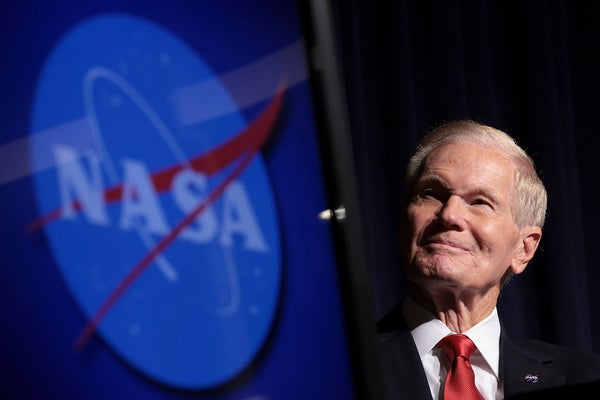
“NASA searches for the unknown in air and space,” said Bill Nelson, NASA’s administrator, during the news conference. “The top takeaway from the study is that there is a lot more to learn.”
Responses to those points make up the bulk of the report. For example, the panel calls for using NASA’s existing fleet of Earth-observing satellites, which operate at too low a resolution to gather UAP sightings directly, to evaluate local environmental conditions around compelling sightings.
The report also suggests that NASA’s expertise in handling and analyzing immense datasets makes the agency well-positioned to catalog UAP observations and convert them, when possible, into more standardized and scientifically robust formats. The report further notes that NASA could leverage its institutional experience with artificial intelligence and machine-learning techniques to inform its UAP work as well.
“We use AI, or artificial intelligence, and machine learning throughout our NASA science portfolio,” said Nicola Fox, associate administrator of NASA’s Science Mission Directorate, during the news conference. Such techniques, Fox said, can dramatically improve efforts to uncover clues “buried in data.”
Right now UAP studies might be said to face the opposite problem: not having nearly enough data to examine. In response, NASA officials at the news conference expressed interest in developing an online portal—perhaps a smartphone app—for the public to submit high-quality data about purported UAP sightings. Spergel compared the idea to the common public-safety message of “see something, say something.”
“I think in this context, we would summarize it as: if you see something, collect high-quality data on it, because then we can learn,” he said.
*Editor’s Note (9/14/23): This paragraph was updated after posting to include the newly released name of NASA’s director of unidentified anomalous phenomena (UAP) research.