New Issue: Orbital Catastrophe Ahead? Read Now

Nasal Spray COVID Preventives Are Finally in Development

Different methods of drug delivery give us more tools to fight disease

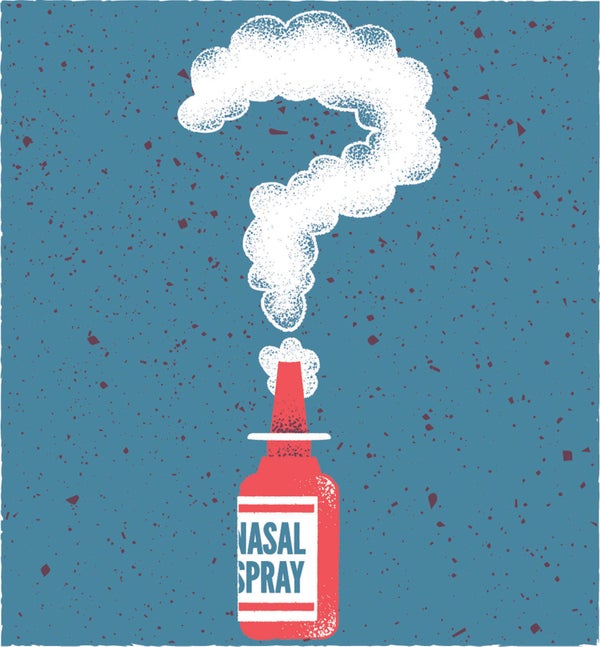
Nasal spray.

James Olstein

Join Our Community of Science Lovers!


On supporting science journalism

If you're enjoying this article, consider supporting our award-winning journalism by subscribing. By purchasing a subscription you are helping to ensure the future of impactful stories about the discoveries and ideas shaping our world today.


Covid is credited with propelling clinical innovation. But for a disease that seems to start in people’s noses, none of the available drugs or vaccines are delivered intranasally. Killing the virus before it travels into our lower airways could prevent serious illness. An intranasal vaccine could do this by stimulating the immune system in the mucus of our noses. And intranasal treatments, such as antibodies or small-molecule antivirals, could stop the virus before it infects enough cells to cause disease. Vaccinated health-care workers, for instance, could take a puff of a virus-killing nasal spray after exposure to protect against breakthrough infection.

So why aren’t intranasal pharmaceuticals here yet? Drugmakers default to injectable vaccines and treatments for a few reasons. Our muscles have lots of blood vessels, so injections in arms are perhaps the fastest way to get immune-stimulating vaccines and therapeutic antibodies into the bloodstream. From there these molecules can work their way to the respiratory system (and other systems), where the COVID virus is doing its dirty work. Similarly, pills get absorbed into our circulation quickly. To make existing drugs or vaccines work intranasally may require reformulation and retesting. But a nasal spray might have benefits that injectables and pills do not: direct delivery to the earliest site of infection.

Several nasal vaccines are now in clinical trials. Intranasals for prevention and treatment are also in development. A scientist at the University of Houston, for example, has shown in animal models of COVID that an intranasal antibody spray seems to reduce viral load; the biotech company he co-founded is working toward clinical trials. Depending on how these methods perform, we may get new tools for living amid this pervasive disease.

Megha Satyanarayana is chief special projects editor at Scientific American. She is a former scientist who has worked at several news outlets, including the Detroit Free Press and STAT. She was a Knight-Wallace Fellow, a cohort member of Poynter’s Leadership Academy for Women in Digital Media and a Maynard 200 Fellow.

More by Megha Satyanarayana
Scientific American Magazine Vol 326 Issue 3This article was published with the title “Nasal Spray Preventives Went into Development” in Scientific American Magazine Vol. 326 No. 3 (), p. 65
doi:10.1038/scientificamerican0322-65

Subscribe to Support Independent Journalism

Great science journalism requires human expertise, time, effort and creativity. And it costs money. That’s why I and the journalists here at Scientific American hope you’ll join our community.

When you subscribe, you are supporting staff and freelance journalists who are passionate about telling science stories that are true, important and compelling. Our editors and reporters are often experts in their fields, which means they understand the nuances of big discoveries and can untangle the breakthroughs from the hype. With a subscription, you are also supporting rigorous fact-checking to ensure the words we publish are precise and accurate. And you’re supporting original illustrations, graphics and photos that bring you closer to an advanced laboratory, an ice sheet in Antarctica or a space mission in orbit. You’re helping us craft other types of high-quality journalism as well: Our newsletters are carefully written, edited and curated by staffers you have or will come to know and love. Our Science Quickly podcast is based on original reporting, collaboration with editors and scientists and exacting production.

Subscriptions keep this engine running so we can continue to deliver thoughtful, rigorous and independent science journalism to you. In an era of viral misinformation, this work is crucial. If you value what we do, I hope you’ll consider joining us as a subscriber

Thank you,

Jeanna Bryner, Editor in Chief, Scientific American

Subscribe