
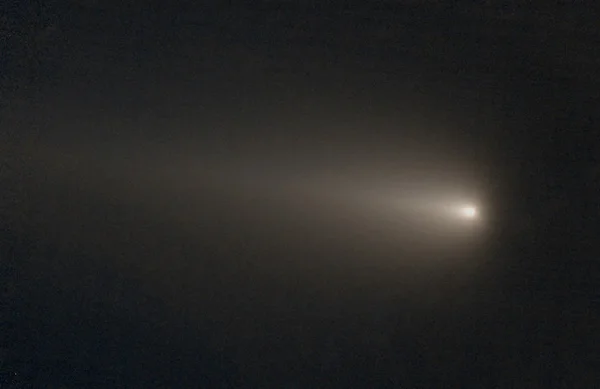
The cosmos may have a special treat in store for the four astronauts of NASA’s Artemis II mission.
NASA astronauts Reid Wiseman, Victor Glover, and Christina Koch and Canadian Space Agency astronaut Jeremy Hansen will be the first humans to see the far side of the moon with their own eyes since the Apollo era when they fly past our companion over the course of a few hours on Monday. But they may also catch sight of a remarkable comet out the window of their Orion capsule. That comet, formally known as Comet C/2026 A1 (MAPS), was the very first one astronomers discovered this year. Now it’s racing toward the sun for a close approach on Saturday that will potentially spark a remarkable spectacle—if the comet can take the heat.
“Over the next few days, the comet is going to be experiencing the most hostile environment our solar system has to offer, and it will suffer accordingly,” says Karl Battams, a space scientist at the Naval Research Laboratory in Washington, D.C. He’s also the principal investigator of the Sungrazer Project, a NASA-funded crowdsourced science initiative named for the comets it seeks—“sungrazers” that approach within 850,000 miles (1.37 million kilometers) of the sun. Sifting through data from sun-gazing spacecraft, Battams’s project has found more than 5,000 so far.
On supporting science journalism
If you're enjoying this article, consider supporting our award-winning journalism by subscribing. By purchasing a subscription you are helping to ensure the future of impactful stories about the discoveries and ideas shaping our world today.
Comet MAPS wasn’t one of them, however. Instead MAPS was discovered on January 13 by a quartet of amateur astronomers—Alain Maury, Georges Attard, Daniel Parrott and Florian Signoret, hence the MAPS acronym—using a remotely operated telescope high in Chile’s Atacama Desert.
The comet’s closest solar approach will occur on April 4, when it will zip within 101,100 miles (162,700 kilometers) of our star. By comparison, that’s almost 40 times closer than the spacecraft record holder, NASA’s Parker Solar Probe, which zipped within about four million miles of the sun (nearly 6.5 million kilometers) on Christmas Eve in 2024. And Parker only withstood that scorching experience thanks to its meticulously engineered heat shield.
Whether Comet MAPS will survive is far from guaranteed—most sungrazers do not, says Quanzhi Ye, a planetary astronomer at the University of Maryland and Boston University.
Helping the comet’s odds is its relatively large size, with an icy core that is some 1,300 feet (400 meters) across, according to recent observations by the James Webb Space Telescope. But this size is only an estimate, and it’s changing all the time: a comet’s brightness comes from light reflecting off gas and dust ejected from its icy core, which shrinks the object as it basks in the sun’s rays.
That’s already happening on Comet MAPS, even days away from its brush with the sun. “It seems to be quite active—actually, a little bit more active than we’d like,” Ye says. In a worst-case scenario, this activity could cause the comet to break apart even before it reaches its closest point to the sun, a moment scientists call perihelion.
“My best guess is that it will disintegrate rapidly over the next couple of days, leaving nothing but a faint cloud of dust to recede from the sun,” Battams says.
Right now the comet is difficult to monitor because of its proximity to our star. Human eyes are not built to look at the sun directly—especially not through a telescope. And although specialized solar spacecraft can spot objects so close to the fierce stellar glare, none that are now flying can produce a high-resolution view of the tiny comet.
So scientists must simply wait and see. But in the unlikely scenario in which the comet endures not just perihelion but also its subsequent solar retreat in the following days, Comet MAPS will soar back into view, giving the crew of Artemis II a unique opportunity to glimpse it in all its glory. During Monday’s lunar flyby, the moon will be between the Orion capsule and the sun, blotting out its retina-burning light so that MAPS’s fainter glow can be safely seen. The result could be spectacular, Ye says. Even if the chances are slim, it’s one more reason to look forward to Monday’s events.