
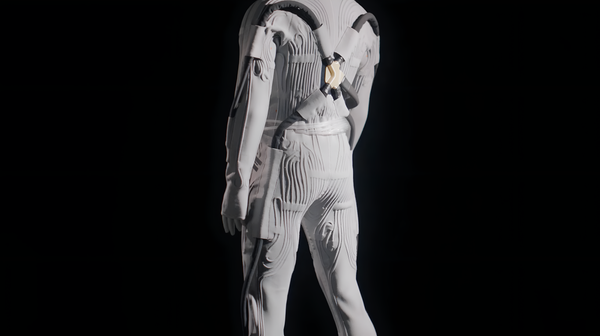
NASA’s Artemis astronauts will bring high fashion to the high frontier on future missions by wearing a Prada-designed inner layer beneath their space suits when they walk on the moon’s surface. Called the Liquid Cooling and Ventilation Garment (LCVG), this futuristic onesie is riddled with tubing that can circulate cold water around the astronauts’ bodies, ensuring they won’t overheat while they gad about on the moon. And of course, it also features the signature red stripe of Prada’s activewear line on one sleeve.
The Italian fashion house has been working for years with Axiom Space, a private company commissioned by NASA to make new space suits for its astronauts to wear during upcoming Artemis missions. The cooling onesie, which was unveiled at a press event on Sunday, will be worn under the Axiom Extravehicular Mobility Unit (AxEMU) space suit, which is also designed in collaboration with Prada. The AxEMU is the first major upgrade to NASA’s space suits in more than 20 years. Currently, the space agency relies on a similar design to the space suits worn during the Apollo era.

On Sunday Axiom Space and Prada unveiled the LCVG.
Axiom Space and Prada
On supporting science journalism
If you're enjoying this article, consider supporting our award-winning journalism by subscribing. By purchasing a subscription you are helping to ensure the future of impactful stories about the discoveries and ideas shaping our world today.
“When we unveiled the AxEMU, we announced that the collaboration between Prada and Axiom Space would continue beyond that first milestone,” said Lorenzo Bertelli, Prada’s group chief marketing officer and head of sustainability, in a statement.
“Today, we are proud to present a new achievement born from the unique combination of Axiom Space’s pioneering expertise and Prada’s know-how in design, patternmaking, and advanced materials, ahead of humanity’s return to the lunar surface,” he added.
Aside from the tubes to circulate liquid around the astronauts’ bodies, the new undergarment also features a ventilation system to deliver oxygen to them and to remove carbon dioxide from inside the space suits.
“Every minute astronauts spend outside their vehicle, the LCVG is working to keep them safe,” said Russell Ralston, Axiom Space’s senior vice president of spacecraft development, in the same statement. “It manages their thermal environment, supports their breathing, and does it all while they’re pushing their bodies to the limit. The work we have done with Prada has taken that capability to a level we could not have achieved alone.”
At Sunday’s event, Axiom’s CEO and president Jonathan Cirtain said the company could test the new undergarment on the International Space Station (ISS), as well as during NASA’s upcoming Artemis III mission, which will feature a crewed orbital test of crucial hardware needed to land humans back on the moon—something NASA hopes to do as soon as 2028.
The unveiling comes after an April report from NASA’s Office of Inspector General (OIG) that warned that the space agency risked not being able to pull off the 2028 moon landing because of delays to Axiom Space’s timeline. The company had originally targeted 2025 to test its lunar AxEMU space suits, which didn’t happen. The OIG report pointedly said that the original timeline was “ultimately unachievable.”
At the time, Axiom Space chief Cirtain said in a statement that the company was on track to demonstrate the suits in space in 2027.