
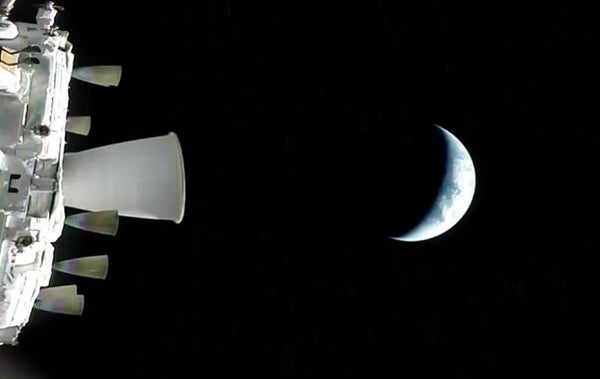
NASA’s Artemis II mission is officially underway, with the first day marked by a series of successful maneuvers and a—thankfully—fixed problem with the onboard toilet.
The Artemis II crew includes NASA astronauts Reid Wiseman, Victor Glover, and Christina Koch and Canadian Space Agency astronaut Jeremy Hansen. Not long into their flight, they were tasked with a very important test: to make sure the toilet was working. This is the first time a moon-bound human spacecraft has had a functional toilet, after all.
Worryingly, they noticed a “blinking fault light” on the toilet, according to NASA, but the issue was short-lived and has since been resolved.
On supporting science journalism
If you're enjoying this article, consider supporting our award-winning journalism by subscribing. By purchasing a subscription you are helping to ensure the future of impactful stories about the discoveries and ideas shaping our world today.
The toilet is a notable innovation. Made of titanium, it sits in the floor of the Orion spacecraft and allows the astronauts to defecate and urinate simultaneously—a luxury not afforded to astronauts who had relied on earlier toilet models. (The Apollo astronauts used bags to collect their waste.) In another first for moon missions, it also has a door.
Software was reportedly acting up as well: in a recording of livestream audio from Orion, the astronauts could be heard saying that their computers had two versions of Microsoft Outlook—neither of which seemed to be working. NASA did not immediately respond to a request for comment on this issue from Scientific American.
NASA's Artemis II live views from Orion
The troubleshooting wasn’t the only task on the crew’s day-one to-do list, however.
The astronauts also practiced an important docking maneuver to test the Orion’s abilities for future missions. Glover, the mission’s pilot, tested the spacecraft’s ability to move up, down, left, and right and tilt in space—critical for ensuring its maneuverability on any future missions.
In the docking test, rather than dock to another spacecraft, the crew used a target on the interim cryogenic propulsion stage (ICPS), which was originally part of the Space Launch System (SLS) rocket that lofted Orion and the crew into space before it separated from the capsule.
After the test, the ICPS will fire its engines for a “disposal burn,” sending it back to Earth and into the Pacific Ocean.
Orion also performed several burns, including one on Thursday morning, to lift the spacecraft’s orbital path, ensuring it wouldn’t fall back to Earth and putting it on the right trajectory as it zips around the planet before heading to the moon.
The rest of day two will also feature some important maneuvers—albeit after the astronauts get some sleep. At around 8:12 P.M. EDT on Thursday, the Artemis II crew will perform a translunar injection burn, a critical step that will send the Orion on its path toward the moon. During this burn, the engines will fire for about six minutes.