
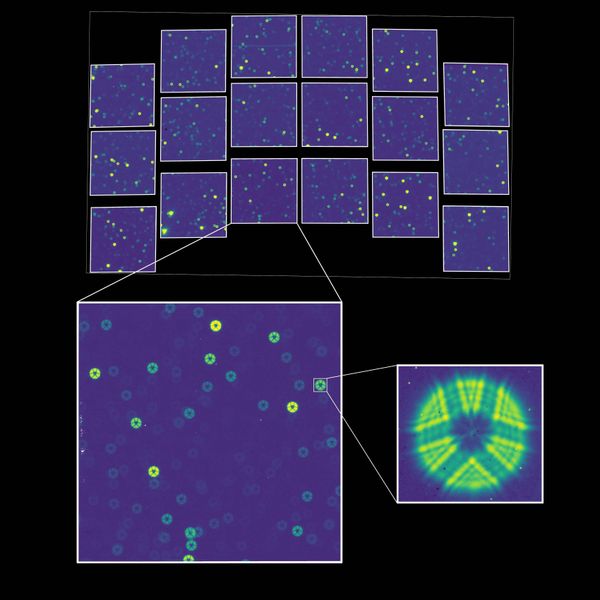
Say cheese, universe. NASA’s Nancy Grace Roman Space Telescope has caught its first glimpses of cosmic light—a major step on the road to beaming back unprecedented images and data about our galaxy and the wider universe.
The telescope activated its Wide Field Instrument (WFI) on September 11, initiating the preliminary setup for Roman’s highly sensitive 300-megapixel camera. This is the first step in the telescope’s mission of looking for dark matter and energy and studying the Milky Way, as well as discovering new exoplanets in distant star systems.
After Roman’s launch on August 30, it spent 10 days drying out to prevent damage to its highly sensitive systems. With that done, the heaters were turned off, and the telescope was cooled down to –225 degrees Fahrenheit (–143 degrees Celsius)—at that point, its 18 infrared instruments could be activated.
On supporting science journalism
If you're enjoying this article, consider supporting our award-winning journalism by subscribing. By purchasing a subscription you are helping to ensure the future of impactful stories about the discoveries and ideas shaping our world today.
Among the systems that came online for the first time were Roman’s calibration system, which NASA put through some testing, as well as light filtering devices and the WFI’s focus mechanism. Meanwhile the telescope continued to cool down to a frigid –300 degrees F (–183 degrees C).
After it is fully operational, the WFI will be used to capture extremely detailed patches of the sky, each bigger than the apparent size of a full moon. That will allow the telescope to study more than 50 times as much of the sky in its planned five years of operation as the Hubble Space Telescope has in 30 years of work.
“After years of effort to build and test the instrument on the ground, we now have confirmation that it is operational in space,” said WFI scientist Josh Schlieder in a statement. “There is much to do, but we are on our way to groundbreaking science.”
Along with the WFI, NASA engineers tested out communications with the telescope’s coronagraph—a complicated series of mirrors, sensors and other instruments that will be used to directly image exoplanets orbiting distant stars.
All the systems are working as expected—good news as we wait for Roman to become fully operational. The first images are expected around the holiday season, while science operations are scheduled to start in January 2027.