
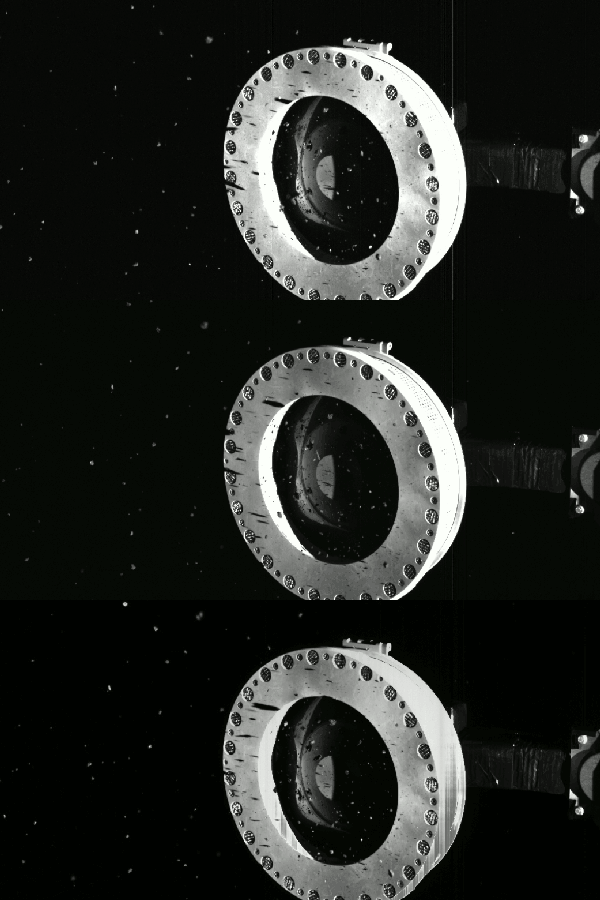
NASA’s first-ever asteroid-sampling operation apparently went a little too well.
The agency’s OSIRIS-REx probe snagged so much dirt and rock from the surface of the near-Earth asteroid Bennu on Tuesday (Oct. 20) that the spacecraft’s sampling mechanism didn’t close properly, allowing some of the collected material to escape into space, mission team members announced Friday (Oct. 23).
OSIRIS-REx’s handlers now plan to stow the collected material in the probe’s return capsule as soon as possible, to minimize the material lost. The team hopes to begin that crucial, multi-day operation on Tuesday (Oct. 27), NASA officials said.
On supporting science journalism
If you're enjoying this article, consider supporting our award-winning journalism by subscribing. By purchasing a subscription you are helping to ensure the future of impactful stories about the discoveries and ideas shaping our world today.
“Bennu continues to surprise us with great science and also [by] throwing a few curveballs,” Thomas Zurbuchen, NASA’s associate administrator for science at the agency’s headquarters in Washington, said in a statement.
“And although we may have to move more quickly to stow the sample, it’s not a bad problem to have,” Zurbuchen said. “We are so excited to see what appears to be an abundant sample that will inspire science for decades beyond this historic moment.”
The $800 million OSIRIS-REx mission launched in September 2016 and arrived at Bennu in December 2018. The mission’s chief goal is to deliver at least 2.1 ounces (60 grams) of pristine Bennu material to Earth. That will happen on Sept. 24, 2023, when the return capsule touches down in the Utah desert.
All indications are that the probe collected more than enough material during Tuesday’s maneuver, which featured a six-second-long “kiss” of Bennu with OSIRIS-REx’s Touch-And-Go Sample Acquisition Mechanism (TAGSAM) head.
The head sank deep into Bennu, perhaps getting up to 19 inches (48 centimeters) beneath the surface, mission principal investigator Dante Lauretta, of the University of Arizona, said during a news conference Friday. And photos captured by the spacecraft show that the sampling head is jammed with material, suggesting that OSIRIS-REx snagged, at minimum, hundreds of grams of Bennu bits, Lauretta added.
But those photos also revealed a cloud of particles escaping from the TAGSAM head, through gaps where small rocks prevented the sampler’s mylar flap from closing all the way. The jailbreak was spurred when OSIRIS-REx moved TAGSAM around to get a look at the collected sample, Lauretta said.
He and his colleagues originally planned to weigh the sample Saturday (Oct. 24), an operation that would have involved spinning OSIRIS-REx around a bit. But that operation would doubtless have liberated more asteroid particles, so mission team members now plan to proceed directly to sample stowage. (They also canceled an engine burn that would have slowed OSIRIS-REx’s retreat from Bennu, for the same reason.)
Skipping the weighing step is no great loss, Lauretta said.
“The challenge that we have in front of us is due to the fact that the TAGSAM is probably really full of material,” he said during Friday’s new conference. The top priority at this point, he added, “is to get this sample safely stowed and minimize any more loss."
It’s tough to quantify how much material has been lost, Lauretta said. But he estimated that up to 10 grams of Bennu samples flew the coop as a result of the recent photography activities, and that “grams to tens of grams” could be lost during the stow operation. (The escape rate seems to be quite low when Bennu stays relatively still, Lauretta said.) If these numbers are correct, and OSIRIS-REx did indeed snag hundreds of grams of material on Tuesday, then the mission is in fine shape going forward.
The samples cannot be stowed immediately, Lauretta said. The team first needs to finalize and validate an updated stowing plan that takes into account leaking asteroid particles, for example. The mission also must secure a long, continuous block of time on NASA’s Deep Space Network (DSN), the set of radio dishes around the globe the agency uses to communicate with its far-flung spacecraft. Sample stowage will be an involved and time-intensive process with lots of back-and-forth between OSIRIS-REx and the ground, Lauretta explained.
These complications notwithstanding, the mission team is happy and excited about how things have gone to date, Lauretta said.
“We couldn’t have performed a better sample-collection experiment,” he said. “The particles are escaping because we were almost a victim of our own success here.”
OSIRIS-REx has been backing away from Bennu since Tuesday’s sampling maneuver and will not swoop in toward the asteroid again, Lauretta said. Assuming the sample is stowed successfully next week, the next big milestone will come in early March, when OSIRIS-REx departs Bennu and starts heading back toward Earth.
That trip will be relatively uneventful, Lauretta said—until September 2023, when the return capsule comes down to Earth (containing an unknown amount of material; there’s no good way to measure the mass once the sample has been stowed).
The asteroid rocks and dirt will then make their way to labs around the world, where scientists can study them for clues about the solar system’s early days and the role that carbon-rich space rocks like Bennu may have played in helping life get started on Earth.
Though OSIRIS-REx (whose name is short for “Origins, Spectral Interpretation, Resource Identification, Security-Regolith Explorer) is NASA’s first asteroid-sampling mission, it’s not the first one overall. Japan’s Hayabusa probe returned small grains of the stony asteroid Itokawa in 2010, and its successor, Hayabusa2, is hauling a sample of the carbon-rich asteroid Ryugu Earthward now. The Ryugu material will land in Australia this coming December.
Copyright 2020 Space.com, a Future company. All rights reserved. This material may not be published, broadcast, rewritten or redistributed.