
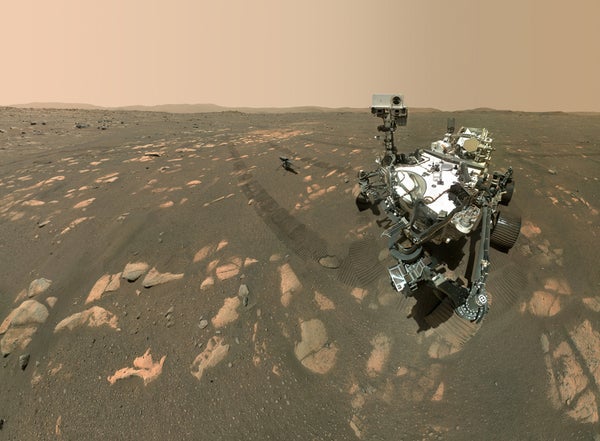
NASA’s Perseverance rover just notched another first on Mars, one that may help pave the way for astronauts to explore the Red Planet someday.
The rover successfully used its MOXIE instrument to generate oxygen from the thin, carbon dioxide-dominated Martian atmosphere for the first time, demonstrating technology that could both help astronauts breathe and help propel the rockets that get them back home to Earth.
The MOXIE milestone occurred on Tuesday (April 20), just one day after Perseverance watched over another epic Martian first—the first Mars flight of NASA’s Ingenuity helicopter, which rode to the Red Planeton the rover’s belly.
On supporting science journalism
If you're enjoying this article, consider supporting our award-winning journalism by subscribing. By purchasing a subscription you are helping to ensure the future of impactful stories about the discoveries and ideas shaping our world today.
“This is a critical first step at converting carbon dioxide to oxygen on Mars,” Jim Reuter, associate administrator of NASA’s Space Technology Mission Directorate, said in a statement today (April 21). “MOXIE has more work to do, but the results from this technology demonstration are full of promise as we move toward our goal of one day seeing humans on Mars.”
Making Mars oxygen
The toaster-sized MOXIE (short for “Mars Oxygen In-Situ Resource Utilization Experiment”) produces oxygen from carbon dioxide, expelling carbon monoxide as a waste product. The conversion process occurs at temperatures around 1,470 degrees Fahrenheit (800 degrees Celsius), so MOXIE is made of heat-tolerant materials and features a thin gold coating to keep potentially damaging heat from radiating outward into Perseverance’s body.
The MOXIE team warmed the instrument up for two hours yesterday, then had it crank out oxygen for an hour. MOXIE produced 5.4 grams of oxygen during that span, about enough to keep an astronaut breathing easily for 10 minutes, NASA officials said.
That first effort didn’t max MOXIE out; it can generate about 10 grams of oxygen per hour. The instrument may reach such levels eventually, for the team plans to conduct about nine more runs over the course of one Mars year (about 687 Earth days).
These trials will be grouped into three phases, NASA officials said. The first phase is checking out and characterizing the instrument, and the second will assess MOXIE’s performance in varying atmospheric conditions. During the third and final phase, “we’ll push the envelope,” MOXIE principal investigator Michael Hecht said in the same statement.
Pushing the envelope will likely involve testing new operating modes or adding “new wrinkles, such as a run where we compare operations at three or more different temperatures,” added Hecht, who’s based at the Massachusetts Institute of Technology’s Haystack Observatory.
MOXIE and humanity’s future on Mars
MOXIE itself cannot produce enough oxygen to make a difference for future exploration efforts. For example, launching four astronauts off the Martian surface would likely require about 15,000 lbs. (7,000 kilograms) of rocket fuel and 55,000 lbs. (25,000 kg) of oxygen, NASA officials said. (Rocket propellant consists of fuel and an oxidizer that helps it burn.)
But much larger MOXIE successors could potentially be great exploration enablers, allowing Mars astronauts to “live off the land” rather than depend on costly and infrequent resupply from Earth, agency officials have said.
Perseverance touched down inside the 28-mile-wide (45 kilometers) Jezero Crater on Feb. 18, tasked with hunting for signs of ancient Mars life and collecting samples for future return to Earth. The rover will be able to focus fully on those core jobs in about two weeks, when Ingenuity’s month-long flight window comes to an end.
And MOXIE will continue to do its thing in the background, pumping little puffs of carbon monoxide into the dusty Mars air every now and again to animate the six-wheeled robot’s considerable labors.
Copyright 2021 Space.com, a Future company. All rights reserved. This material may not be published, broadcast, rewritten or redistributed.