
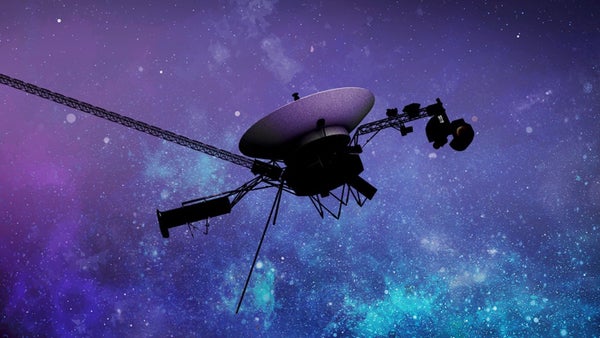
The venerable Voyager 1 spacecraft is one step closer to the end of its scientific road.
NASA turned off one of its three remaining operational instruments last Friday to save power after the spacecraft’s energy levels unexpectedly dropped during a maneuver in late February, according to a statement from the agency.
“While shutting down a science instrument is not anybody’s preference, it is the best option available,” said Kareem Badaruddin, Voyager mission manager at NASA’s Jet Propulsion Laboratory in California, in the statement. “The team remains focused on keeping both Voyagers going for as long as possible.”
On supporting science journalism
If you're enjoying this article, consider supporting our award-winning journalism by subscribing. By purchasing a subscription you are helping to ensure the future of impactful stories about the discoveries and ideas shaping our world today.
Voyager 1 and its twin, Voyager 2, launched in 1977 on a grand tour of the outer solar system. Voyager 1 zipped past Jupiter, Saturn and the latter planet’s largest moon, Titan, all within just a few years after its launch. And ever since, it has been pushing the bounds of human exploration beyond the solar system. The spacecraft is currently 15.78 billion miles away from Earth and traveling at more than 51,000 miles per hour.
But the journey has taken a toll on the spacecraft’s nuclear power supply, which no longer generates nearly as much juice as when the probe first launched. Ever since the late 1980s, NASA has been sunsetting each Voyager spacecraft’s science instruments one by one to reduce the amount of power required to remain operational—and last Friday another device on Voyager 1 shut down for good.
That instrument, the Low-Energy Charged Particles (LECP) experiment, measured particles, including ions, electrons and cosmic rays. Its data have helped scientists understand pressure fronts and other structures within the interstellar medium that fills the void beyond the edge of the solar system.
NASA engineers long ago came up with the order in which instruments on the twin spacecraft would be turned off as they aged and lost power. Before this month, Voyager 1’s last instrument loss came in February 2025, when engineers turned off its cosmic ray subsystem experiment. Voyager 2 lost its LECP experiment shortly after; it currently has three operational science instruments.
Now Voyager 1 is gathering data with only its magnetometer and its plasma wave subsystem. Given the spacecraft’s current power supply, NASA expects it will be able to operate in this configuration for about a year. During that time, the space agency will be working to fine-tune a plan called the “Big Bang,” which is designed to help both Voyager spacecraft save energy and extend their operations. That procedure will be tested on Voyager 2 beginning next month.