
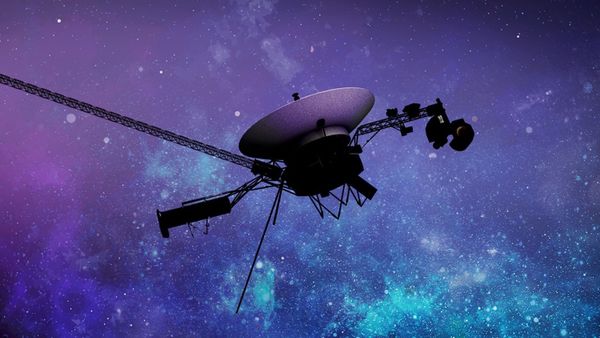
“Big bang” is not a phrase NASA typically wants for describing any of its space missions, let alone its beloved twin Voyager interstellar probes. But engineers have successfully performed a delicate procedure with just that nickname on Voyager 2—a process they believe could extend the spacecraft’s operations by two years. And Voyager 1 is up next.
“This is the most important thing we’ve done on the Voyager spacecraft in decades,” says Kareem Badaruddin, Voyager mission manager and a systems engineer at NASA’s Jet Propulsion Laboratory in California.
The audacious effort was designed to address the Voyagers’ constant dilemma—how to keep the probes running on an ever shrinking trickle of power. Each spacecraft carries a plutonium-based nuclear power source that provides electricity and heat through radioactive decay. But as the plutonium progressively decays, it also produces less energy, so each spacecraft is losing about four watts of power generation annually.
On supporting science journalism
If you're enjoying this article, consider supporting our award-winning journalism by subscribing. By purchasing a subscription you are helping to ensure the future of impactful stories about the discoveries and ideas shaping our world today.
Over the years, this has forced NASA to slowly turn off science instruments. Yet the plutonium decay and the spacecraft operations it powers also produce the heat that keeps each Voyager operational: if the fuel lines feeding one of these spacecraft’s thrusters were to freeze, the probe would fall silent, and its storied mission would come to an end.
The Voyagers have been skirting this dismal fate for years now, with NASA engineers carefully monitoring each spacecraft’s power supplies and plotting out when to turn off individual instruments to keep the missions going as long as possible. But the situation had become critical, demanding an urgent remedy.
The Voyagers have long been in an unusual position for NASA spacecraft. Both launched in 1977, with Voyager 2 blasting off about three weeks before its twin, although Voyager 1 followed a different trajectory to catch up and surpass it. Voyager 1 zipped past Jupiter in 1979 and, in 1980, flew by Saturn and its largest moon, Titan. Voyager 2 conducted a “grand tour” of the outer solar system that took it past Jupiter and Saturn and then executed humanity’s only flybys to date of Uranus and Neptune in the late 1980s.
Ever since the two spacecraft have been steadily trekking into the unknown—and so have their engineers. No one really expected the extraordinarily resilient probes to last so long. The spacecraft are now studying the strange interstellar medium with instruments designed to observe planets, their computers were designed in an era of punch cards, and the only models engineers can use to test potential consequences of a command were built a quarter century after the Voyagers left Earth. Mission personnel can’t even directly measure now critical parameters such as the coldest parts of the spacecrafts’ fuel lines: freezing was never a potential concern for the initial mission, so there are no sensors there.
Those challenges mean the Voyager program can’t approach operations like other NASA projects do—or even as it has in recent years. “We can’t do things the way they were always done,” Badaruddin says, “every process, every command, everything we have to evaluate and ask the question, ‘Does this serve us? Is this what’s best for the mission now?’”
It’s that mindset that spurred the “big bang,” which engineers thought could address each spacecraft’s power and heat issues. The maneuver involves simultaneously turning off three devices—an old tape recorder and two heaters—while turning on three others—two different heaters and a propulsion instrument—in a carefully choreographed shuffle that reduces power demand by nearly 10 watts per year without any critical components becoming too cold. “At this point, almost everything functions as a heater, no matter what it was designed to do,” Badaruddin says.
Engineers spent months pondering the approach in late 2025 and early 2026, when the only antenna that was able to communicate with Voyager 2 was down for repair anyway. Even as the mission experts warmed to the strategy, they knew it was risky. “We couldn’t afford to be wrong,” Badaruddin says.
So they designed a power test and a thermal test, which Voyager 2 cleared during May and June. The “big bang” itself occurred in July, with the full process complete by midmonth. The engineers are now stepping through the same process on Voyager 1, expecting to wrap up in the coming weeks. Just last week, Badaruddin says, “we did the power test, and it went extremely well.”
“I don’t want to jinx it, but this ‘big bang’ test has gone remarkably smoothly,” he adds. “Voyager 2—we’re done, and it went exactly to plan. Voyager 1—so far, so good.”
He and his colleagues hope the maneuver could give each spacecraft an additional two years of operations, even as the Voyagers are poised to break records that once seemed unthinkable. In November Voyager 1 is expected to reach a distance of one light-day away from Earth, and the team hopes to coax both probes to their 50th anniversaries in space next year, before finally bidding the Voyagers farewell as they slip away in the endless interstellar night. “These people love these spacecraft and will do anything to see these spacecraft succeed,” Badaruddin says.