
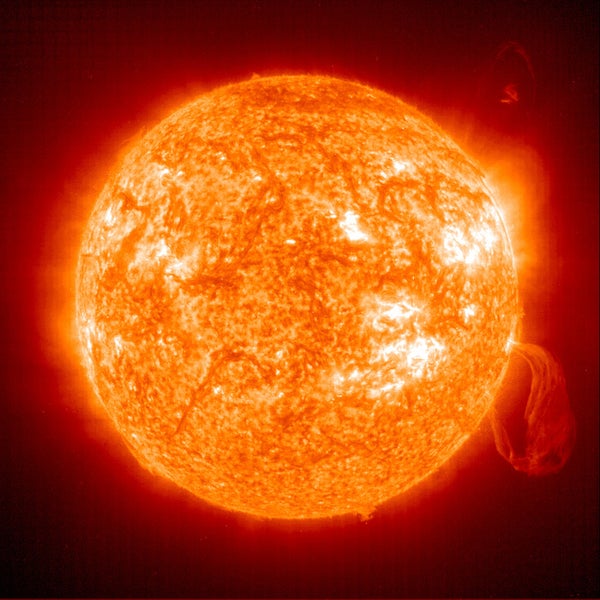
Physicists have filled in the last missing detail of how nuclear fusion powers the Sun, by catching neutrinos emanating from the star’s core.
The detection confirms decades-old theoretical predictions that some of the Sun’s energy is made by a chain of reactions involving carbon and nitrogen nuclei. This process fuses four protons together into a helium nucleus, releasing two neutrinos—the lightest known elementary particles of matter—as well as other subatomic particles and copious amounts of energy. This carbon-nitrogen (CN) reaction is not the Sun’s only fusion pathway—it produces less than 1% of the Sun’s energy—but it is thought to be the dominant energy source in larger stars.
“It’s intellectually beautiful to actually confirm one of the fundamental predictions of stellar structure theory,” says Marc Pinsonneault, an astrophysicist at Ohio State University in Columbus.
On supporting science journalism
If you're enjoying this article, consider supporting our award-winning journalism by subscribing. By purchasing a subscription you are helping to ensure the future of impactful stories about the discoveries and ideas shaping our world today.
The findings, which have not yet been peer reviewed, were reported on 23 June by the Borexino underground experiment in central Italy, at the virtual Neutrino 2020 conference.
The facility has previously made the first direct detections of neutrinos from three distinct steps of a separate reaction that accounts for most of the Sun’s fusion. “With this outcome, Borexino has completely unravelled the two processes powering the Sun,” said Borexino co-spokesperson Gioacchino Ranucci, a physicist at the University of Milan, Italy, who presented the results.
The findings are a final milestone for Borexino, which is still taking data but may now be destined to shut down within a year. “We ended with a bang,” says Marco Pallavicini of the University of Genoa, Italy, the experiment’s other co-spokesperson.
Balloon detector
The Borexino solar-neutrino experiment occupies a hall under more than 1 kilometre of rock in the Gran Sasso National Laboratories, where it has been in operation since 2007. The detector consists of a giant nylon balloon filled with 278 tonnes of liquid hydrocarbons, and immersed in water. The vast majority of neutrinos from the Sun zip through Earth—and Borexino—in a straight line, but a tiny number bounce off electrons in the hydrocarbons, producing flashes of light that are picked up by photon sensors lining the water tank.
Neutrinos from the Sun’s CN reaction chain are relatively rare, because it is responsible for only a small fraction of solar fusion. Moreover, the CN neutrinos are easy to confuse with those produced by the radioactive decay of bismuth-210, an isotope that leaks from the balloon’s nylon into the hydrocarbon mixture.
Although the contamination exists in extremely low concentrations—at most a few dozen bismuth nuclei decay per day inside Borexino—separating the solar signal from bismuth noise required a painstaking effort that began in 2014. The bismuth-210 couldn’t be prevented from leaking out of the balloon, so the goal was to slow the rate at which the element seeped into the middle of the fluid, while ignoring any signals from the outer edge. To do this, the team had to control any temperature imbalances across the tank, which would produce convection and mix its contents faster. “The liquid must be extraordinarily still, moving at most at a few tenths of centimetres per month,” Pallavicini says.
To keep the hydrocarbons at constant, uniform temperature, they wrapped the entire tank in an insulating blanket and installed heat exchangers to automatically balance the temperature throughout. Then, they waited. It was only in 2019 that the bismuth noise became quiet enough for the neutrino signal to stand out. By early 2020, the researchers had gathered enough of the particles to claim the discovery of detecting neutrinos from the CN nuclear fusion chain.
“It is the first really direct evidence that hydrogen burning through CN operates in stars,” Says Aldo Serenelli, an astrophysicist at the Institute of Space Sciences in Barcelona, Spain. “So this is really amazing.”
Sun surface speculation
As well as confirming theoretical predictions about what powers the Sun, the detection of CN neutrinos could shed light on the structure of the core—specifically the concentrations of elements astrophysicists call metals (anything heavier than hydrogen and helium).
The amounts of neutrinos seen by Borexino seem consistent with the standard models in which the Sun’s core has similar ‘metallicity’ to its surface. But more up-to-date studies have begun to question that assumption, Serenelli says.
These studies suggest that the metallicity is lower. And because these elements regulate how fast heat diffuses from the Sun’s core, it implies the core is slightly colder than previous estimates. Neutrino production is extremely sensitive to temperature and, taken together, the various amounts of neutrinos seen by Borexino seem to be consistent with the older metallicity values, Serenelli says—not with the new ones.
As a possible explanation, he and other astrophysicists have suggested that the core has higher metallicity than the outer layers. Its composition could reveal more about early stages of the Sun’s life, before the formation of the planets removed some of the metals that were accreting onto the young star.
This article is reproduced with permission and was first published on June 24 2020.