
The views expressed are those of the author(s) and are not necessarily those of Scientific American.
"Courage."
That's how Apple Senior Vice President Phil Schiller summarized the company's rationale for removing the 3.5 mm headphone jack in the iPhone 7. I couldn't condense my reaction to one word, and I can't publish the two words I shouted upon hearing this, but I'm amazed by Apple's hubris.
On supporting science journalism
If you're enjoying this article, consider supporting our award-winning journalism by subscribing. By purchasing a subscription you are helping to ensure the future of impactful stories about the discoveries and ideas shaping our world today.
Some might argue that I shouldn't be surprised by the company's bold-faced confidence in the face of an expected consumer backlash. Critics of Apple have lashed out at the company for acting as if it knew better for years, and I'm finally ready to join them.
I was happy to see the optical disk drive hit the road with the MacBook Air, because I sold my DVD collection years ago and Netflix made streaming the norm. Unfortunately, Apple (and Motorola with its USB Type-C-based Moto Z) couldn't wait for the industry to move to a new universal standard. It had to leap, headfirst with its most important product, on its own.
Apple boasted a total of 900 million Lightning connector-based devices in the market, which it claims makes the connector the largest digital audio connector in the world. And while Apple may be correct, that doesn't make Lightning the most widespread audio standard in the world. That's still the 3.5 millimeter analogue headphone jack.
From the monitors in the backs of seats on airplanes to ATMs around the country, there is no technology as ubiquitous as that 3.5mm jack. For all of those devices, the new Lightning-based Earpods are worthless.
Sure, Apple offers a $9 adapter that lets you use 3.5mm headphones with the new iPhone, but it doesn't sell a dongle that makes the new EarPods compatible with existing technology. Maybe they will soon, but I won't celebrate Apple for selling another dongle that will clutter the bags and desks of iPhone 7 owners.
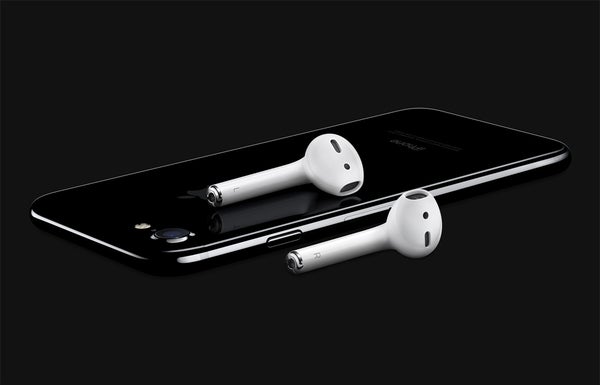
And those AirPods? Thanks, Apple, for making another device that probably won't work well with non-Apple devices. I know I'm not supposed to own non-Apple devices, as that's the unwritten law of The Privilege of Being an Apple User, but as long as I'm forced by my employers to use a PC laptop, these AirPods can't be my one true pair either.
During the event, Apple subtly mocked the age of the 3.5mm jack by displaying a photo of its origins, at a switchboard. Showing that image ignored the modern truth that the analog audio connector is as reliable as any other.
Apple claims AirPods will offer simple, reliable connections, using iCloud IDs and a combination of Bluetooth and proprietary technology. This sounds an awful lot like Apple's flaky Airdrop file-sharing method, which always leaves me tapping at my screen repeatedly, waiting for it to "just work." A two-word phrase that used to be synonymous with Apple, but hasn't been in years.
But hey, Mr. Schiller, I've got some other one-word synopses of Apple's decision:
Egotistical
Greedy
Shortsighted
Dongles
And as a coworker said to me as I explained all of this, "I'm definitely not giving up my iPhone 6 now!"
Copyright 2016 Toms Guide, a Purch company. All rights reserved. This material may not be published, broadcast, rewritten or redistributed.